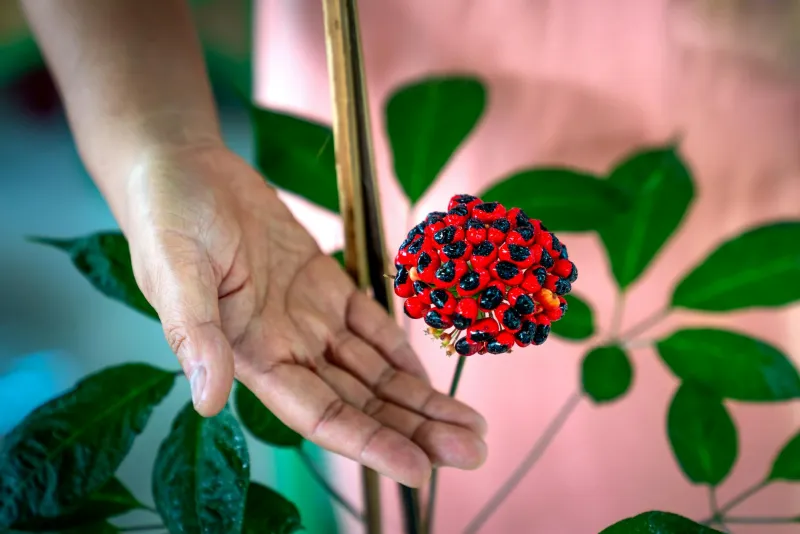
What Is Ginseng and Why Is It So Valued?
Shop this category — in stock now
Ginseng is one of the world's oldest and most widely used medicinal plants. Its name comes from the Chinese word "ren shen" or "man root" — a reference to the root's human-body-like shape. Ginseng has been used in Asian medicine for over 5,000 years and is one of the most thoroughly studied herbal supplements in modern science.
However, the word "ginseng" actually refers to several different plants belonging to different genera and having different effects. Understanding this is important for choosing the right variant.
Three Main Types of Ginseng
1. Korean/Asian Ginseng (Panax ginseng (Kim et al., 2013))
- Most traditional and extensively studied
- Grows in Korea, China, Japan
- Active compounds: ginsenosides (Rg1, Rb1, Rg3, etc.)
- Effect: stimulating, energizing, "warming"
- Best for: energy, cognitive function, sexual function
2. American Ginseng (Panax quinquefolius)
- Grows in North America
- Active compounds: ginsenosides (higher Rb1 content)
- Effect: calmer, "cooling," balancing
- Best for: stress, blood sugar, immunity
3. Siberian Ginseng (Eleutherococcus senticosus)
- Not actually true ginseng (different genus)
- Grows in Siberia, China, Korea
- Active compounds: eleutherosides (not ginsenosides)
- Effect: adaptogenic (Lee & Rhee, 2017), endurance-supporting
- Best for: endurance, immunity, stress
How Does Ginseng Work in the Body?
Ginseng's main active compounds — ginsenosides — are steroid-like compounds that affect multiple body systems.
Key mechanisms:
1. HPA Axis Regulation Ginseng modulates the stress response, normalizing cortisol levels and improving stress tolerance.
2. NO (Nitric Oxide) Production Ginsenosides increase NO synthesis, which:
- Improves blood flow
- Supports erectile function
- Increases exercise performance
3. Neurotransmitter Modulation Ginseng affects acetylcholine, dopamine, and serotonin systems, supporting cognitive function and mood.
4. Immune System Activation Ginseng increases NK cell, T-cell, and macrophage activity.
What Do Scientific Studies Show?
Energy and Fatigue
Kim et al. (2013) — chronic fatigue:
- 90 participants with chronic fatigue syndrome
- 1g Korean ginseng extract 2x daily for 4 weeks
- Fatigue decreased by 47% (placebo 29%)
- Physical and mental energy levels rose significantly
Barton et al. (2013) — cancer-related fatigue:
- 364 cancer patients
- 2g American ginseng (Panax quinquefolius) daily for 8 weeks
- Fatigue decreased significantly compared to placebo
- Valid even during active chemotherapy
Cognitive Function
Kennedy et al. (2004):
- 30 healthy volunteers
- 200mg Korean ginseng extract
- Results:
- Memory improved significantly
- Arithmetic speed and accuracy improved
- Effect was strongest at 2.5 hours
Scholey et al. (2010) — Cereboost study:
- American ginseng standardized extract
- Working memory improved at 100-400mg doses
- Reaction time decreased
- Effect appeared after a single dose
Reay et al. (2005):
- Korean ginseng improved mental performance and reduced mental fatigue
- Effect was strongest in complex cognitive tasks
- Blood sugar remained more stable in the ginseng group
Immune System
Predy et al. (2005) — cold study:
- 323 participants
- 400mg American ginseng extract (COLD-fX) daily
- Number of colds decreased by 25%
- Number of sick days decreased by 31%
- Symptom severity was lower
Scaglione et al. (1996):
- Korean ginseng + flu vaccine vs vaccine alone
- Ginseng group antibody levels were twice as high
- Flu incidence was lower
Sexual Function
Jang et al. (2008) — men's study:
- 119 men with mild to moderate erectile dysfunction
- Korean red ginseng (3g daily) for 8 weeks
- Erectile quality improved significantly (IIEF score)
- Sexual satisfaction increased
Oh et al. (2010) — women's study:
- 32 menopausal women
- Korean red ginseng 3g daily for 12 weeks
- Sexual function improved (FSFI score)
- Menopausal symptoms decreased
Which Ginseng Should You Choose?
| Feature | Korean (Panax ginseng) | American (Panax quinquefolius) | Siberian (Eleutherococcus) |
|---|---|---|---|
| Effect | Stimulating, energizing | Calming, balancing | Adaptogenic, endurance |
| Best time | Morning | Any time | Morning |
| Energy | +++ | ++ | ++ |
| Stress | ++ | +++ | +++ |
| Cognition | +++ | ++ | + |
| Immunity | ++ | +++ | +++ |
| Sexual function | +++ | + | + |
| Blood sugar | ++ | +++ | + |
Our Type Selection Recommendation
- Energy and cognitive performance → Korean ginseng
- Stress and anxiety → American ginseng
- General endurance and immunity → Siberian ginseng
- Sexual health support → Korean red ginseng
- Blood sugar regulation → American ginseng
What Is the Right Dose?
Dosing by Type and Goal
| Type | Goal | Dose |
|---|---|---|
| Korean ginseng | Energy/cognition | 200-400 mg extract (4-7% ginsenosides) |
| Korean ginseng | Sexual function | 900-1,000 mg 3x daily |
| American ginseng | Stress/immunity | 200-400 mg extract |
| American ginseng | Blood sugar | 3g root powder before meals |
| Siberian ginseng | Endurance | 300-1,200 mg extract |
References
- Arring NM, Millstine D, Marks LA, Nail LM. (2018). Ginseng as a treatment for fatigue: a systematic review. Journal of Alternative and Complementary Medicine, 24(7), 624-633.
- Lee S, Rhee DK. (2017). Effects of ginseng on stress-related depression, anxiety, and the hypothalamic-pituitary-adrenal axis. Journal of Ginseng Research, 41(4), 589-594.
- Kim HG, Cho JH, Yoo SR, et al. (2013). Antifatigue effects of Panax ginseng C.A. Meyer: a randomised, double-blind, placebo-controlled trial. PLoS ONE, 8(4), e61271.
- Shergis JL, Zhang AL, Zhou W, Xue CC. (2013). Panax ginseng in randomised controlled trials: a systematic review. Phytotherapy Research, 27(7), 949-965.
See also:
- Rhodiola Rosea: Energy, Endurance, and Stress Resilience
- Maca: Energy, Libido and Hormonal Balance Guide
- Cordyceps: Energy, Endurance and Athletic Performance
Read more: Cognitive Supplements: A Science-Based Guide
Important Guidelines
- Cycle: 3-4 weeks on / 1-2 weeks off (especially Korean ginseng)
- Timing: Korean ginseng in the morning (stimulating); American ginseng any time
- Quality: Choose standardized extract (ginsenosides 4-7%)
- Effects appear: within 1-4 weeks
Does Ginseng Have Side Effects?
Safety Profile
Ginseng is generally safe, but Korean ginseng can be too stimulating for some people.
Possible side effects:
- Insomnia (especially Korean ginseng when taken in the evening)
- Headache
- Digestive issues
- Elevated blood pressure (Korean ginseng, rarely)
- Nervousness and irritability
Contraindications
- Pregnancy and breastfeeding — insufficient data
- Hormone-sensitive conditions — ginseng may have estrogenic activity
- Uncontrolled hypertension — especially Korean ginseng
- Bleeding disorders — ginseng may affect blood clotting
Interactions
- Blood thinners (warfarin) — increased bleeding risk
- Diabetes medications — enhances blood sugar lowering effect
- Stimulants/caffeine — excessive stimulation with Korean ginseng
- MAO inhibitors — possible interaction
How to Combine Ginseng with Other Supplements?
Synergistic combinations:
- Ginseng + ashwagandha — two adaptogens with different profiles: ginseng stimulates, ashwagandha calms
- Ginseng + ginkgo biloba — classic combination for cognitive function support
- Ginseng + magnesium — balances stimulating effects
- Ginseng + B vitamins — supports energy metabolism
- Ginseng + coenzyme Q10 — mitochondrial function enhancement
- Ginseng + vitamin D — comprehensive immune support
Avoid:
- Korean ginseng + strong caffeine (excessive stimulation)
- Korean ginseng + ashwagandha at the same time of day (opposing profiles; better to take Korean in morning, ashwagandha in evening)
Our Recommendation
For Energy and Mental Clarity
- 200-400 mg Korean ginseng extract in the morning
- Standardized to 4-7% ginsenosides
- Cycle: 3 weeks on / 1 week off
- Combine with B vitamins
For Immune Support
- 400 mg American ginseng extract daily
- Combine with vitamin C and zinc
- Especially useful during cold season
For Athletes
- 200-400 mg Korean ginseng before training
- Or 300-600 mg Siberian ginseng for endurance
- Combine with electrolytes
For Sexual Health Support
Summary
Ginseng is one of the world's best-studied adaptogens with broad potential from energy to immunity.
Key takeaways:
- Three main types: Korean, American, and Siberian ginseng
- Korean ginseng is stimulating and energizing
- American ginseng is calmer and more balancing
- Siberian ginseng is an adaptogenic endurance supporter
- Standard dose: 200-400 mg extract, standardized to 4-7% ginsenosides
- Cycle usage (3-4 weeks on / 1-2 weeks off)
- Improves cognitive function, energy, and immunity
- Most common side effect is insomnia (Korean ginseng) — take in the morning
- Consult your doctor if using blood thinners or diabetes medications