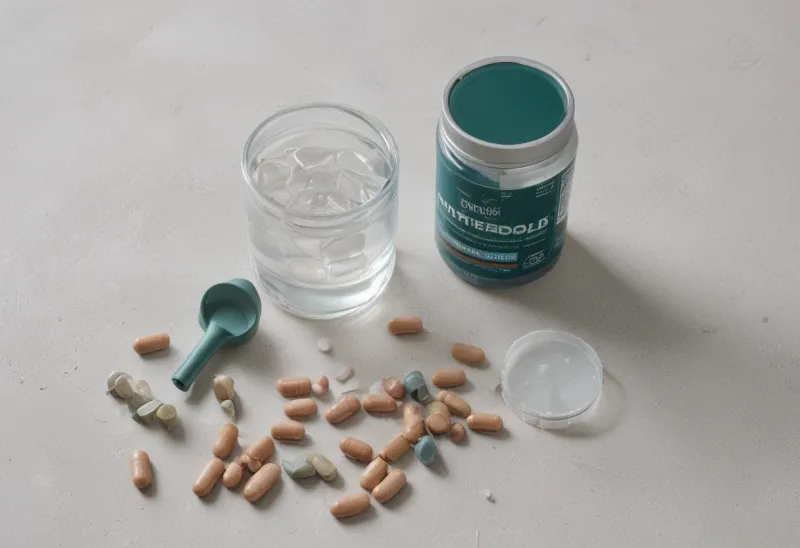
Protein before or after workout: the short answer
If you have ever rushed to chug a shake within minutes of racking the last bar, this is for you. The honest answer to whether protein timing before or after workout actually matters is: far less than the gym mythology suggests. The famous "anabolic window" — the idea that you must flood your muscles with protein in the 30 minutes after training or lose your gains — is much wider than that. For most people it spans several hours on either side of the session. What truly drives muscle growth is your total daily protein intake, not whether your shake hits your stomach at minute 5 or minute 90.
Stressing about protein timing? Pick the goal that matters most and we'll show top picks.
Browse the rangeThat does not mean timing is useless. It means you can relax, stop watching the clock, and focus on the bigger levers. Let's unpack what the research really says and how to apply it without overthinking.
Protein timing before or after workout: what the science actually says
The "30-minute window" took hold because muscle protein synthesis (MPS) does rise after resistance training, and feeding amino acids amplifies that response. The leap in logic — that the window slams shut quickly — never held up. A landmark meta-analysis by Schoenfeld and colleagues (2013) pooled the timing studies and found that once total daily protein was equated between groups, precise timing around the workout had no meaningful independent effect on strength or hypertrophy.
The elevated-MPS response to a single training bout lasts roughly 24 hours, not 30 minutes. So if you ate a protein-containing meal one to two hours before lifting, those amino acids are still circulating during and after your session. "Pre" and "post" effectively blur into one extended feeding period.
Why the myth persists
The anabolic-window idea is sticky for a simple reason: it sells supplements and gives lifters a tidy ritual. A precise deadline feels actionable, and the post-workout shake became a cultural badge. But the original studies that fuelled the panic often compared protein versus no protein at all, or were run in fasted subjects — special cases that exaggerate timing's importance. In a normally fed person who trains a few hours after a meal, the urgency simply evaporates. Recognising this frees you to plan protein around your real life rather than a stopwatch.
How much protein per dose?
Research by Moore and colleagues (2009) showed that about 20 g of high-quality protein maximally stimulates MPS after resistance exercise in young men — more than that gives diminishing returns for muscle building. Areta and colleagues (2013) refined this: spreading protein as 20 g every 3 hours beat both a 40 g-every-6-hours pattern and a 10 g-every-1.5-hours pattern. Distribution across the day matters more than nailing a single post-workout shot.
How much protein per day?
Morton and colleagues (2018) ran a large meta-analysis and found benefits to muscle and strength plateaued around 1.6 g of protein per kg of body weight per day. The International Society of Sports Nutrition position stand (Jäger et al., 2017) recommends 1.4–2.0 g/kg/day for active people, with roughly 0.25 g/kg per meal. Hit that daily total spread over three to five meals and the timing question largely takes care of itself.
Pre vs post vs the "window": the realities
| Scenario | The old myth | What the evidence shows |
|---|---|---|
| Protein 30 min before training | Pointless — too early | Amino acids still elevated through your session; perfectly fine |
| Protein within 30 min after | Mandatory or you lose gains | Helpful but not magic; the window is hours wide |
| Trained fasted, ate 2 h later | Gains ruined | MPS stays elevated ~24 h; a post-session meal still works |
| Total daily protein hit | A minor detail | The single biggest driver of hypertrophy |
Practical takeaways
- Prioritise your daily total. Aim for ~1.6–2.0 g/kg of body weight. A scoop of MyProtein Impact Whey Protein 1 kg Strawberry Cream or Scitec 100% Whey Protein Professional 2350g Coconut is an easy way to top up without cooking. Browse options under valgud / protein.
- Spread it out. Three to five protein feedings of ~20–40 g each beats one giant meal. OstroVit 100% Whey Protein 700g Biscuit Dream mixes fast for a convenient between-meals dose.
- Have protein "around" training, not at a precise minute. A meal or shake in the couple of hours before or after lifting covers you completely.
- Train fasted? Just eat afterward. A 20–40 g serving post-session restarts the feeding clock.
- Stack the proven basics. Creatine is one of the most evidence-backed supplements for strength — Scitec Creatine Monohydrate 300g works at any time of day. For general health alongside training, OstroVit Omega 3 Ultra 90 caps supports heart and joints. See kreatiin and omega-3.
At MaxFit, Estonia's sports nutrition store, we see the same anxiety again and again: people stressing about a 30-minute deadline while undershooting their daily protein by 40 grams. Fix the daily total first — it is where almost all the results live.
References
- Schoenfeld BJ, Aragon AA, Krieger JW. (2013). The effect of protein timing on muscle strength and hypertrophy: a meta-analysis. Journal of the International Society of Sports Nutrition, 10, 53. https://pubmed.ncbi.nlm.nih.gov/24299050/
- Morton RW, Murphy KT, McKellar SR, et al. (2018). A systematic review, meta-analysis and meta-regression of the effect of protein supplementation on resistance training-induced gains in muscle mass and strength in healthy adults. British Journal of Sports Medicine, 52(6), 376–384. https://pubmed.ncbi.nlm.nih.gov/28698222/
- Areta JL, Burke LM, Ross ML, et al. (2013). Timing and distribution of protein ingestion during prolonged recovery from resistance exercise alters myofibrillar protein synthesis. The Journal of Physiology, 591(9), 2319–2331. https://pubmed.ncbi.nlm.nih.gov/23459753/
- Moore DR, Robinson MJ, Fry JL, et al. (2009). Ingested protein dose response of muscle and albumin protein synthesis after resistance exercise in young men. American Journal of Clinical Nutrition, 89(1), 161–168. https://pubmed.ncbi.nlm.nih.gov/19056590/
- Jäger R, Kerksick CM, Campbell BI, et al. (2017). International Society of Sports Nutrition Position Stand: protein and exercise. Journal of the International Society of Sports Nutrition, 14, 20.
FAQ
Do I really need a protein shake right after my workout?
No. The post-workout window is hours wide, not 30 minutes. As long as you eat enough protein across the day — spread over three to five meals — having your shake within an hour or two of training is perfectly fine. If you ate before lifting, you are already covered.
Is protein before or after workout better for building muscle?
Neither beats the other meaningfully once your total daily protein is equated. Amino acids from a pre-workout meal stay elevated through your session, and muscle protein synthesis remains raised for about 24 hours afterward. Pick whichever fits your routine.
How much protein should I aim for each day?
For people doing resistance training, roughly 1.6–2.0 g per kg of body weight per day, in doses of about 20–40 g per meal. That daily total is the single biggest lever for muscle growth — far more important than precise timing.