


Plant protein on the Estonian shelf: what you can actually buy here
The English-language "pea vs rice vs hemp vs soy" comparison implies you are standing in front of four jars and freely choosing between them. In Estonia that is not the situation, and no article on this topic says so. Pure rice protein, pure hemp protein and standalone soy isolate are rarely stocked here, and when they are, it is in small quantities. What you actually buy is almost always a pea-based blend with rice protein added, sometimes sunflower or pumpkin seed protein, plus flavouring and sweetener.
So the real question is not "pea or rice". There are three real questions. Does the blend cover the amino acids that a single source leaves short? How much more of it do you need compared with whey? And is the price per gram of protein reasonable in Estonia? MaxFit's plant protein selection is small today and mostly pea-based — that is not a gap to hide, it is exactly what the numbers below explain.
Why plant protein behaves differently at all
Two things separate plant protein from animal protein, and both are measurable rather than matters of belief.
The first is leucine. Triggering muscle protein synthesis requires a certain amount of leucine inside a single meal. Whey is about 10-11% leucine by protein, pea protein sits around 8%, and rice and hemp protein lower still (Gorissen et al., 2018). The same number of grams therefore delivers a weaker signal.
The second is amino acid balance and digestibility. Gorissen et al. (2018) measured commercial plant isolates in the lab and the pattern was consistent: pea protein is short on methionine, rice and hemp are short on lysine, soy has the most complete profile. On top of that, a share of plant protein passes through the gut unabsorbed because cell walls and phytates are in the way.
Pinckaers et al. (2021) summarised it honestly: a single dose of plant protein triggers muscle protein synthesis less strongly than the same dose of animal protein, but that gap essentially closes when you raise the dose and combine sources. That is the entire practical content. Not "plant does not work", but "plant takes more of it, and it needs blending".
Pea protein: the closest thing to whey
Pea protein is made from yellow field pea isolate and it is the backbone of today's plant powders. Protein content in the isolate is 80-85%, leucine around 8% of protein and branched-chain amino acids close to 18% — the nearest thing to whey the plant world offers (Gorissen et al., 2018).
The most important fact about pea protein is that it is the only plant form with a direct muscle trial against whey. Babault et al. (2015) gave 161 men 50 g of pea protein, 50 g of whey or placebo daily alongside 12 weeks of resistance training. Biceps thickness gains in the pea group were comparable to whey and both beat placebo. That is not marketing copy, it is a randomised double-blind trial, and it is the main reason pea protein is the first ingredient in blends.
Pea protein's weakness is methionine. Taken alone, that amino acid runs short, which is precisely why rice protein is added to blends. The second weakness is taste: pea protein has a characteristic pea-flour aftertaste that chocolate-based flavours mask better than vanilla ones. The third is gas — pea protein carries more fibre and oligosaccharides than whey, so it is worth halving the dose for the first week. A fuller treatment is in Pea protein: the complete guide for athletes.
Rice protein: a good partner, a poor solo act
Protein made from brown rice has enough methionine but little lysine. Leucine sits at roughly 7-8% of protein and protein content typically at 75-85% (Gorissen et al., 2018). Used alone, that profile is clearly incomplete.
Even so, rice protein has its own human trial. Joy et al. (2013) compared 48 g of rice protein with 48 g of whey over eight weeks in trained young men, and body composition and strength changes were similar between groups. Note the dose: 48 g, not 25 g. A large dose compensates for the weaker profile, and that is the general rule for rice protein.
The practical conclusion for an Estonian buyer: there is no point hunting for standalone rice protein here. Read the ingredient list on a blend — if pea and rice protein sit side by side (typically 70:30), you already have this combination without buying two jars.
Soy protein: the best profile, the most suspicion
Soy isolate is the only widely sold plant protein whose amino acid profile is complete without blending: 88-90% protein, 7-8% leucine, and all nine essential amino acids in sensible amounts (Gorissen et al., 2018). It also has the largest dataset — the Messina et al. (2018) meta-analysis of resistance-training studies found no difference between soy and animal protein for gains in muscle mass or strength.
The isoflavone worry has persisted for a long time and it does not hold in the form gym conversation gives it: the same Messina et al. (2018) work found no negative effect on training outcomes at normal intakes. Soy's real drawbacks are more mundane. It is one of the most common allergens, it is surprisingly poorly stocked as a supplement in Estonia, and anyone on thyroid medication should discuss timing with their doctor.
Hemp protein: good food, mediocre protein powder
Hemp seed protein is 50-70% protein, 5-6% leucine, and high in fibre (Gorissen et al., 2018). To hit the same protein target you need noticeably more scoops of hemp powder than of anything else listed here, and that gets expensive.
Hemp protein's real value is not muscle growth but food: the seed brings a fatty acid profile and fibre along with it. Stirring it into porridge is a good idea. Buying it as your main post-training protein is an expensive way to get very little leucine. In Estonia hemp protein is mostly sold in organic food shops as a foodstuff rather than as a sports supplement, and that placement reflects reality fairly accurately.
Head-to-head comparison
| Property | Pea | Rice | Soy isolate | Hemp |
|---|---|---|---|---|
| Protein content | 80-85% | 75-85% | 88-90% | 50-70% |
| Leucine (% of protein) | ~8% | 7-8% | 7-8% | 5-6% |
| Limiting amino acid | methionine | lysine | essentially none | balanced but dilute |
| Human trial vs whey | yes (Babault et al., 2015) | yes (Joy et al., 2013) | yes (Messina et al., 2018) | no |
| Allergenicity | low | very low | high | very low |
| Taste | pea-flour | mild | beany | earthy |
| Availability in Estonia | good, in blends | poor standalone | poor | organic shops |
| Role | base protein | partner | base protein | food add-on |
What plant protein actually costs in Estonia
Supplements are worth comparing by the price of protein, not the price of the jar. Here is the arithmetic from the MaxFit shelf at prices as of the time of writing.
BIOTECHUSA Vegan Protein 500g Vaniljeküpsis. That works out to 4.38 euros per 100 g of powder. The forest fruit, banana, hazelnut and chocolate-cinnamon versions of the same line cost the same, so flavour choice does not change the maths.
For comparison, whey from the same shelf. BIOTECHUSA 100% Pure Whey 2270g Banaan costs 69.90 euros, or 3.08 euros per 100 g of powder. Optimum-nutrition Gold Standard 100% Whey 450g Maasikas costs 24.90 euros, or 5.53 euros per 100 g — a small tub is always more expensive per gram, regardless of what is inside it.
Now the part the label does not do for you. A flavoured plant blend is often around 70% protein; flavoured whey concentrate is 75-80%. If the plant blend is 70% protein, 100 g of protein costs about 6.26 euros. If the large whey tub is 75% protein, 100 g of protein costs about 4.11 euros. Add the roughly one-fifth larger serving plant protein needs for the same effect, and the real gap per gram is close to double. Plant protein is not the cheap option in Estonia, and any claim to the contrary is either the wrong jar price or the wrong arithmetic. The whey side of this is worked out in Whey protein in Estonia 2026: compared by euros per 100 g of protein.
And one more thing that is constantly confused here. 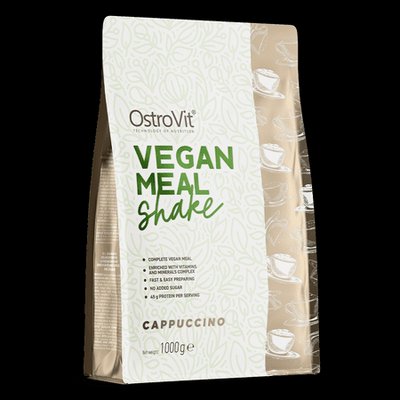 OstroVit Vegan Meal Shake 1000g Cappuccino€19.85 In stock costs 18.90 euros and looks like the cheapest plant product on the shelf per kilo. It is not a protein powder. It is a meal replacement, with carbohydrate, fat and a vitamin blend alongside the protein. As a meal it is a sensible purchase; as a post-training protein dose you would have to drink enough of it to take on half a meal's calories. Always read the "of which protein" line rather than the pack size.
A practical protocol: dose, timing, blending
Total intake. The International Society of Sports Nutrition position stand puts resistance-training protein at 1.4-2.0 g per kilogram of body weight per day (Jäger et al., 2017). If most of that comes from plants, take the top of that range, 1.8-2.0 g/kg — it covers both the lower leucine content and the poorer digestibility.
Single serving. With whey, 20-25 g is enough. From a plant blend take 30-40 g of protein, and remember that often means 40-50 g of powder. Two scoops instead of one is not waste, it is exactly the correction Pinckaers et al. (2021) described.
Blending. If your product is pea only, methionine has to come from elsewhere during the day: oats, buckwheat, seeds, sunflower seeds. If the blend is pea plus rice, you do not need to calculate anything extra. Ordinary Estonian food does a decent job here, incidentally — rye bread and oats supply methionine, pea soup and legumes supply lysine, and that classic pairing is better balanced than most powder blends.
Timing. Rather than one post-workout window, distribution across the day matters more: 3-4 protein-rich meals, each with at least 25-30 g of protein. On a plant-based diet that rule is stricter than on an animal-based one, because the anabolic signal from a single meal is weaker.
Digestion. Start at half a serving for the first 5-7 days. Pea protein's oligosaccharides produce gas in an unaccustomed gut, and most people who say "plant protein did not agree with me" went straight to a full scoop.
What the powder leaves out
A protein powder solves protein and nothing else. If you eat mostly plants, three things need separate attention.
Creatine. Muscle creatine stores are lower in vegetarians, because dietary creatine comes mainly from meat. That is why creatine supplementation often shows a larger measurable effect in vegetarians than in omnivores (Kaviani et al., 2020). This is the clearest place where creatine gives a plant-based athlete more than it gives anyone else, and 3-5 g of monohydrate a day is the entire protocol.
B12 and iron. B12 is not present in reliable amounts in plant food at all, and Estonia's Health Board recommends that vegans take it separately. Plant iron absorbs less well than animal iron; a vitamin C source in the same meal improves that noticeably.
Omega-3. Plant ALA converts to EPA and DHA poorly. Hemp and flax seeds do not replace fish oil or algae oil.
Most of these are covered by one decent vitamin complex, but creatine and B12 usually have to be added separately. Check what is already in the jar you have before buying a new one.
Who should skip this
If you are not vegan and not intolerant of milk protein, there is no performance reason to switch. You pay more and get the same or a slightly weaker amino acid profile. The environmental argument exists and is legitimate, but it is not a sports argument.
If you have inflammatory bowel disease or irritable bowel syndrome, pea protein's fibre and oligosaccharide load is likely to be a problem. A rice-based product is more tolerable here, but start from a very small dose.
If you have a soy allergy, soy products are out without discussion — and check blend ingredients too, since soy lecithin is a common additive.
If you already eat 1.8 g of protein per kilogram a day from real food, a powder adds nothing. A powder is convenience, not medicine.
And an honest point: if your whole diet is chaotic, switching to a better plant protein fixes nothing. Settle your daily total and meal count before choosing a powder. The broader picture on plant proteins is in Plant protein: pea, rice and hemp for athletes.
Common mistakes
The same dose as whey. The most frequent error. 25 g of plant protein is not 25 g of whey; take 30-40 g.
Comparing jar price instead of protein price. Two 500 g jars do not hold the same amount of protein if one is 70% and the other 85%.
Buying a meal replacement as a protein powder. Read the protein per serving, not the pack size.
Sticking to a single source. Pure pea protein day after day leaves methionine short unless the rest of your diet covers it.
Starting at a full dose. Halve it for the first week, or you will judge plant protein by digestive discomfort instead of results.
FAQ
Does plant protein build muscle as well as whey?
At a sufficient dose, yes. Babault et al. (2015) found comparable muscle thickness gains between pea protein and whey over 12 weeks, and the Messina et al. (2018) meta-analysis found no difference between soy and animal protein. The condition is dose: plant protein takes more per meal.
Do I have to blend pea and rice protein myself?
No. Most plant powders sold in Estonia are already blends. Read the ingredient list — if two or three protein sources are listed, the work is done.
How much plant protein per day?
Alongside resistance training, 1.8-2.0 g per kilogram of body weight, the top of the range the International Society of Sports Nutrition recommends (Jäger et al., 2017). Split it across 3-4 meals.
Is plant protein cheaper than whey in Estonia?
No. At the time of writing a plant blend costs about 4.38 euros per 100 g of powder and a large whey tub 3.08 euros — and you need more of the plant one. The reason to choose plant protein is diet or intolerance, not price.
Is hemp protein suitable as a main protein source?
Poorly. Protein content is 50-70% and leucine 5-6%, so you would need very large servings. Hemp powder is a good addition to porridge or a smoothie, not a post-training base protein.
Do vegetarians need more creatine?
They need the same amount, but the effect is often larger because baseline muscle creatine is lower (Kaviani et al., 2020). 3-5 g of monohydrate per day, no loading phase.
References
- Babault, N., Païzis, C., Deley, G., Guérin-Deremaux, L., Saniez, M.H., Lefranc-Millot, C. & Allaert, F.A. (2015). Pea proteins oral supplementation promotes muscle thickness gains during resistance training: a double-blind, randomized, placebo-controlled clinical trial vs. whey protein. Journal of the International Society of Sports Nutrition, 12, 3. https://pubmed.ncbi.nlm.nih.gov/25628520/
- Joy, J.M., Lowery, R.P., Wilson, J.M., Purpura, M., De Souza, E.O., Wilson, S.M., Kalman, D.S., Dudeck, J.E. & Jäger, R. (2013). The effects of 8 weeks of whey or rice protein supplementation on body composition and exercise performance. Nutrition Journal, 12, 86. https://pubmed.ncbi.nlm.nih.gov/23782948/
- Gorissen, S.H.M., Crombag, J.J.R., Senden, J.M.G., Waterval, W.A.H., Bierau, J., Verdijk, L.B. & van Loon, L.J.C. (2018). Protein content and amino acid composition of commercially available plant-based protein isolates. Amino Acids, 50(12), 1685-1695. https://pubmed.ncbi.nlm.nih.gov/30167963/
- Messina, M., Lynch, H., Dickinson, J.M. & Reed, K.E. (2018). No difference between the effects of supplementing with soy protein versus animal protein on gains in muscle mass and strength in response to resistance exercise. International Journal of Sport Nutrition and Exercise Metabolism, 28(6), 674-685. https://pubmed.ncbi.nlm.nih.gov/29722584/
- Pinckaers, P.J.M., Trommelen, J., Snijders, T. & van Loon, L.J.C. (2021). The anabolic response to plant-based protein ingestion. Sports Medicine, 51(Suppl 1), 59-74. https://pubmed.ncbi.nlm.nih.gov/34515966/
- Kaviani, M., Shaw, K. & Chilibeck, P.D. (2020). Benefits of creatine supplementation for vegetarians compared to omnivorous athletes: a systematic review. International Journal of Environmental Research and Public Health, 17(9), 3041. https://pubmed.ncbi.nlm.nih.gov/32824979/
- Jäger, R., Kerksick, C.M., Campbell, B.I., Cribb, P.J., Wells, S.D., Skwiat, T.M. et al. (2017). International Society of Sports Nutrition position stand: protein and exercise. Journal of the International Society of Sports Nutrition, 14, 20.


