Mass Gainers Done Right: Lean Bulking for Hard Gainers
For some people, building muscle is less about training and more about the kitchen. The 'hard gainer' — naturally lean, fast metabolism, easily full — can train consistently for months and barely move the scale. Mass gainers are marketed straight at this person, but they are also widely misused. Used well, a gainer is a practical tool. Used carelessly, it is a fast track to unwanted fat. Here is how to get it right.
Why a Surplus Is Non-Negotiable
Muscle growth requires three things: a training stimulus, enough protein, and enough total energy. The energy part is where hard gainers fall short. A review of the question concluded that while small amounts of muscle can be gained at maintenance calories in some untrained individuals, a clear energy surplus is required to maximise the muscle gained alongside resistance training (Slater et al., 2019).
The problem is simple arithmetic. If you burn more than you eat, the scale will not rise no matter how well you train. For naturally lean people with high activity and a brisk appetite-suppressing metabolism, eating that surplus from whole food alone can be genuinely hard — solid meals are filling, and there are only so many you can fit in a day.
How Big Should the Surplus Be?
Bigger is not better. A narrative review of off-season nutrition for physique athletes recommends a modest surplus — on the order of 10–20% above maintenance — paired with a target rate of weight gain of roughly 0.25–0.5% of body weight per week (Iraki et al., 2019). For an 80 kg person that is around 200–400 g per week, not per day.
The reason for restraint is body composition. A study of elite athletes found that a slower, controlled approach to weight gain led to a better ratio of muscle to fat than aggressive overfeeding (Garthe et al., 2013). Eat far above maintenance and the surplus simply spills over into fat, which then has to be dieted off later. The goal of a smart bulk is the most muscle for the least fat — and that means patience.
Where a Mass Gainer Fits
A mass gainer is, at its core, a calorie-dense, convenient drink: protein plus carbohydrates, sometimes with added fats, in a form you can sip rather than chew. Its value is purely practical — it makes the surplus easier to hit when food volume is the bottleneck.
Optimum Nutrition Serious Mass 2.73kg Vanill is a high-calorie gainer built for exactly this: a way to add a substantial block of energy and protein to the day without sitting down to another full meal. The best times to use it are around training or in place of a meal you would otherwise skip — a post-workout shake, or a mid-afternoon top-up on a busy day.
A few practical rules:
- Treat it as a supplement, not a foundation. Whole food should still supply most of your calories. A gainer fills the gap, it does not replace the plate.
- Adjust the serving. Many gainers list large servings. If a full scoop overshoots your surplus, use half. The goal is a controlled climb, not a flood.
- Mind the protein total. Gainers are carb-heavy. Make sure your day still hits 1.6–2.2 g of protein per kg; a quality whey such as MST Protein Best Whey + Enzymes 510g Banana Yogurt is a leaner way to add protein without the extra carbohydrate load.
- Pair it with creatine. Creatine monohydrate is the most evidence-backed supplement for strength and muscle. A daily dose of a product like
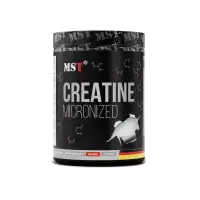 MST Creatine Micronized 500g Unflavored€29.90 In stock supports the training that turns those extra calories into muscle rather than fat.
Training and Patience Still Decide the Outcome
No powder builds muscle on its own. The surplus and the protein give your body the raw materials; progressive resistance training is the signal that tells it to spend those materials on muscle. Recommendations for off-season muscle gain consistently pair the nutrition advice with structured, progressive lifting (Helms et al., 2014).
And it takes time. Realistic muscle gain for a natural trainee is measured in a few kilograms per year, not per month. Track your weight as a weekly average, take progress photos, and adjust your intake based on the trend — if the scale is climbing too fast, the extra is fat; if it is flat, eat more.
The Bottom Line
Mass gainers are not a shortcut, but they are a genuinely useful tool for the lean, busy or poor-appetite trainee who struggles to eat enough. Keep the surplus modest, aim for a slow and steady climb, let whole food carry most of the load, and pair the calories with hard, progressive training. Do that, and a gainer helps you build muscle with minimal fat — exactly what 'bulking done right' means.
Mass gainers, whey protein and creatine are available at maxfit.ee, with free delivery on orders over €60.
FAQ
Will a mass gainer make me fat?
Only if you overuse it. Mass gainers are calorie-dense, so adding one on top of a diet that already meets your needs creates an excessive surplus that spills into fat. Used to fill a real calorie gap, with a modest overall surplus, a gainer supports lean muscle gain.
Can I just use a regular whey protein instead?
If your appetite is fine and you can eat enough food, yes — a standard whey plus meals may be all you need. A mass gainer earns its place specifically when total calories are the bottleneck and eating more solid food is impractical.
How fast should I expect to gain weight?
Slowly. Research on physique athletes supports gaining roughly 0.25–0.5% of body weight per week (Iraki et al., 2019). For most people that is a few hundred grams a week. Faster gains tend to be mostly fat.
References
- Slater, G. J., Dieter, B. P., Marsh, D. J., et al. (2019). Is an energy surplus required to maximize skeletal muscle hypertrophy associated with resistance training? Frontiers in Nutrition, 6, 131.
- Iraki, J., Fitschen, P., Espinar, S., & Helms, E. (2019). Nutrition recommendations for bodybuilders in the off-season: a narrative review. Sports, 7(7), 154.
- Garthe, I., Raastad, T., Refsnes, P. E., & Sundgot-Borgen, J. (2013). Effect of nutritional intervention on body composition and performance in elite athletes. European Journal of Sport Science, 13(3), 295–303.
- Helms, E. R., Aragon, A. A., & Fitschen, P. J. (2014). Evidence-based recommendations for natural bodybuilding contest preparation: nutrition and supplementation. Journal of the International Society of Sports Nutrition, 11, 20.