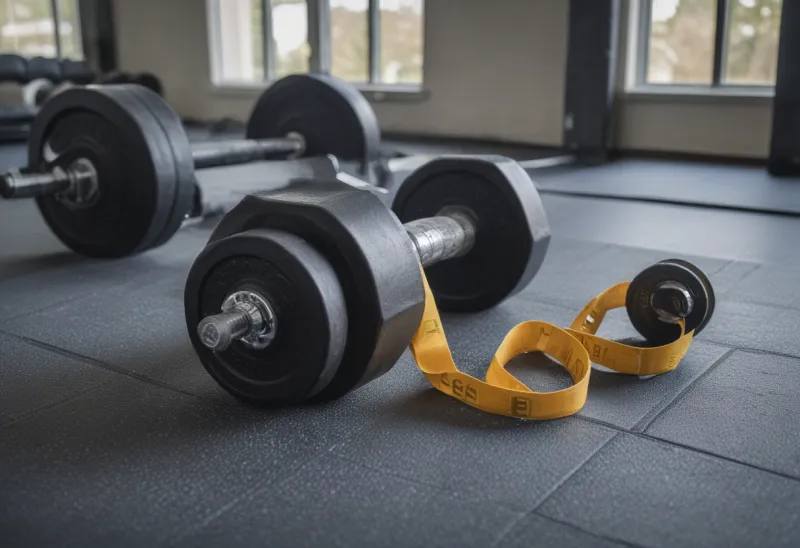
How men over 50 can train around joint pain and keep building muscle
If your knees crackle on the leg press or your shoulders complain on overhead day, the temptation is to quietly stop lifting. That is exactly the wrong move. Joint pain training for men over 50 is less about giving up and more about adjusting — choosing angles, ranges and recovery tools that let you keep loading muscle without aggravating the joint. The honest answer up front: most men over 50 can keep building muscle through joint pain, and stopping resistance training does more long-term harm than good.
Let us look at why, and what actually helps.
Training around joint pain — what would help you most?
Browse the rangeWhy you should not stop lifting
Strength training is one of the clearest longevity levers we have. Muscle-strengthening activity is associated with about 15% lower all-cause mortality, with most of the benefit at just 30–60 minutes per week (Momma et al., 2022). A pooled analysis of 11 cohorts found any strength-promoting exercise linked to 23% lower all-cause mortality and 31% lower cancer mortality (Stamatakis et al., 2018). Walking away from the weights to "protect" your joints trades a small short-term comfort for a large long-term cost.
The muscle you keep also stabilises the very joints that hurt. Stronger quads support the knee; a stronger upper back and rotator-cuff musculature support the shoulder.
Adjust the training, not the goal
The smart approach is to train hard in pain-free ranges and load patterns:
- Swap the implement, not the muscle. If a barbell bench irritates the shoulder, a neutral-grip dumbbell or machine press often does not.
- Shorten the range to the pain-free zone. A partial squat that does not hurt still builds quads.
- Use slower tempo and higher reps. Lighter loads with controlled tempo grow muscle with less joint stress.
- Keep protein high. After 50, muscles respond a little less to each meal, so the building blocks matter more than ever.
That last point is key. To protect muscle as you age, reviews recommend aiming above the old RDA, toward at least 1.2 g/kg/day of protein (Phillips et al., 2016). A scoop of Scitec 100% Whey Protein Professional 2350g Coconut or Optimum Nutrition Gold Standard 100% Whey 450g Vanilla Ice Cream makes that target far easier on busy days. Browse the full protein range at maxfit.ee.
What the science says about joint-comfort supplements
Two supplements have genuine, if modest, evidence here.
Collagen hydrolysate has the strongest support for activity-related joint pain. In a 24-week study of 147 athletes, 10 g/day of collagen hydrolysate significantly reduced activity-related joint pain versus placebo (Clark et al., 2008). A later systematic review of 15 trials found the most consistent benefit at 5–15 g/day was for joint comfort and function (Khatri et al., 2021).
Omega-3 fatty acids are the other reasonable add-on. A meta-analysis found EPA and DHA lowered triglycerides, systolic blood pressure and the inflammation marker CRP (AbuMweis et al., 2018). EFSA's authorised claim sits at 250 mg/day EPA+DHA for normal heart function. A simple fish-oil softgel such as OstroVit Omega 3 Ultra 90 caps or NOW Omega 3 1000mg 500 Soft Gels is an easy way to cover it — explore the omega-3 category.
A quick honesty note: these support comfort and recovery; they do not treat or cure arthritis, and persistent or sharp joint pain should be checked by a clinician.
Where creatine helps
Creatine is not a joint supplement, but it supports the training that protects your joints. Creatine monohydrate is among the most evidence-backed strength aids, and 3–5 g/day of Mutant Creatine Monohydrate 300g or ICONFIT Creatine Monohydrate Unflavored 300g lets you maintain strength even when you are working in reduced ranges. See the creatine category.
Practical takeaways
- Keep lifting — strength training is a major longevity and joint-stability lever.
- Adjust angles, ranges and tempo to train hard without aggravating the joint.
- Hold protein at roughly 1.2 g/kg/day or more to protect muscle after 50.
- Consider collagen (5–15 g/day) and omega-3 for joint comfort and recovery.
- Get sharp, persistent or swelling joint pain assessed by a professional.
References
Momma, H., Kawakami, R., Honda, T., & Sawada, S. S. (2022). Muscle-strengthening activities are associated with a lower risk of all-cause mortality and major non-communicable diseases: a systematic review and meta-analysis of cohort studies. British Journal of Sports Medicine, 56(13), 755–763. https://pubmed.ncbi.nlm.nih.gov/35228201/
Stamatakis, E., Lee, I. M., Bennie, J., et al. (2018). Does strength-promoting exercise confer unique health benefits? A pooled analysis of 11 population cohorts. American Journal of Epidemiology, 187(5), 1102–1112. https://pubmed.ncbi.nlm.nih.gov/29099919/
Clark, K. L., Sebastianelli, W., Flechsenhar, K. R., et al. (2008). 24-week study on the use of collagen hydrolysate as a dietary supplement in athletes with activity-related joint pain. Current Medical Research and Opinion, 24(5), 1485–1496. https://pubmed.ncbi.nlm.nih.gov/18416885/
Khatri, M., Naughton, R. J., Clifford, T., Harper, L. D., & Corr, L. (2021). The effects of collagen peptide supplementation on body composition, collagen synthesis, and recovery from joint injury and exercise: a systematic review. Amino Acids, 53(10), 1493–1506. https://pubmed.ncbi.nlm.nih.gov/34491424/
AbuMweis, S., Jew, S., Tayyem, R., & Agraib, L. (2018). Eicosapentaenoic acid and docosahexaenoic acid containing supplements modulate risk factors for cardiovascular disease: a meta-analysis of randomised placebo-controlled trials. Journal of Human Nutrition and Dietetics, 31(1), 67–84. https://pubmed.ncbi.nlm.nih.gov/28675488/
Phillips, S. M., Chevalier, S., & Leidy, H. J. (2016). Protein "requirements" beyond the RDA: implications for optimizing health. Applied Physiology, Nutrition, and Metabolism, 41(5), 565–572. https://pubmed.ncbi.nlm.nih.gov/27337671/
FAQ
Should I stop lifting if my joints hurt?
Usually not. Stopping resistance training removes a major longevity and joint-stability benefit. The better move is to adjust angles, ranges and tempo so you can keep loading muscle without aggravating the painful joint, and to get sharp or persistent pain checked.
Does collagen help joint pain?
The evidence is modest but real. In studies, 5–15 g/day of collagen hydrolysate reduced activity-related joint pain and supported joint function. It is a support tool, not a treatment for diagnosed joint disease.
How much protein do I need after 50?
Reviews suggest aiming above the old 0.8 g/kg RDA, toward at least 1.2 g/kg per day, spread across meals, to counter the age-related drop in how strongly muscles respond to protein.