Hawthorn: A Heart Herb That Science Has Taken Seriously
Hawthorn (Crataegus monogyna, C. laevigata) has been used in traditional European folk medicine for centuries to support heart and circulatory health. Today it is one of the few botanical compounds for which randomised controlled clinical trials have been conducted in humans — and results are partially positive.
This guide covers what science actually knows about hawthorn extract: bioactive compounds, clinical evidence, dosing, and safety.
TL;DR: Key Points
- Active compounds: oligomeric proanthocyanidins (OPCs), flavonoids, triterpene acids
- Main studied preparation: WS 1442 extract (18.75% OPCs), 80–160 mg 3x daily
- Cochrane review (Pittler 2008): improved exercise tolerance in mild to moderate heart failure (NYHA II)
- SPICE trial: hawthorn was not harmful, but added no clinical benefit in more severe heart failure alongside modern drug therapy
- Important: hawthorn is mild supportive care — it does not replace cardiac medications
- Drug interactions: digoxin, antihypertensive medications, nitrates
Bioactive Compounds in Hawthorn
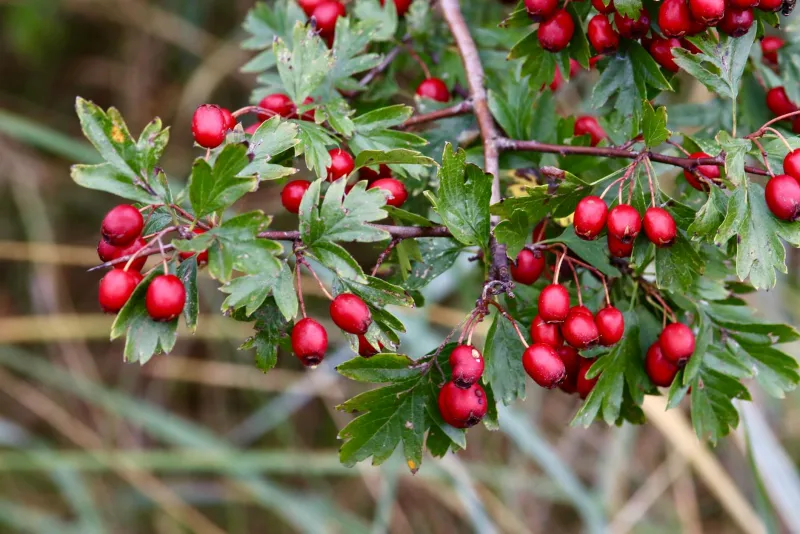
Hawthorn leaves, flowers, and berries are used to prepare extracts. The key active compounds are:
Oligomeric proanthocyanidins (OPCs):
- Potent antioxidants, scavenge free radicals
- Inhibit phosphodiesterase, which may strengthen cardiac contractions
- Dilate blood vessels via nitric oxide (NO)-dependent pathways
Flavonoids (vitexin, hyperoside, orientin):
- Antioxidant and anti-inflammatory properties
- Support endothelial function
Triterpene acids (ursolic acid, oleanolic acid):
- Cardioprotective effects in laboratory studies
Clinical Evidence: What Actually Works
Cochrane Review (Pittler et al., 2008)
This is the most authoritative summary of hawthorn research. Fourteen randomised controlled trials with 900+ participants were analysed. Key conclusions for mild to moderate heart failure (NYHA class I–II):
- Maximum exercise tolerance (NYHA II): statistically significant improvement favouring hawthorn
- Exercise tolerance: improvement versus placebo
- Symptoms (shortness of breath, fatigue): positive trend, statistically inconsistent
- Side effects: generally mild — dizziness, nausea, palpitations
HEDGEHOG Trial (Tauchert, 2002)
Randomised double-blind trial of WS 1442 (900 mg vs 1800 mg/day) with 209 participants (NYHA II). Both doses improved exercise tolerance and reduced symptoms versus placebo. Higher dose showed no additional benefit.
SPICE Trial (Zick et al., 2009)
Larger trial (2208 participants) in patients with more severe heart failure (NYHA II–III) already receiving modern conventional treatment. Result: hawthorn was not harmful, but added no statistically significant clinical benefit on top of contemporary cardiac medications.
Conclusion: Hawthorn works for mild to moderate heart failure, particularly when modern drug therapy has not been fully established. In more severe disease alongside optimal modern treatment, the added effect is unclear.
Mechanism: How Hawthorn Works
Mild positive inotropic effect: Hawthorn modestly increases the force of cardiac contractions, acting similarly to digitalis but much more weakly and without the toxicity risk at normal doses.
Vasodilation: NO-mediated vessel dilation reduces vascular resistance, easing the heart's workload.
Antioxidant protection: OPCs protect cardiac and vascular cells from oxidative stress, which is relevant in chronic disease.
Standardised Extract: WS 1442 vs LI 132
Clinical trials have mainly used two standardised extracts:
| Extract | Standardisation | Studied Doses |
|---|---|---|
| WS 1442 (Crataegutt) | 18.75% OPCs | 80–160 mg 3x daily |
| LI 132 | 2.2% flavonoids | 100–160 mg 3x daily |
Common tinctures may not contain these studied standardised concentrations. With tinctures, precise dose control is harder than with capsules.
Hawthorn Tincture in Estonia
Hawthorn grows naturally in Estonia (Crataegus monogyna, C. rhipidophylla). Traditional tincture is prepared from berries, flowers or leaves, typically in 70% alcohol. Pharmacies in Estonia usually sell non-standardised tinctures.
Estonian pharmacy prices (2026): hawthorn tincture 50 ml ~€3–6. Standardised capsule preparations (based on WS 1442) are mostly imported products, costing €10–25 per month's supply.
Drug Interactions
Hawthorn interactions are real and require attention:
| Medication | Interaction |
|---|---|
| Digoxin | May increase effect and plasma concentration |
| Antihypertensive drugs | Additive blood pressure-lowering effect |
| Nitrates | Possible additive vasodilation |
| Beta-blockers | Additive heart rate-lowering effect |
If you take heart medications, consult your doctor before adding hawthorn.
Frequently Asked Questions
Is hawthorn tincture suitable for heart patients?
For mild to moderate heart failure (NYHA I–II), evidence is positive. For severe heart failure, it does not replace medical treatment and you must consult a cardiologist.
Does hawthorn lower blood pressure?
Modestly, via vasodilation mechanism. This is not the primary indication, but interaction with antihypertensive medications is possible.
Is hawthorn suitable for cardiac prevention in healthy people?
Evidence is absent here. Hawthorn clinical trials have been conducted in the context of heart failure, not prevention.
How many weeks of hawthorn use before seeing an effect?
Trials showed results within 4–8 weeks. No faster effect has been observed.
Is hawthorn vegan?
Yes — plant-based, suitable for vegans.
References
- Pittler MH, Guo R, Ernst E. (2008). Hawthorn extract for treating chronic heart failure. Cochrane Database of Systematic Reviews, 2008(1), CD005312.
- Tauchert M. (2002). Efficacy and safety of crataegus extract WS 1442 in comparison with placebo in patients with chronic stable New York Heart Association class-III heart failure. American Heart Journal, 143(5), 910–915.
- Zick SM, Vautaw BM, Gillespie B, Aaronson KD. (2009). Hawthorn extract randomized blinded chronic heart failure (HERB CHF) trial. European Journal of Heart Failure, 11(10), 990–999.
- Holubarsch CJ, Colucci WS, Meinertz T, et al. (2008). The efficacy and safety of Crataegus extract WS 1442 in patients with heart failure: the SPICE trial. European Journal of Heart Failure, 10(12), 1255–1263.
- Chang Q, Zuo Z, Harrison F, Chow MS. (2002). Hawthorn. Journal of Clinical Pharmacology, 42(6), 605–612.
Summary
Hawthorn tincture and extract are among the few botanical preparations for which positive clinical trial evidence exists in mild to moderate heart failure. Based on the Cochrane review, standardised WS 1442 extract improves exercise tolerance and reduces symptoms in NYHA class II patients.
However, an important limitation applies: hawthorn is supportive care, not a replacement for cardiological treatment. Consult your doctor before use, especially if you take heart medications.
At MaxFit.ee you will find quality supplements including plant-based products. For decisions related to heart health, we always recommend medical advice.
See also:
- Licorice Root (Glycyrrhiza glabra): Benefits, Risks and Proper Dosing
- Magnesium: Why Most People Need More
- Which Vitamins Should You Take? A Need-Based Guide
See also: