Combining Travel and Training: Why It's Harder Than It Seems
Travel disrupts routine. Irregular sleep, shifting mealtimes, no gym access — all of this makes training difficult. And there's often the temptation to say: "I'll rest this week and get back to it later."
The problem is that one week becomes two, two becomes three — and then you're starting over. Research shows that even 2 weeks of complete training cessation significantly reduces muscle oxidative capacity and insulin sensitivity (Mujika & Padilla, 2000).
Good news: staying in shape while traveling doesn't require much. Even 20–30 minutes of bodyweight exercise 3 times per week preserves most muscle mass and strength gains.
Hotel Room Workout: 6 Exercises, Zero Equipment
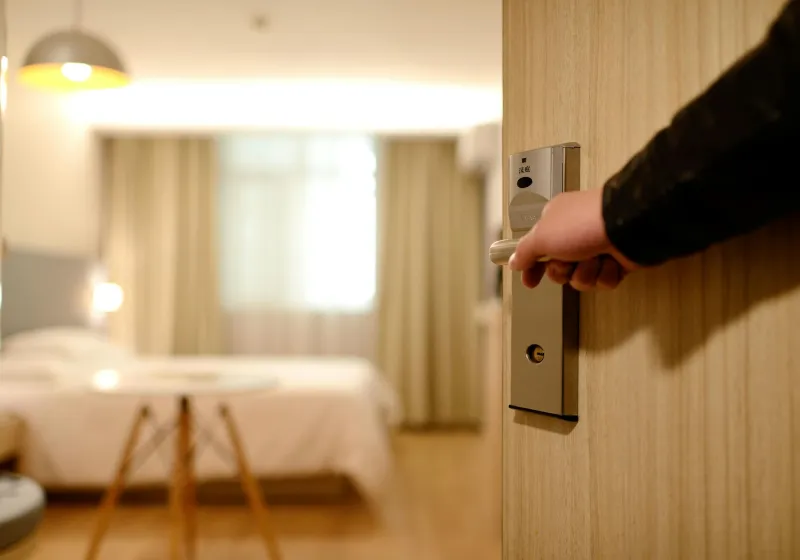
This routine works for any hotel room, rental apartment, or other accommodation:
| Exercise | Sets × Reps | Muscle Group |
|---|---|---|
| Push-ups | 3 × 12–15 | Chest, triceps, shoulders |
| Bodyweight squat | 3 × 15–20 | Quads, glutes |
| Lunges | 3 × 12 per leg | Quads, balance |
| Plank | 3 × 45–60 sec | Core |
| Glute bridge | 3 × 15 | Glutes, lower back |
| Mountain climbers | 3 × 30 sec | Core, cardio |
Total session: 25–35 minutes.
Traveling with Resistance Bands
Resistance bands fit in any suitcase and significantly expand your exercise options:
- Band deadlift — posterior chain
- Band row — back
- Band bicep curl — arms
- Band squat — lower body
A single band set (light + medium + heavy) weighs under 500 g and fits in a small pouch.
Public Options While Traveling
Hotel Gyms
Most hotels have at least a small fitness center. Use the opportunity even if equipment is limited — 30 minutes on the treadmill plus a few dumbbell exercises is far better than nothing.
Local Parks
Parks with running tracks, outdoor gym equipment, and open spaces are common almost everywhere. Interval running (10 min warm-up + 6 × 1 min sprint + 10 min cool-down) is an excellent 30-minute cardio session.
Pools
Many hotel complexes and spas offer swimming facilities. Swimming is an excellent low-impact training option.
Eating While Traveling
Travel is the greatest challenge for nutrition. Some core rules:
Before Flights
- Eat a protein-rich meal (eggs, chicken, Greek yogurt) 1–2 hours before
- Avoid high-sugar foods that cause energy crashes mid-flight
At Airports
- Look for protein and vegetable-based options
- Avoid chips and sugary drinks
At Restaurants
- Add a protein source to every meal (chicken, fish, eggs, legumes)
- Choose brown rice, potatoes, or oats as carbohydrates
- Limit alcohol consumption
Compact Supplements for Travel
ICONFIT Instant BCAA 2:1:1 Cranberry 300g is a great travel companion — small dose in your bag, dissolves in water, supports muscle recovery even without a gym. BCAAs help reduce muscle breakdown when workouts are irregular.
Protein can be a challenge on the road — restaurants don't always provide enough. MuscleTech Nitro Tech 100% Whey Gold 2.27kg Strawberry has a dense protein concentration; divide it into smaller pouches. Find protein supplements in the protein category at maxfit.ee.
Electrolytes are critical while traveling — aircraft, air conditioning, and irregular eating all increase dehydration risk. Check the electrolytes category at maxfit.ee.
Managing Time Zones and Sleep
Time zone travel disrupts sleep — and sleep is the foundation of recovery. Some practical tips:
- Adjust to destination time by the first evening of travel
- Avoid caffeine 6 hours before bedtime
- Use an eye mask and earplugs
- At destination: seek as much daylight exposure as possible (circadian rhythm)
FAQ
How many times per week should you train while traveling?
At minimum 3 times per week, even if sessions are shorter (20–30 minutes). This preserves the vast majority of training adaptations.
Does flying harm your fitness?
Short flights (under 6 hours) have minimal impact. Longer flights cause temporary dehydration and circadian disruption — both can be mitigated.
Is it worth doing light exercises while traveling?
Absolutely. Even 3–4 simple bodyweight exercises for 20 minutes preserves muscle activation patterns and baseline cardiovascular fitness.
References
- Mujika, I., & Padilla, S. (2000). Detraining: Loss of training-induced physiological and performance adaptations. Sports Medicine, 30(2), 79–87.
- Chtourou, H., & Souissi, N. (2012). The effect of training at a specific time of day. Journal of Strength and Conditioning Research, 26(7), 1984–2005.
- Stults-Kolehmainen, M. A., & Sinha, R. (2014). The effects of stress on physical activity and exercise. Sports Medicine, 44(1), 81–121.
- Waterhouse, J., et al. (2007). Jet lag: Trends and coping strategies. Lancet, 369(9567), 1117–1129.
- Tipton, K. D., & Wolfe, R. R. (2004). Protein and amino acids for athletes. Journal of Sports Sciences, 22(1), 65–79.