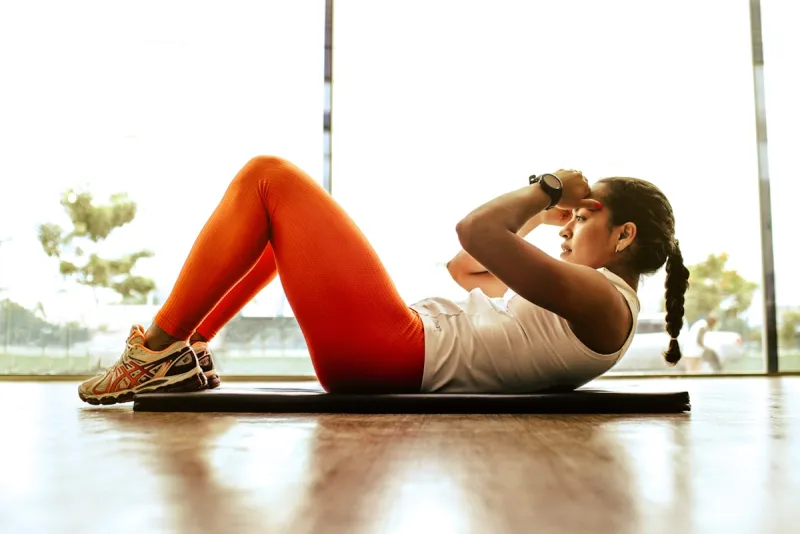
Why Home Workouts Work
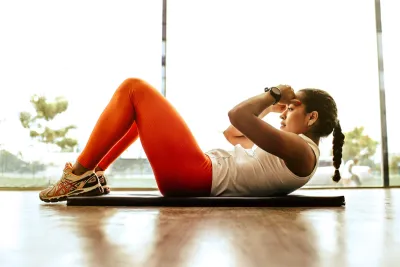
Home workouts have become significantly more popular — and for good reason. Research shows that bodyweight exercises and minimal equipment (resistance bands, dumbbells) can produce the same muscle growth as traditional gym training when training volume and intensity are sufficient (Calatayud et al., 2015).
Home workouts are:
- Time-efficient (no commute)
- Cost-effective
- Flexible in timing
- Private
Minimal Equipment, Maximum Effect
Recommended home workout equipment (you don't need all at once):
| Equipment | Price | Use |
|---|---|---|
| Resistance bands (set) | ~€20–40 | Versatile strengthening |
| Exercise mat | ~€20–30 | Floor exercises |
| Dumbbells (pair) | ~€30–80 | Added resistance |
| Pull-up bar | ~€20–40 | Upper body strength |
Resistance bands are a particularly cost-effective investment — you can train almost every muscle group with them. Browse workout gear at maxfit.ee.
4-Week Home Training Plan
Weeks 1–2: Beginner Level
Workout A (3× per week)
- Bodyweight squat — 3 × 15
- Push-ups — 3 × 10 (on knees if needed)
- Alternating lunges — 3 × 12 per leg
- Plank — 3 × 30 sec
- Superman (back exercise) — 3 × 12
- Side plank — 3 × 20 sec
Weeks 3–4: Intermediate Level
Workout A (lower body)
- Jump squats — 3 × 12
- Push-ups — 3 × 12 (full)
- Bulgarian split squat — 3 × 10 per leg
- Hollow body plank — 3 × 45 sec
- Resistance band seated row — 3 × 15
Workout B (upper body)
- Band chest press — 3 × 15
- Band lat pulldown (around a door frame) — 3 × 12
- Band overhead press — 3 × 12
- Band bicep curl — 3 × 15
- Band tricep extension — 3 × 15
Bodyweight Exercise Progression Hierarchy
Since you can't increase weight like in a gym, progression options include:
- Increasing repetitions
- Adding more sets
- Choosing harder variations (e.g., push-ups → single-arm push-ups)
- Reducing rest periods
- Changing tempo (slower descent = more time under tension)
Developing Upper Body Without a Pull-Up Bar
Pull-ups are one of the most effective exercises. Alternatives at home:
- Band lat pulldown around a door frame
- Table rows — inverted rows under a sturdy table
- Single-arm band row — one-arm variation with band
Adding Cardio Elements
Effective home cardio alternatives:
- Jump rope (if ceiling height allows)
- Burpees
- Jump squats
- High-knees running in place
- Interval training 20/10 (20 sec work, 10 sec rest)
Nutrition for Home Training Results
Training is only half the equation. ICONFIT Instant BCAA 2:1:1 Cranberry 300g supports muscle recovery after training. BCAAs (branched-chain amino acids) help reduce muscle tissue breakdown, which is equally important whether training at home or in a gym.
Aim for 1.6–2.0 g of protein per kg of body weight daily. Find protein supplements in the protein category at maxfit.ee.
Common Home Workout Mistakes
Inconsistency
Home workouts are easier to skip than gym visits — there's nothing forcing you there. Solution: schedule fixed training times at the start of each week and treat them like appointments.
Skipping the Warm-Up
If warm-up is often skipped at the gym, it's even more common at home. But the injury risk is the same.
No Progressive Overload
Increasing reps and sets is just as important as adding weight in a gym.
FAQ
Can you really build muscle at home?
Yes. Studies have shown that bodyweight exercises produce comparable muscle growth results when training volume is sufficient. The key to success is progression — always move toward harder variations.
What if I have no equipment at all?
Bodyweight exercises — push-ups, squats, lunges, planks, burpees — are sufficient for several months, especially for beginners. Resistance bands are the first recommended investment.
How long should a home workout last?
30–45 minutes is optimal. Longer sessions don't necessarily produce better results if intensity is sufficient.
References
- Calatayud, J., et al. (2015). Bench press and push-up at comparable levels of muscle activity results in similar strength gains. Journal of Human Kinetics, 46(1), 95–104.
- Lopes, J. S. S., et al. (2019). Effects of training with elastic resistance versus conventional resistance on muscular strength. SAGE Open Medicine, 7, 1–7.
- Schoenfeld, B. J., & Grgic, J. (2019). Does training to failure maximize muscle hypertrophy? Strength and Conditioning Journal, 41(5), 108–113.
- Contreras, B., et al. (2016). Effects of a six-week hip thrust vs. front squat resistance training program on performance in adolescent males. Journal of Strength and Conditioning Research, 30(6), 1634–1640.
- ACSM. (2021). ACSM's Guidelines for Exercise Testing and Prescription (11th ed.). Wolters Kluwer.