Shoulder Pain on the Overhead Press: The Actual Cause
Overhead pressing is one of the most natural human movements — reaching and lifting overhead has always been part of human life. Yet it is also one of the most commonly painful exercises in the gym. Most people assume the shoulder is inherently fragile. The reality is more specific: the culprit is nearly always the bar path traveling too far forward combined with restricted thoracic (upper-back) mobility, not the movement itself.
When the bar drifts forward, the shoulder has to rotate to compensate, pinching the rotator cuff tendons between the bones of the shoulder joint — a mechanism known as subacromial impingement. Ludewig & Cook (2000) documented how altered shoulder kinematics correlate directly with impingement symptoms.
What's your main goal for a back-friendly leg day?
All magnesiumWhy Your Shoulder Hurts: A Cause-by-Cause Breakdown
| Cause | What you feel | Quick check |
|---|---|---|
| Bar path too forward | Pinch at the top of the press | Bar should track vertically over the shoulder joint |
| Poor thoracic mobility | Low-back arching to compensate | Can you reach both hands overhead without flaring ribs? |
| Grip too wide | Outer shoulder impingement | Try a grip 2 finger-widths narrower than your current one |
| Elbow flare at setup | Pain at front of shoulder | Elbows should be 30–45° in front of the bar, not directly below |
| Volume spike | Day-after diffuse shoulder ache | Reduce sets, add one extra rest day |
The most fixable issue — and the one that solves the majority of cases — is grip width and bar path. A too-wide grip narrows the subacromial space for the rotator cuff. Elbows positioned too far below the bar at setup forces the shoulder into a position where impingement is almost inevitable.
Fix Your Setup Before You Fix Your Shoulder
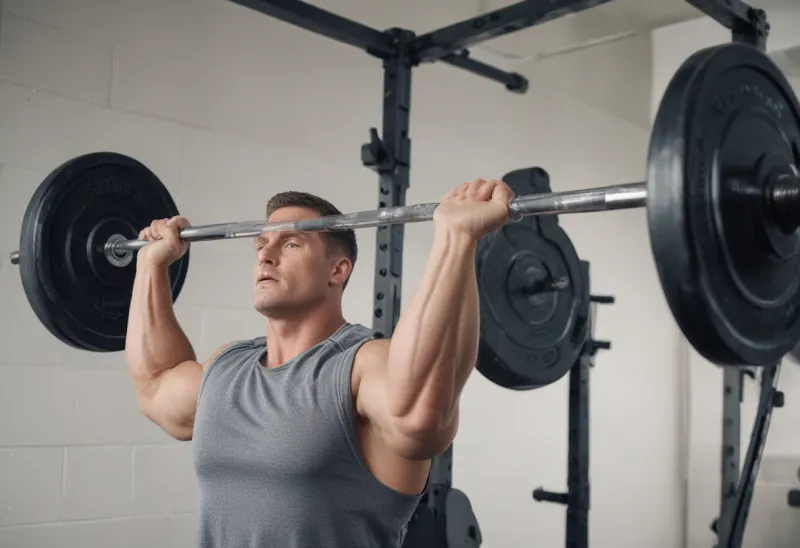
Grip width: Your hands should be just outside shoulder width, not a snatch-width grip. Rule of thumb: with the bar on your shoulders at the starting position, your forearms should be vertical or very close to it.
Elbow position: At the starting position (bar at upper chest), elbows should be slightly in front of the bar — roughly 30–45° forward of the frontal plane, not pointing straight down. This is sometimes called the "elbows slightly forward" position.
Bar path: The bar should travel in a nearly vertical line directly over the shoulder joint. If a recording of your press shows the bar arcing forward away from your face, that is the problem. Drive the bar straight up, not forward.
Brace: Ribcage down, not flared upward. Abs and glutes engaged. This prevents the spine from excessive extension that compensates for limited thoracic mobility.
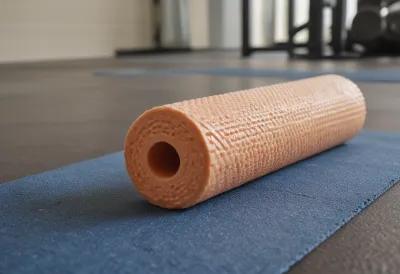
Thoracic mobility warm-up: Before pressing, spend 5 minutes on thoracic extension over a foam roller, or cat-cow with arm reaches. Even modest improvement in T-spine range reduces shoulder impingement risk significantly.
Variation Swaps for an Irritated Shoulder
If setup corrections reduce but do not eliminate pain, switch variation temporarily:
Dumbbell overhead press: The neutral or semi-neutral grip option allows each arm to find its own pain-free plane of motion. Most people with pressing shoulder pain can continue dumbbell pressing without issue.
Landmine press: The angled, single-arm nature means you never reach full overhead range — ideal for maintaining pressing volume while the shoulder recovers. Excellent thoracic rotation demand as a bonus.
Incline bench press: Not true overhead, but maintains pushing strength without the subacromial stress of a full overhead position.
When to Swap or Stop Completely
- Pain is 0–3/10 → Continue with the variation, monitor
- Pain is 4–6/10 → Switch to a less provocative variation immediately
- Pain is >6/10 on any rep or any variation → Stop pressing; do 2 weeks of unloaded thoracic mobility work and rotator cuff activation only
- All variations hurt → See a physiotherapist or sports medicine doctor before continuing
Recovery Support
Omega-3 fatty acids from fish oil support normal inflammatory processes during tissue recovery (Calder, 2017). OstroVit Omega 3 Ultra 90 caps is a concentrated, high-dose EPA/DHA option to include during a recovery period. Explore the full omega-3 range.
For joint connective tissue, particularly when the shoulder capsule and rotator cuff tendons are under repeated load, collagen peptides taken with vitamin C have been studied for connective tissue support (Shaw et al., 2017). MST Collagen for Joints Fortigel 500ml – Pineapple uses Fortigel bioactive collagen peptides. Browse the full joint support range.
Red Flags — When Pain Is More Than Impingement
See a physiotherapist or sports medicine doctor promptly if you experience:
- Pain radiating down the arm (possible nerve root involvement or rotator cuff tear)
- Numbness or tingling in the hand or fingers
- Extreme weakness — inability to raise the arm overhead at all, especially if sudden
- A sudden sharp pop heard or felt during the press (possible rotator cuff or labrum tear)
- Shoulder pain at night when lying still (red flag for structural pathology)
References
- Ludewig PM, Cook TM. (2000). Alterations in shoulder kinematics and associated muscle activity in people with symptoms of shoulder impingement. Physical Therapy, 80(3), 276–291. https://pubmed.ncbi.nlm.nih.gov/10696154/
- Calder PC. (2017). Omega-3 fatty acids and inflammatory processes: from molecules to man. Biochemical Society Transactions, 45(5), 1105–1115. https://pubmed.ncbi.nlm.nih.gov/28900017/
- Shaw G et al. (2017). Vitamin C-enriched gelatin supplementation before intermittent activity augments collagen synthesis. American Journal of Clinical Nutrition, 105(1), 136–143. https://pubmed.ncbi.nlm.nih.gov/27852613/
FAQ
What is shoulder impingement and can I train through it?
Subacromial impingement is when the soft tissue — primarily the supraspinatus tendon and the subacromial bursa — gets repeatedly pinched between the humeral head and the acromion (the roof of the shoulder) during arm elevation. At low pain levels (0–3/10) with a modified movement, you can continue training. At higher pain levels, continuing to compress the already-irritated tissue tends to prolong recovery significantly. The fix is usually positional rather than simply resting.
Is the overhead press bad for shoulders?
No. It is one of the most effective upper-body strength movements and is shoulder-safe when performed with correct setup. The evidence shows impingement correlates with technique errors and mobility limitations, not with overhead pressing as a category (Ludewig & Cook, 2000). Athletes with excellent long-term shoulder health typically include some form of overhead pressing in their training.
Which press variation is most shoulder-friendly?
For most people with pressing discomfort, the landmine press causes the least impingement because the movement arc keeps the arm below full overhead range and the angle is more natural for the shoulder. Dumbbell press with a neutral grip is the next most shoulder-friendly option. Barbell overhead press is mechanically sound when setup is correct but least forgiving of technical errors.