How to Maximize Quercetin Absorption
Quercetin is one of the most studied flavonoids, found naturally in onions, apples, and capers. Despite its widespread presence in plant foods, quercetin absorption is notoriously poor when consumed in isolation. Understanding what drives and limits its bioavailability is the first step to getting real value from quercetin supplementation.
What Limits Quercetin Absorption
Quercetin is a fat-soluble polyphenol with limited water solubility, which makes crossing the intestinal membrane a challenge. In its standard aglycone (free) form, quercetin must be taken up by passive diffusion across the enterocytes of the small intestine. This process is slow and incomplete.
In whole foods, quercetin often appears as glycoside conjugates (bound to sugar molecules), particularly quercetin-3-glucoside (the form found in onions). These glycoside forms are actually absorbed more readily via active glucose transporters — an advantage that pure isolated quercetin does not have.
Bioavailability studies comparing quercetin forms have found meaningful differences based on food matrix and formulation (Hollman et al., 1997). The presence of gut microbiota also affects quercetin metabolism — these bacteria can either activate or degrade quercetin conjugates in the colon.
Cofactors That Help Quercetin Absorption
Bromelain, a proteolytic enzyme derived from pineapple, is one of the most studied cofactors for quercetin. It is thought to improve gut permeability slightly and may enhance quercetin uptake across the intestinal lining. 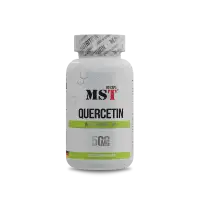 MST Quercetin Bromelain€26.90 In stock 60caps combines both in a single capsule specifically for this synergistic purpose.
Vitamin C is another well-studied cofactor. Quercetin and vitamin C appear to enhance each other's stability in biological fluids; their combination has been used in research protocols examining immune-related outcomes (Mlcek et al., 2016).
Piperine, the active compound in black pepper, has been shown to inhibit intestinal glucuronidation — a major clearance mechanism that reduces circulating quercetin levels. While most piperine research focuses on curcumin, the same mechanism theoretically applies to quercetin.
Form and Timing Effects
A number of pharmaceutical-grade quercetin forms have been developed to address poor absorption. These include:
- Quercetin phytosome (bound to phosphatidylcholine): shows improved absorption vs. standard quercetin in pharmacokinetic studies.
- Quercetin-3-glucoside: the naturally occurring food form with higher intestinal transport via active carriers.
- Standard quercetin aglycone: widely available and the most studied form, but lowest bioavailability without cofactors.
OstroVit Quercetin 90caps offers a reliable standardised quercetin aglycone dose. Taking it with bromelain and a fat-containing meal represents the most practical absorption stack available at maxfit.ee.
Timing: consume quercetin with a moderate-fat meal. Fat stimulates bile production and slows gastric emptying, giving more time for passive diffusion at the intestinal wall.
Food Pairings That Enhance Quercetin Absorption
Certain foods and combinations may enhance quercetin uptake:
- Olive oil or nuts: fat-rich foods that extend gut transit time and stimulate bile, improving passive uptake.
- Onions and apples (quercetin-3-glucoside): if taking a whole-food quercetin approach, these provide the active-transported glycoside form.
- Pineapple (fresh): provides bromelain alongside quercetin in a food context.
- Black pepper: adding a small amount alongside a quercetin supplement may reduce rapid glucuronidation.
Practical Tips for Better Quercetin Absorption
- Take with a fat-containing meal: even a small amount of fat meaningfully improves fat-soluble polyphenol uptake.
- Combine with bromelain or vitamin C: these cofactors have the strongest evidence base for improving quercetin bioavailability.
- Consider phytosome or glycoside forms if standard quercetin does not seem effective — these have improved pharmacokinetic profiles.
- Avoid high-fibre meals simultaneously: very high fibre can bind polyphenols and reduce their absorption window.
- Consistency: daily dosing maintains steadier plasma and tissue levels than intermittent high doses.
Category link: explore the quercetin supplement range at maxfit.ee for available products.
References
Hollman, P. C., van Trijp, J. M., Buysman, M. N., et al. (1997). Relative bioavailability of the antioxidant flavonoid quercetin from various foods in man. FEBS Letters, 418(1-2), 152-156. https://pubmed.ncbi.nlm.nih.gov/9414116/
Mlcek, J., Jurikova, T., Skrovankova, S., & Sochor, J. (2016). Quercetin and its anti-allergic immune response. Molecules, 21(5), 623. https://pubmed.ncbi.nlm.nih.gov/27187333/
FAQ
Why is quercetin absorption so low compared to other supplements?
Quercetin is a fat-soluble polyphenol with limited water solubility. In its pure aglycone form it crosses the gut wall only by slow passive diffusion, and it undergoes rapid conjugation in gut and liver cells, reducing circulating levels. Food-bound glycoside forms and cofactors like bromelain can improve this substantially.
Does taking quercetin with vitamin C actually help?
Vitamin C and quercetin appear to mutually enhance each other's stability in biological fluids, and the combination is commonly used in immune-support research protocols. The effect on pure absorption magnitude is modest, but combining them is low-risk and potentially beneficial.
How long does quercetin take to build up in the body?
Because quercetin is cleared relatively quickly, consistent daily intake is more effective than occasional large doses for maintaining tissue levels. Most research uses daily supplementation over several weeks.



