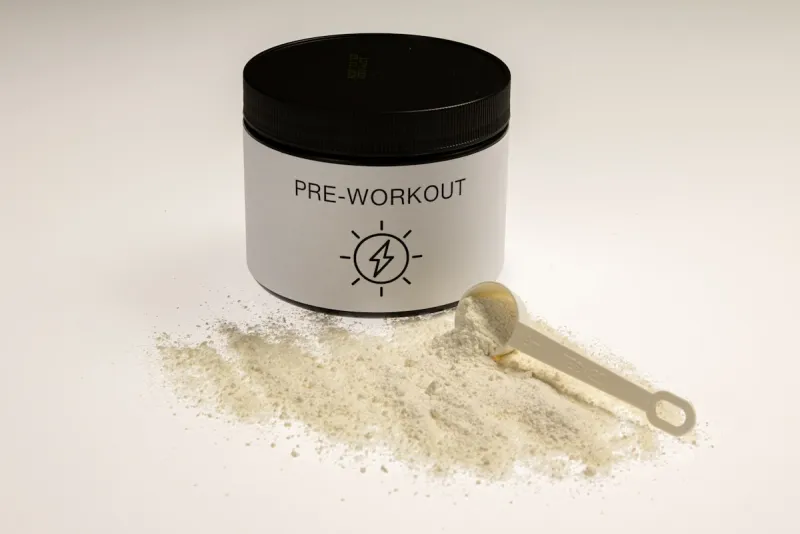
Pre-Workout Supplements: A Science-Based Guide
What is pre-workout?
A pre-workout is a dietary supplement taken before exercise. It typically comes as a powdered blend containing multiple ingredients such as caffeine, creatine, amino acids, and vitamins. Pre-workout is not a single substance but a combination of components selected to support training.
In the European Union, pre-workout supplements are regulated as food supplements, and only health claims approved by the European Food Safety Authority (EFSA) may be used in their marketing.
How does it work?
A pre-workout blend works through its individual ingredients. Each component has its own mechanism of action:
Caffeine is a central nervous system stimulant that acts on adenosine receptors in the brain. This helps improve alertness and may support prolonged effort during training.
Creatine is stored in muscles as creatine phosphate, where it participates in the regeneration of ATP (adenosine triphosphate) during short-term, high-intensity efforts.
Because pre-workout is a multi-ingredient product, health claims do not apply to the product as a whole. They apply to each individual ingredient separately, provided the amount meets the required conditions.
Supported benefits (EFSA-approved claims only)
The following benefits are based on health claims authorised under Commission Regulation (EU) No 432/2012:
Caffeine
- Caffeine contributes to an increase in endurance performance — this claim is valid when 3 mg of caffeine per kilogram of body weight is consumed approximately 1 hour before exercise. The target population is trained adults.
- Caffeine helps to increase alertness — this claim is valid when a serving contains at least 75 mg of caffeine.
- Caffeine helps to increase attention — valid under the same conditions (at least 75 mg per serving).
Creatine (if present in the pre-workout)
- Creatine increases physical performance in successive bursts of short-term, high intensity exercise — this claim is valid with a daily intake of 3 g of creatine. The target population is adults performing high-intensity exercise.
B Vitamins (if present in the pre-workout)
- Vitamin B6 contributes to normal energy-yielding metabolism — valid when a serving provides at least 0.21 mg of vitamin B6.
- Vitamin B12 contributes to normal energy-yielding metabolism — valid when a serving provides at least 0.375 ug of vitamin B12.
- Niacin contributes to normal energy-yielding metabolism — valid when a serving provides at least 2.4 mg of niacin.
Important note: Claims such as "increases energy", "improves pump", or generic "enhances performance" are not approved by EFSA and must not be used.
How to take it
Pre-workout supplements are typically consumed 30 to 60 minutes before training. Mix the powder with water according to the instructions on the product label.
Guidelines:
- Start with a smaller serving to assess your tolerance, particularly to caffeine
- Always follow the recommended daily serving stated on the label — do not exceed it
- Time your intake according to your workout: caffeine reaches peak blood levels roughly 45 to 60 minutes after consumption
- Avoid taking pre-workout late in the evening, as caffeine may interfere with sleep
- If the product contains creatine, maintain adequate fluid intake
Caffeine cycling: Long-term daily caffeine consumption may lead to tolerance. Some individuals prefer to take periodic breaks of 1 to 2 weeks.
Who should use it?
Pre-workout supplements are intended for trained adults who want to support their exercise with specific ingredients.
Pre-workout may be of interest to:
- Strength trainers and bodybuilders who train regularly at high intensity
- Endurance athletes (running, cycling) who want caffeine-based support for endurance
- People who train early in the morning or after a long workday and need alertness support
Who should exercise caution:
- Individuals under 18 years of age
- Pregnant or breastfeeding women
- People with cardiovascular conditions or high blood pressure
- Individuals sensitive to caffeine
- People who already consume significant caffeine from other sources (coffee, tea, energy drinks)
When in doubt, always consult your doctor.
Frequently Asked Questions
Can I take pre-workout every day? Yes, pre-workout can be used on training days. However, it is sensible to take periodic breaks to avoid building caffeine tolerance. Always follow the recommended serving on the label.
What is the tingling sensation after taking pre-workout? This is paraesthesia caused by beta-alanine — a tingling or itching feeling on the skin. It is harmless and subsides within 30 to 60 minutes. Not everyone experiences it.
Is pre-workout suitable for weight loss? Pre-workout itself does not cause weight loss. However, it may help you train more intensively, which supports your overall training programme. Check the calorie content of the product — most pre-workouts contain very few calories.
Can I mix pre-workout with protein? Technically yes, but it is not recommended because protein may slow the absorption of caffeine. It is better to take pre-workout separately, 30 to 60 minutes before training.
How much caffeine is in pre-workout? This varies by product. A typical serving contains 150 to 300 mg of caffeine. For comparison, one cup of coffee contains approximately 80 to 100 mg. EFSA considers up to 400 mg of caffeine per day safe for healthy adults.
Is stimulant-free pre-workout effective? Stimulant-free (caffeine-free) pre-workout does not provide alertness support, but it may contain other ingredients such as creatine. For creatine, the EFSA-approved claim regarding physical performance applies (3 g per day).
See also: