


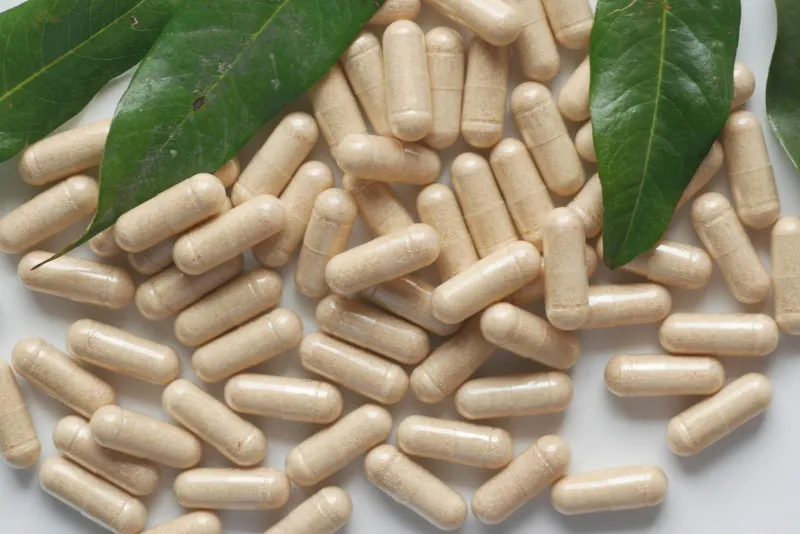
What NAC is, how it works, and why the dose matters at all
NAC, or N-acetylcysteine, is an acetylated form of the amino acid cysteine. The acetyl group makes the molecule more stable and more water-soluble than free cysteine. In the body, cysteine is the rate-limiting link in glutathione synthesis: of the three amino acids that make up glutathione, cysteine is the one whose shortage slows the whole process.
This is where the reason for NAC's seemingly large doses comes in. Orally administered NAC goes through extensive first-pass metabolism in the gut and liver, and the fraction that reaches plasma unchanged has been estimated as very low, in the single-digit percent range (Šalamon et al., 2019). So a 600 mg capsule does not mean 600 mg of active compound in circulation, and that is why trial doses are many times larger than any extra cysteine you would get from food.
The dose matters for three practical reasons. First, there is a threefold gap between 600 and 1800 mg and most people have no idea which end they belong at. Second, NAC side effects are clearly dose-dependent: digestive complaints usually come from large doses taken on an empty stomach (Rhodes & Braakhuis, 2017). Third, the price difference is real - powder and capsules sold in Estonia deliver the same daily dose at very different cost, and we work that out precisely below.
One caveat up front: this article is about supplement dosing in the context of a healthy adult. It is not a treatment recommendation and it does not replace medical advice.
Studied dose ranges: what trials actually used
If you look at what researchers actually gave people, the picture divides fairly cleanly.
In a sports context, the most practical reference is a nine-day trial where trained cyclists took 1200 mg of NAC per day through an intensified training block and time-trial performance improved relative to placebo (Slattery et al., 2014). Note that this was not a single pre-workout dose but consistent daily intake through the whole block.
Another frequently cited trial found that NAC extended time to fatigue in endurance-trained individuals by roughly a quarter (Medved et al., 2004). But there is a detail that usually disappears from blog posts: NAC was given as an intravenous infusion, not as a capsule. An infusion result cannot be transferred one-to-one to an oral dose, because first-pass metabolism is exactly what eats most of the oral dose.
A systematic review and meta-analysis of NAC in exercise found that benefits appear most consistently in endurance protocols with a high oxidative load, and that reports of adverse effects cluster at the higher doses used in trials (Rhodes & Braakhuis, 2017). Outside sport, clinical trials have typically used 600-2400 mg per day (Dodd et al., 2008).
Mucolytic use belongs in a separate box entirely. That is the medicine lane, not the supplement lane, and even there the effect is modest: a Cochrane review in chronic bronchitis found a small rather than dramatic benefit for mucolytic agents (Poole et al., 2019). If your goal concerns the airways, the right address is a pharmacy and a doctor, not a supplement shelf.
Dose by goal
| Goal | Dose used in trials | Duration | Note |
|---|---|---|---|
| General antioxidant support | 600 mg per day | long term | most common capsule strength |
| Training block, endurance | 1200 mg per day, split in two | 1-3 weeks at a time | (Slattery et al., 2014) |
| Range used in clinical trials | 600-2400 mg | varies by trial | (Dodd et al., 2008) |
| Airways, mucolytic use | medicine lane | doctor's call | (Poole et al., 2019) |
| Starting out, tolerance check | 600 mg with food | first 7 days | reduces digestive complaints |
Bodyweight-based dosing is generally not used in oral NAC trials - doses are fixed in milligrams. In practice this means a 60 kg and a 100 kg person took the same amount in most studies.
Capsule, powder or combination product: what is on the shelf in Estonia and at what price
At the time of writing the MaxFit NAC category holds three products in stock. That is the reality of the Estonian market: NAC is not a mass-market item like whey protein, and the range is narrow. Prices at the time of writing.
OstroVit NAC 200g supreme pure is 13.90 euros. This is pure unflavoured powder. Do the arithmetic yourself: 200 grams divided by a 600 mg daily dose gives about 333 days, roughly four cents per day. At 1200 mg the tub lasts about 166 days, about eight cents per day. No capsule product comes close to that price.
The powder has two practical catches that product descriptions never mention. First: 600 mg is not a weight you can measure on a kitchen scale. Most household scales step in one-gram increments, which means the measurement error on 0.6 g is larger than the dose itself. You need either a 0.01 g scale or the micro-scoop supplied with the tub. Second: NAC powder smells of sulphur, roughly like a boiled egg. That is not a sign of spoilage, it is a property of the molecule. Solve it by mixing the powder into a small amount of juice or a tart drink rather than plain water.
VitalHarmony NAC 90caps is 8.90 euros, which works out at about ten cents per capsule. A capsule is a win on convenience and a loss on price. Check the label for how many milligrams sit in one capsule - that determines whether your daily dose is one capsule or two, and that number decides whether ten cents per capsule is expensive or not.
OstroVit Liver Aid 90caps is 13.90 euros and is a combination product. The logic of combination products is always the same trade-off: convenience on one side, loss of dose control on the other. When NAC sits alongside other components, you cannot raise or lower its amount independently. Read the label and check how much acetylcysteine each capsule actually carries. We compare the forms in detail in The best NAC form: how to choose.
And one honest Estonia-specific note. The same molecule sits on two different shelves here: acetylcysteine is also registered as an over-the-counter medicine in Estonian pharmacies, typically at 200 and 600 mg strengths. A medicine carries an approved indication, a package leaflet and a pharmacist's advice; a food supplement does not. The supplement lane is usually cheaper per gram, but you pay for that on the information and oversight side. Borderline classification decisions in Estonia are made by the State Agency of Medicines, not by a manufacturer's marketing department.
A practical check before you buy: at the pharmacy counter - in Tallinn, Tartu or anywhere else - ask for the tablet strength and the pack size, then work out the cost per day exactly the way we did for the tub above. A medicine pack is usually sized for a short course and a supplement tub for months, and that difference, not the shelf label, decides the final cost.
Timing: when, and in how many doses
Three rules cover most situations.
Split the dose in two. 600 mg twice a day is usually tolerated better than 1200 mg at once, and plasma levels fluctuate less. If your daily dose is 600 mg, once is enough.
Take it with food. An empty stomach is the single most common reason someone reports nausea and then concludes that NAC does not suit them. Food usually solves it.
Pre-workout timing is not where the win is. In the trial where performance improved, cyclists took NAC every day throughout the block (Slattery et al., 2014). Consistency outweighs clock precision. One nuance though: long-term use of large antioxidant doses alongside training is genuinely debated in the research world, because some training adaptation signals run through oxidative stress itself. The practical conclusion is not fear but moderation - use higher doses in blocks rather than year-round. Timing is covered at length in When to take NAC.
Safety, side effects and interactions
The most common side effects of oral NAC are digestive: nausea, diarrhoea, bloating, less often vomiting. The review noted that adverse effect reports come predominantly from the higher doses used in trials (Rhodes & Braakhuis, 2017). Many people are also bothered by the sulphur smell, particularly with powder.
In the European Union no formal tolerable upper intake level has been set for NAC as a food supplement. That does not mean there is no ceiling - it means no number has been fixed. A sensible ceiling for an ordinary user is what trials have used, not what the tub allows.
Among interactions, nitrates deserve a mention. Interactions have been described in clinical settings for people taking nitroglycerin and other nitrates, and that conversation belongs with your doctor before you start. The same applies to blood pressure medication and blood thinners. If you have elective surgery coming up, tell your surgeon about every supplement you use - that is a general rule, not a NAC peculiarity.
Combining with other antioxidants is common in trials and commercial formulas: vitamin C, selenium, alpha-lipoic acid (Dodd et al., 2008). At typical doses no problematic interactions are well documented, but stacking several high antioxidant doses at once is poorly mapped in human trials. If you already take a multi-ingredient product, check the vitamin complexes label to see whether the same compound is already in there. Stacking is covered further in What to combine NAC with.
Who should skip NAC
- Anyone already taking a pharmacy medicine containing acetylcysteine. Two sources at once means a double dose, often unknowingly.
- People on nitrates or blood pressure medication - only after speaking with a doctor.
- Pregnant and breastfeeding women. In the supplement context there is not enough data to recommend a dose.
- Anyone with an asthma diagnosis. The airway side belongs on a doctor's desk, not on a supplement tub.
- Under-18s. The trials were conducted in adults.
- Anyone expecting a fast, noticeable effect. NAC is not a stimulant. If you are looking for something you feel immediately, this is the wrong product.
- Anyone hoping NAC will offset chronic sleep deprivation or regular drinking. It does not work that way, and the next section explains why.
What NAC does not do: the detox promise versus reality
The word detox sells especially well in Estonia in spring. The honest picture is more modest. The body's clearance work is done continuously by the liver and kidneys, not in courses, and no supplement shifts them into a higher gear like a turbo. Glutathione is an important molecule in that system and cysteine is the rate-limiting link in its synthesis - that is a mechanism, not a promise.
What that means in practice. If someone sleeps five hours, trains hard, eats few vegetables and drinks heavily at weekends, 600 mg of NAC is not the variable that decides anything. If the basics are in place and you want to try a well-studied, cheap supplement with modest claims, NAC is a reasonable candidate.
There is also a regulatory fact worth stating: in the European Union no health claims are authorised for NAC as a food supplement. If a sales text promises a specific therapeutic effect, that is a claim that should not be made for a supplement. We hold the same line in our own text.
Cysteine from food: where to find it in Estonia
Before adding a supplement it is worth knowing how much cysteine already arrives daily. Whey protein is the most cysteine-rich protein source in food, and that explains why some gym-goers notice nothing at all from NAC: their baseline intake is already high. If you drink a scoop of Optimum-nutrition Gold Standard 100% Whey 450g Vanillijäätis every day, cysteine comes along without a separate purchase. The full protein selection sits in its own category.
In an Estonian context, cysteine and sulphur-containing compounds come most easily from eggs, quark and cottage cheese, chicken and fish, oats, sunflower and pumpkin seeds, garlic, onions, and cruciferous vegetables such as cabbage, cauliflower and rocket. Sauerkraut is a double win here, because alongside sulphur compounds it also delivers vitamin C in winter, when the choice is narrow anyway.
An honest distinction: cysteine from food is not the same thing as 600 mg of pharmaceutical-grade NAC. Trial doses exceed ordinary dietary amounts several times over. But it does explain why the effect of the supplement varies so much between individuals - whoever has the weaker food side has the most room to change.
An eight-week practical protocol
Week one: 600 mg once a day with dinner. The only goal is a tolerance check. Do not start three new supplements in the same week, or you will never know later which did what.
Weeks two to four: if your stomach is calm and the goal is general antioxidant support, stay at 600 mg. If the goal is a training block, move to 600 mg twice a day, at breakfast and dinner.
Weeks five to eight: hold the dose steady and track three things - digestion, sleep and training tolerance. Write them down, because memory is a poor witness when judging supplements.
After eight weeks: take a four-week break, especially if you used the higher dose. The break answers the question you would otherwise never resolve - whether anything changed at all.
One rule applies throughout: if a new or persistent symptom appears, stop and talk to a doctor. A supplement is not the place to test your patience.
FAQ
How much NAC should I take per day?
The most common dose in both supplements and trials is 600 mg per day. In a training block 1200 mg split into two doses has been used (Slattery et al., 2014), and the clinical trial range extends to 2400 mg (Dodd et al., 2008). Start at 600 mg and increase only if you have a specific reason.
Should NAC be taken on an empty stomach or with food?
With food. Digestive complaints are the most common NAC side effect and they are strongly tied to empty-stomach intake and large single doses (Rhodes & Braakhuis, 2017). Food does not ruin the effect.
Why does NAC powder smell of sulphur?
Because cysteine is a sulphur-containing amino acid, and that smell is a property of the molecule rather than a sign of spoilage. Capsules hide it, powder does not. Juice or a tart drink masks it best.
Is NAC the same thing as the acetylcysteine sold in pharmacies?
The active compound is the same molecule. Regulatorily they are different things: the pharmacy medicine has an approved indication, a leaflet and a defined strength, while a food supplement has none of those. You should not use both sources at once, because that means an unknown total dose.
Can NAC be taken with vitamin C?
This combination is common in trials and commercial formulas (Dodd et al., 2008) and at typical doses no problems are well documented. Still, check whether your multivitamin already contains the same compound.
Does NAC need to be cycled?
There is no obligation, but eight weeks on and four weeks off is a sensible rhythm. The break is the only way to tell whether the supplement did anything for you, and it keeps higher doses tied to training blocks rather than a year-round routine.
References
- Rhodes, K., & Braakhuis, A. (2017). Performance and side effects of supplementation with N-acetylcysteine: a systematic review and meta-analysis. Sports Medicine, 47(8), 1619-1636. https://pubmed.ncbi.nlm.nih.gov/28102488/
- Slattery, K. M., Dascombe, B., Wallace, L. K., Bentley, D. J., & Coutts, A. J. (2014). Effect of N-acetylcysteine on cycling performance after intensified training. Medicine and Science in Sports and Exercise, 46(6), 1114-1123. https://pubmed.ncbi.nlm.nih.gov/24576857/
- Medved, I., Brown, M. J., Bjorksten, A. R., Murphy, K. T., Petersen, A. C., Sostaric, S., Gong, X., & McKenna, M. J. (2004). N-acetylcysteine enhances muscle cysteine and glutathione availability and attenuates fatigue during prolonged exercise in endurance-trained individuals. Journal of Applied Physiology, 97(4), 1477-1485. https://pubmed.ncbi.nlm.nih.gov/15194675/
- Šalamon, Š., Kramar, B., Marolt, T. P., Poljšak, B., & Milisav, I. (2019). Medical and dietary uses of N-acetylcysteine. Antioxidants, 8(5), 111.
- Dodd, S., Dean, O., Copolov, D. L., Malhi, G. S., & Berk, M. (2008). N-acetylcysteine for antioxidant therapy: pharmacology and clinical utility. Expert Opinion on Biological Therapy, 8(12), 1955-1962. https://pubmed.ncbi.nlm.nih.gov/18990082/
- Poole, P., Sathananthan, K., & Fortescue, R. (2019). Mucolytic agents versus placebo for chronic bronchitis or chronic obstructive pulmonary disease. Cochrane Database of Systematic Reviews, 5, CD001287. https://pubmed.ncbi.nlm.nih.gov/31107966/


