Lion's Mane Mushroom: How to Choose, Dose, and What to Expect
You have probably heard that Lion's Mane (Hericium erinaceus) is good for the brain. But the supplement aisle is packed with products ranging from cheap mycelium-on-grain capsules to premium dual-extracted powders — and the price difference can be fivefold. This practical guide helps you cut through the noise.
This article is for supplement buyers who already know the basics of Lion's Mane and want actionable advice on product selection, dosing protocol, and realistic timelines. For a deeper dive into the science and mechanisms, see our companion article on Lion's Mane and brain health.
TL;DR
- The best products use dual extraction (hot water + alcohol) from the fruiting body, with stated beta-glucan content ≥25%.
- Mycelium-on-grain products are often 50–70% starch and contain minimal active compounds (Stamets & Chilton debate, 2017–present).
- Effective clinical dose: 750–3,000 mg/day standardised extract; the pivotal Mori et al. (2009) trial used 750 mg/day.
- Allow 8–16 weeks for cognitive benefits to develop — this is not a stimulant.
- Combine with vitamin D and omega-3 for a practical Northern European brain-support stack.
Understanding Lion's Mane Products: Not All Are Equal
Fruiting Body vs. Mycelium
This is the single most important distinction when buying Lion's Mane.
| Factor | Fruiting body extract | Mycelium on grain |
|---|---|---|
| Active compounds | Hericenones + polysaccharides | Erinacines (variable) |
| Starch content | Low (<5%) | High (50–70%) |
| Beta-glucan concentration | 25–40% | 5–15% |
| Price per effective dose | Medium | Appears cheap but diluted |
| Research basis | Most human studies | Primarily animal studies |
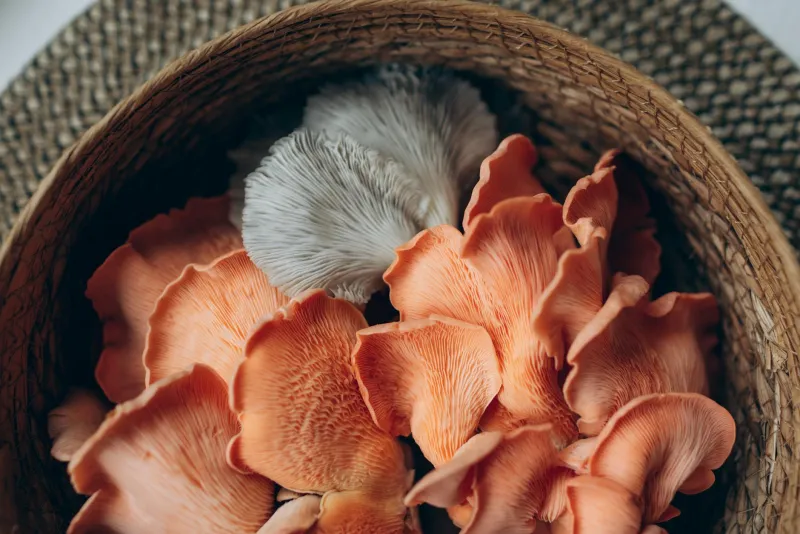
The fruiting body is the visible mushroom — the part that looks like a white waterfall. It contains hericenones, the compounds shown to stimulate nerve growth factor (NGF) in cell studies (Lai et al., 2013). Mycelium is the root-like network grown in substrate (usually grain). Mycelium products contain erinacines, which also stimulate NGF, but commercial mycelium-on-grain products often include significant amounts of the grain substrate itself, diluting active compound concentrations.
Our recommendation: Look for products that specify "fruiting body" or "dual extract (fruiting body + mycelium)" and list beta-glucan content. Avoid products that only say "mycelium biomass" without standardisation data.
Extraction Methods
- Hot water extraction captures polysaccharides and beta-glucans (immune-supportive).
- Alcohol (ethanol) extraction captures hericenones and terpenoids (neuroactive).
- Dual extraction (both methods) provides the full spectrum and is the gold standard.
- No extraction (raw powder) means many compounds remain locked in chitin cell walls and are poorly bioavailable.
Quality Markers to Check
- Beta-glucan content ≥25% — the single best quality indicator. Some premium products hit 30–40%.
- Starch content listed — if a product contains >5% starch, it has significant grain filler.
- Extraction ratio stated — e.g., 10:1, 8:1 (how many kg of raw material per kg of extract).
- Organic certification — mushrooms bioaccumulate heavy metals, so substrate quality matters.
- Third-party COA — Certificate of Analysis from an independent lab, ideally testing for heavy metals and pesticides.
Dosing Protocol
By Product Type
| Product form | Daily dose | How to take |
|---|---|---|
| Standardised extract capsules (≥30% polysaccharides) | 500–1,000 mg, 1–3x daily | Morning or early afternoon, with or without food |
| Dual-extract powder | 1–2 g | Mix into coffee, tea, or smoothie |
| Whole mushroom powder (non-extracted) | 3–5 g | Higher dose needed due to lower bioavailability |
| Tincture (dual extract) | 1–2 mL (per manufacturer) | Under tongue or in water |
A Practical Starter Protocol
Weeks 1–2: 500 mg standardised extract, once daily in the morning. Assess tolerance. Weeks 3–4: Increase to 500 mg twice daily (1,000 mg total) if well tolerated. Weeks 5–16: Maintain 1,000–1,500 mg daily. This aligns with the duration that showed cognitive benefits in the Mori et al. (2009) trial. Assessment: After 8 weeks, note any changes in focus, mental clarity, or recall. If no benefit by week 16, Lion's Mane may not be the right supplement for your goals.
Stacking with Other Supplements
Lion's Mane synergises well with:
- Omega-3 (EPA+DHA) — supports neuronal membrane integrity alongside NGF stimulation.
- Vitamin D3 — essential in Northern Europe; deficiency impairs cognitive function independently.
- B-vitamins — support methylation and neurotransmitter synthesis.
- Niacin (vitamin B3) — some practitioners combine 50–100 mg niacin with Lion's Mane (the "Stamets Stack"), though clinical evidence for this specific combination is anecdotal.
Realistic Expectations
Let us be straightforward about what Lion's Mane can and cannot do:
What the evidence supports:
- Modest improvement in cognitive test scores in older adults with mild cognitive impairment (Mori et al., 2009).
- Reduced self-reported anxiety and depression in a small trial (Nagano et al., 2010).
- NGF stimulation demonstrated in cell and animal studies (Lai et al., 2013).
What the evidence does NOT support (yet):
- Treating or preventing Alzheimer's disease or dementia.
- Dramatic "limitless pill" cognitive enhancement in healthy young adults.
- Replacing prescribed medications for neurological conditions.
The honest picture: Lion's Mane is a promising functional food with genuine biological mechanisms. It is not a miracle drug. Most healthy people will experience subtle, cumulative benefits — slightly sharper focus, better recall under stress, improved mental endurance during long work sessions. Some will notice nothing. This is normal for a non-stimulant, neurotrophin-based supplement.
Common Mistakes When Buying Lion's Mane
- Choosing by price alone. A €10 mycelium-on-grain product may contain less active compound per capsule than a €25 fruiting body extract. Calculate cost per effective milligram, not per capsule.
- Ignoring beta-glucan content. If a product does not list beta-glucan percentage, that is a red flag.
- Expecting caffeine-like effects. Lion's Mane is not a stimulant. Benefits are gradual and subtle.
- Buying "proprietary blends" that hide individual ingredient amounts. You cannot assess dosing adequacy without knowing how much Lion's Mane is in the capsule.
- Taking it inconsistently. Daily use for 8–16 weeks is how the clinical trials were run. Sporadic use is unlikely to produce meaningful results.
FAQ
What is the difference between Lion's Mane and other medicinal mushrooms?
Reishi is primarily for immunity and sleep. Chaga is an antioxidant powerhouse. Lion's Mane is the only one with strong evidence for NGF stimulation and cognitive support. They target different systems and can be used together.
Can I grow my own Lion's Mane?
Yes, home grow kits are available. However, the concentration of active compounds in fresh homegrown mushrooms is much lower than in concentrated extracts. You would need to eat significant quantities daily to match a standardised supplement dose.
Is Lion's Mane mushroom the same as the supplement?
Fresh or dried culinary Lion's Mane is a delicious gourmet mushroom (it tastes somewhat like crab meat when sauteed). However, you would need to eat 50–100 g daily to approach the active compound levels in a 1 g concentrated extract. The supplement form is vastly more practical.
Does cooking destroy the active compounds?
Heat can degrade some hericenones, but the polysaccharides are heat-stable. Supplements use controlled extraction processes optimised for compound preservation. Cooking fresh Lion's Mane for culinary use is fine — you are still getting nutritional value — but it is not equivalent to a standardised extract.
Any drug interactions I should know about?
Lion's Mane may theoretically interact with blood-thinning medications (anticoagulants) and diabetes medications (due to mild blood sugar lowering effects observed in animal studies). Consult your physician if you take prescription medications.
Estonia-Specific Notes
In Estonia, Lion's Mane supplements are increasingly available online through shops like MaxFit.ee. Local availability in brick-and-mortar supplement stores remains limited, so online ordering with home delivery is the practical route. Budget €15–30/month for a quality fruiting body extract. Given Estonia's long dark winters, stacking Lion's Mane with vitamin D (2,000–4,000 IU/day) is a sensible autumn-to-spring protocol for cognitive and mood support.
References
- Lai, P.L., Naidu, M., Sabaratnam, V., et al. (2013). Neurotrophic properties of the Lion's mane medicinal mushroom, Hericium erinaceus. International Journal of Medicinal Mushrooms, 15(6), 539–554.
- Mori, K., Inatomi, S., Ouchi, K., Azumi, Y. & Tuchida, T. (2009). Improving effects of the mushroom Yamabushitake (Hericium erinaceus) on mild cognitive impairment: a double-blind placebo-controlled clinical trial. Phytotherapy Research, 23(3), 367–372.
- Nagano, M., Shimizu, K., Kondo, R., et al. (2010). Reduction of depression and anxiety by 4 weeks Hericium erinaceus intake. Biomedical Research, 31(4), 231–237.
- He, X., Wang, X., Fang, J., et al. (2017). Structures, biological activities, and industrial applications of the polysaccharides from Hericium erinaceus. International Journal of Biological Macromolecules, 97, 228–237.
See also:
Browse Lion's Mane and nootropic supplements at MaxFit.ee →
See also: