Gotu Kola: The Asian Herb for Brain and Circulation Support
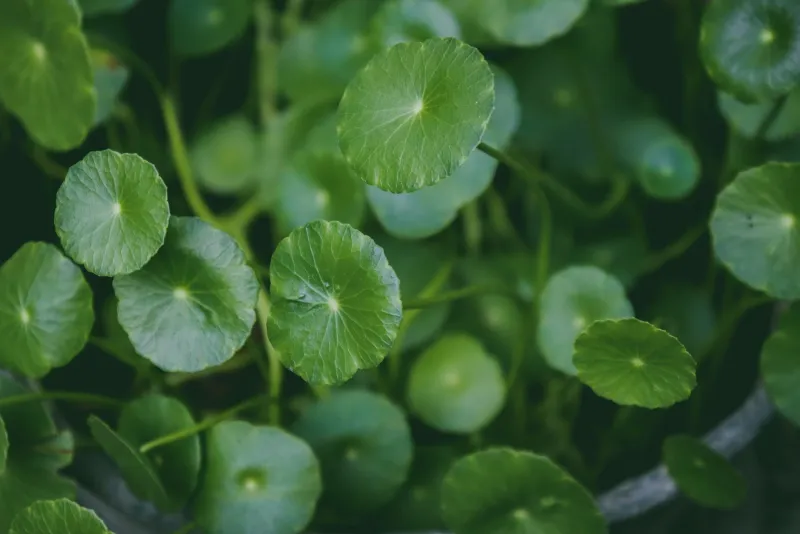
Gotu kola (Centella asiatica) is a small creeping plant native to tropical regions of Asia. In Ayurveda, it's called "brahmi" (not to be confused with Bacopa monnieri, which shares this name) and has been used for thousands of years to support memory and circulation. But what does modern science say?
Who this is for: Anyone who's heard about gotu kola as a nootropic or venous health remedy and wants to know whether the scientific evidence backs up those claims.
TL;DR
- Gotu kola's active compounds are triterpenoids (asiaticoside, madecassoside, asiatic acid, and madecassic acid)
- Venous insufficiency: Strongest evidence — the triterpenic fraction improves venous tone and reduces swelling (Cesarone et al., 2001)
- Cognitive function: Preliminary evidence — one small study showed improved memory and mood in elderly subjects (Wattanathorn et al., 2008)
- Wound healing: Traditional use is partially confirmed by science — stimulates collagen synthesis (Bylka et al., 2014)
- Typical dose: 500-1000 mg dried herb extract daily, or 60-120 mg standardised triterpenoids
- Side effects are rare, but long-term use (over 6 weeks) requires caution regarding liver function
- This is not coffee or a fast-acting energy booster — the effect is subtle and cumulative
What Does Gotu Kola Contain?
Gotu kola's main active compounds are pentacyclic triterpenoids:
- Asiaticoside and madecassoside — glycosides that influence collagen synthesis and venous tone
- Asiatic acid and madecassic acid — aglycones responsible for neurobiological effects
Quality gotu kola products are standardised for the content of these four compounds. Standardisation matters because plant extract potency varies depending on growing conditions, harvest timing, and processing methods.
Scientific Evidence: What We Know
1. Venous Insufficiency and Leg Swelling
This is gotu kola's best-studied application.
Cesarone et al. (2001) conducted a randomised controlled trial with 94 patients where TTFCA (total triterpenic fraction of Centella asiatica) at 60 mg twice daily:
- Significantly reduced ankle swelling compared to placebo
- Improved capillary filtration rate
- Effects appeared within 4-8 weeks
Incandela et al. (2001) confirmed these results in the context of air travel: TTFCA reduced leg swelling during long flights.
Practical takeaway: Gotu kola is one of the few herbal supplements with clinical evidence for venous problems.
2. Cognitive Function and Memory
Wattanathorn et al. (2008) studied gotu kola's effects in 28 healthy elderly people (65+):
- 750 mg gotu kola extract daily for 2 months
- Improvements in working memory and mood (self-reported)
- However: Very small sample, short duration, single study only
Animal studies show that asiatic acid promotes dendritic growth and synaptic plasticity in the hippocampus (Soumyanath et al., 2012). This is a biologically plausible mechanism, but human studies remain insufficient.
Honest assessment: Cognitive effects are possible but evidence is weak. This isn't in the same league as bacopa monnieri or caffeine for nootropic use.
3. Wound Healing and Skin Health
Bylka et al. (2014) reviewed in-vitro and animal studies, finding that gotu kola triterpenoids:
- Stimulate type I collagen synthesis
- Promote fibroblast proliferation
- Are used in dermatology in creams and ointments
This traditional use has the strongest mechanistic support, though most studies are in-vitro rather than clinical.
Dosing
| Form | Dose | Notes |
|---|---|---|
| Dried herb (capsule/powder) | 500-1000 mg daily | Unstandardised, variable |
| Standardised extract (triterpenoids) | 60-120 mg daily | Preferred, consistent effect |
| TTFCA (triterpenic fraction) | 60 mg twice daily | Used in clinical studies |
| Tea | 1-2 cups daily | Lowest concentration |
Timing: Can be taken with or without food. Some people experience mild headache on an empty stomach — in that case, take with a meal.
Cycling: Many herbalists recommend 6-week cycles followed by a 2-week break. This is a precautionary measure rather than a strict scientific requirement, but it's prudent given limited long-term data.
Gotu Kola vs Other Nootropics
| Feature | Gotu kola | Bacopa monnieri | Ashwagandha | Caffeine |
|---|---|---|---|---|
| Primary effect | Circulation, mild cognitive | Memory, learning | Stress, cortisol | Alertness, focus |
| Evidence strength | Moderate (circulation), weak (brain) | Strong (memory) | Strong (stress) | Very strong |
| Onset | 4-8 weeks | 6-12 weeks | 4-8 weeks | 15-30 min |
| Side effects | Rare, liver concern long-term | GI upset | Drowsiness | Anxiety, dependence |
| Best use | Venous insufficiency, mild cognitive support | Academic/learning | Stress management | Quick focus |
Side Effects and Precautions
- Hepatotoxicity: Isolated cases have been reported with long-term use (3+ months). This is why cyclic use is recommended (Jorge & Jorge, 2005)
- Drug interactions: May potentiate sedative medications. Consult your doctor if taking blood thinners
- Pregnancy: Do not use during pregnancy — teratogenic effects observed in animal studies at high doses
- Allergy: Rare but possible — especially in people allergic to plants in the Apiaceae family
Common Mistakes
- Expecting quick results — Gotu kola is not a stimulant. Effects are cumulative and appear over weeks.
- Using unstandardised products — Without triterpenoid content standardisation, you don't know what you're actually getting.
- Long-term use without breaks — To protect the liver, use cyclically (6 weeks on, 2 weeks off).
- Confusing gotu kola with kola nut — Gotu kola (Centella asiatica) and kola nut (Cola nitida, caffeine) are completely different plants. Gotu kola contains no caffeine.
Frequently Asked Questions
Does gotu kola contain caffeine?
No. Despite the name, gotu kola (Centella asiatica) is unrelated to the kola nut (Cola nitida). It contains no caffeine and is not a stimulant.
Can I take gotu kola every day?
Yes, but we recommend cyclic use — 6 weeks on, followed by a 2-week break — to protect the liver during long-term consumption.
Does gotu kola help with anxiety?
Preliminary evidence suggests mild anxiolytic properties, but it's not as well-studied as ashwagandha in the anxiety context. See our ashwagandha guide.
Is gotu kola useful for athletes?
It's not directly a sports supplement. However, improved circulation may support recovery and leg health in athletes who spend a lot of time on their feet.
When is the best time to take gotu kola?
There's no specific optimal time. Some prefer morning (mild cognitive effect), others evening (relaxing properties). Try both and see what works for you.
Estonia Angle
Gotu kola is available in Estonia primarily as capsules and powder from health stores and online shops. Prices range from 8-18 per month. Estonia's long winters and routine desk work make circulation support and mild cognitive enhancement relevant concerns.
If you're looking for more evidence-based nootropic support, also check out ashwagandha for stress and caffeine + L-theanine for focus.
Browse our vitamins and supplements selection
References
- Cesarone, M.R., Incandela, L., De Sanctis, M.T., Belcaro, G., Bavera, P., Bucci, M. & Ippolito, E. (2001). Evaluation of treatment of diabetic microangiopathy with total triterpenic fraction of Centella asiatica: a clinical prospective randomized trial with a microcirculatory model. Angiology, 52(Suppl 2), S49-S54.
- Incandela, L., Belcaro, G., Cesarone, M.R., De Sanctis, M.T., Nargi, E., Patricelli, P. & Bucci, M. (2001). Treatment of superficial vein thrombosis with TTFCA: Centella asiatica triterpenic fraction. Angiology, 52(Suppl 2), S69-S71.
- Wattanathorn, J., Mator, L., Muchimapura, S., Tongun, T., Pasuriwong, O., Piyawatkul, N., Yimtae, K., Sripanidkulchai, B. & Singkhoraard, J. (2008). Positive modulation of cognition and mood in the healthy elderly volunteer following the administration of Centella asiatica. Journal of Ethnopharmacology, 116(2), 325-332.
- Soumyanath, A., Zhong, Y.P., Gold, S.A., Yu, X., Koop, D.R., Bourdette, D. & Gold, B.G. (2012). Centella asiatica accelerates nerve regeneration upon oral administration and contains multiple active fractions increasing neurite elongation in-vitro. Journal of Pharmacy and Pharmacology, 57(9), 1221-1229.
- Bylka, W., Znajdek-Awizen, P., Studzinska-Sroka, E., Danczak-Pazdrowska, A. & Brzezinska, M. (2014). Centella asiatica in dermatology: an overview. Phytotherapy Research, 28(8), 1117-1124.
- Jorge, O.A. & Jorge, A.D. (2005). Hepatotoxicity associated with the ingestion of Centella asiatica. Revista Espanola de Enfermedades Digestivas, 97(2), 115-124.
See also:
- Maltodextrin and Blood Sugar: What to Know Before You Use It
- Lion's Mane Supplement: A Nootropic Mushroom for Brain Health
- Yam: Complete Guide 2026
Browse our vitamins and supplements at MaxFit.ee