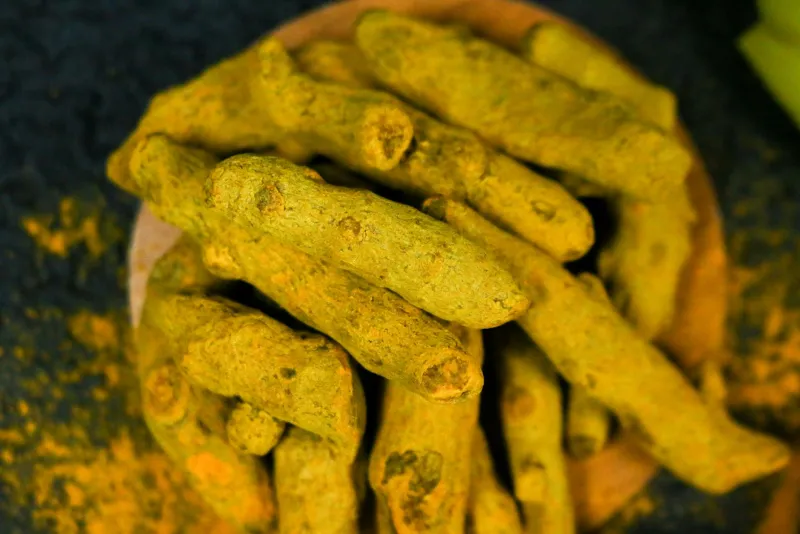
What to Stack with Curcumin: Synergies & Conflicts
Curcumin stacking is one of the most studied areas in supplement science — largely because curcumin itself has a well-documented absorption problem. The active compound in turmeric is poorly absorbed when taken alone, so intelligent stacking is not optional; it is central to getting any meaningful effect.
Evidence-Based Synergies
Piperine — the most validated partner
Piperine, the active alkaloid in black pepper, inhibits glucuronidation enzymes in the gut wall and liver, slowing curcumin's clearance. Research confirms that co-administration significantly raises plasma curcumin concentrations compared with curcumin taken alone (Shoba et al., 1998). This synergy is so well-established that many commercial curcumin products already include piperine in the formula. OstroVit Turmeric + Black pepper + Ginger 90tabs and MST Curcumin NovaSOL 60 liquid caps are available at maxfit.ee and cover this combination directly.
Fat or phospholipid co-ingestion
Curcumin is fat-soluble. Taking it with a meal containing healthy fats, or with a phospholipid-based delivery system (phytosome), improves lymphatic uptake. A randomised crossover study found that curcumin in a lipid matrix produced meaningfully higher plasma levels than standard curcumin powder (Gundermann et al., 2011). Omega-3 fish oil is a practical co-ingestion partner because it supplies fat and may complement curcumin's own anti-inflammatory signalling.
Resveratrol
Both curcumin and resveratrol modulate NF-kB signalling pathways. The combination has been studied for synergistic anti-inflammatory potential in cell models, though large human RCTs are limited. Mechanistically, the pairing makes sense for general anti-inflammatory stacks.
Boswellia
Boswellic acids (from frankincense) and curcumin act on overlapping but distinct inflammatory mediators — curcumin on COX-2 and NF-kB, boswellia primarily on 5-LOX. The combination is used in joint-health formulas and shows additive effects in osteoarthritis models (Haroyan et al., 2018).
Antagonistic Combinations
Iron supplements
Curcumin chelates iron. Regular high-dose curcumin supplementation alongside iron supplements may reduce iron absorption, which is particularly relevant for individuals at risk of iron deficiency. If you take both, separate them by at least two hours.
Blood-thinning medications
Curcumin has mild antiplatelet activity. Stacking with pharmaceutical anticoagulants or high-dose fish oil warrants medical supervision — not because the combination is universally dangerous, but because the interaction is pharmacologically plausible.
Antacids or proton pump inhibitors
Altered gastric pH can affect curcumin solubility. The evidence is indirect, but timing curcumin away from antacid use is a sensible precaution.
Timing Within a Stack
Take curcumin with your largest meal of the day — ideally one containing at least moderate dietary fat. If using a piperine-containing product, the piperine is already co-formulated, so no separate timing is needed. If taking iron separately, leave a two-hour gap before or after curcumin.
For workout-focused stacks, curcumin is generally taken post-workout to support recovery, but the timing evidence for this specific window is weak. Consistency matters more than precise timing.
Sample Stacks by Goal
| Goal | Core stack | Notes |
|---|---|---|
| General anti-inflammatory | Curcumin + piperine + omega-3 | Take with meals |
| Joint support | Curcumin + boswellia + collagen | Morning and evening |
| Active recovery | Curcumin + omega-3 + vitamin D | Post-workout meal |
| Cognitive/mood | Curcumin + resveratrol + B-vitamins | With breakfast |
What to Avoid
- Do not combine high-dose curcumin with iron supplements at the same time of day.
- Avoid stacking with blood thinners without medical guidance.
- Do not expect results without addressing absorption — plain curcumin powder without piperine or a lipid delivery system has very low bioavailability.
- Resist the temptation to stack too many anti-inflammatory supplements simultaneously; the additive benefit plateaus and monitoring interactions becomes harder.
FAQ
Does curcumin stacking require piperine?
Not strictly — lipid-based formulations and phytosomes can also raise bioavailability — but piperine is the most cost-effective and widely available absorption enhancer. If your product already contains black pepper extract, you are covered.
Can I take curcumin with vitamin C?
Yes. There is no known antagonism between curcumin and vitamin C. Some research even suggests complementary antioxidant activity, though the combination has not been rigorously studied as a primary outcome.
How long before I notice effects from curcumin stacking?
Most intervention studies run for four to eight weeks. Anti-inflammatory and joint-support effects tend to emerge gradually. Expect to evaluate results after consistent use for at least a month.
References
Shoba, G., Joy, D., Joseph, T., Majeed, M., Rajendran, R., & Srinivas, P. S. (1998). Influence of piperine on the pharmacokinetics of curcumin in animals and human volunteers. Planta Medica, 64(4), 353-356. https://pubmed.ncbi.nlm.nih.gov/9619120/
Gundermann, K. J., Kuenker, A., Kuntz, E., & Drozdzik, M. (2011). Activity of essential phospholipids (EPL) from soybean in liver diseases. Pharmacological Reports, 63(3), 643-659. https://pubmed.ncbi.nlm.nih.gov/21857075/
Haroyan, A., Mukuchyan, V., Mkrtchyan, N., Minasyan, N., Gasparyan, S., Sargsyan, A., Narimanyan, M., & Hovhannisyan, A. (2018). Efficacy and safety of curcumin and its combination with boswellic acid in osteoarthritis: a comparative, randomized, double-blind, placebo-controlled study. BMC Complementary and Alternative Medicine, 18(1), 7. https://pubmed.ncbi.nlm.nih.gov/29316908/



