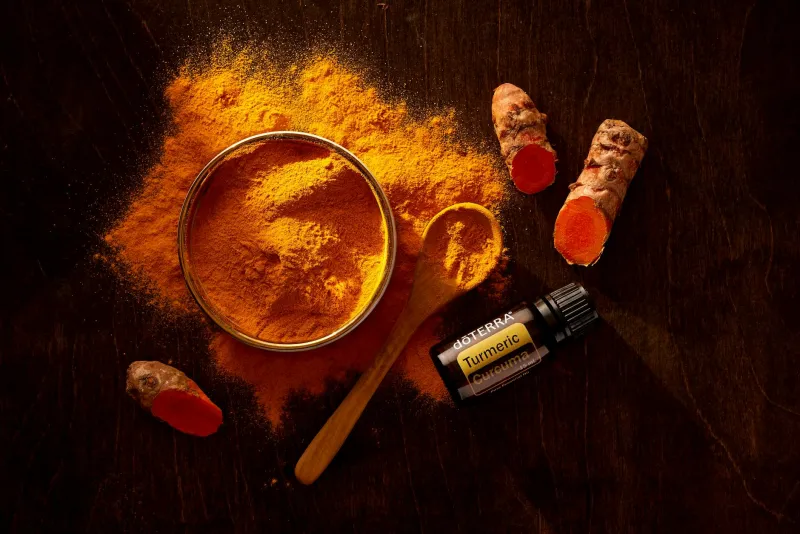
What Is Curcumin and Why Does It Matter?
Curcumin is a bioactive polyphenol that makes up roughly 3–5% of turmeric powder. Turmeric (Curcuma longa) has been used in Asian medicine for thousands of years, but curcumin is responsible for the majority of the health effects attributed to the plant.
Curcumin's greatest challenge is low bioavailability — it absorbs poorly, metabolises rapidly, and is excreted before clinically relevant concentrations reach the bloodstream. Modern curcumin formulations (NovaSOL, phospholipid complexes, piperine combinations) therefore offer substantially better bioavailability than plain turmeric capsules.
Primary Evidenced Benefits
Anti-inflammatory effect
Curcumin's most studied effect is inhibiting the NF-kB pathway — the body's primary inflammation regulator. Controlled trials have shown that curcumin reduces inflammatory markers, particularly IL-6, TNF-α, and CRP levels (Hewlings & Kalman, 2017). The effect has been well-reproduced across different study populations.
Joint health and arthritis symptoms
In knee osteoarthritis trials, curcumin has shown reductions in pain and stiffness comparable to ibuprofen in some studies (Kuptniratsaikul et al., 2009). This is one of curcumin's most clinically significant findings.
Secondary and Emerging Effects
Antioxidant protection
Curcumin directly neutralises free radicals and potentiates the body's own antioxidant enzymes (SOD, catalase, glutathione peroxidase). This makes it an effective defence against oxidative stress.
Brain function and BDNF
Laboratory studies suggest curcumin may increase BDNF (brain-derived neurotrophic factor) levels, which play a key role in neuroplasticity. Clinical evidence is more limited, but some trials suggest positive effects on memory and mood.
Metabolic health
Curcumin may support insulin sensitivity and reduce blood sugar fluctuations, but evidence remains limited.
Where Evidence Is Weak
- Cancer treatment: laboratory data are promising, but clinical trials are few and do not support curcumin as a cancer treatment
- Depression: some positive trials exist, but sample sizes are small
- Gastrointestinal complaints: evidence for IBS and Crohn's disease is limited and mixed
- Non-enhanced forms: plain turmeric capsules without bioavailability enhancement are ineffective at clinically meaningful doses
Who Gains Most
Curcumin is best suited for:
- People experiencing chronic inflammation (joint pain, arthritis)
- Athletes wanting to support joint health and training recovery
- Those seeking a natural alternative to anti-inflammatory medications (consult your doctor first)
- People exposed to high oxidative stress (high-intensity training, older adults)
Curcumin offers less benefit for:
- Quick relief of acute pain (it works more slowly than medications)
- Those whose digestive systems do not tolerate curcumin well
At maxfit.ee you can find OstroVit Turmeric + Black pepper + Ginger 90tabs (piperine for enhanced absorption) and MST Curcumin NovaSOL 60 liquid caps — the latter uses NovaSOL technology that substantially improves bioavailability.
Bioavailability Is the Key Issue
Plain turmeric powder has very low bioavailability. To achieve better absorption:
- Piperine (black pepper extract): combination with piperine substantially increases curcumin absorption (Shoba et al., 1998)
- NovaSOL / micellar curcumin: liquid nanomicellar form is better absorbed
- Phospholipid complexes (Meriva): bound to lecithin, improves absorption
- Take with fat: curcumin is fat-soluble — adding healthy fats to your meal helps
FAQ
How many mg of curcumin per day?
Most clinical trials use 500–1,500 mg per day of standardised curcumin extract. With plain turmeric powder, far larger quantities would be needed to achieve the same effect.
Is curcumin safe for long-term use?
Generally yes — curcumin is well-tolerated. At high doses (above 8 g per day) gastrointestinal side effects may occur. Those on anticoagulant medications should consult their doctor.
Does curcumin need to be taken with black pepper?
Piperine improves curcumin absorption. If you use the NovaSOL form, piperine is not necessary — bioavailability is already substantially improved through other mechanisms.
References
- Hewlings SJ, Kalman DS. (2017). Curcumin: a review of its effects on human health. Foods, 6(10), 92. https://pubmed.ncbi.nlm.nih.gov/29065496/
- Kuptniratsaikul V, Thanakhumtorn S, Chinswangwatanakul P, Wattanamongkonsil L, Thamlikitkul V. (2009). Efficacy and safety of Curcuma domestica extracts in patients with knee osteoarthritis. Journal of Alternative and Complementary Medicine, 15(8), 891-897. https://pubmed.ncbi.nlm.nih.gov/19678780/
- Shoba G, Joy D, Joseph T, Majeed M, Rajendran R, Srinivas PS. (1998). Influence of piperine on the pharmacokinetics of curcumin in animals and human volunteers. Planta Medica, 64(4), 353-356. https://pubmed.ncbi.nlm.nih.gov/9619120/



