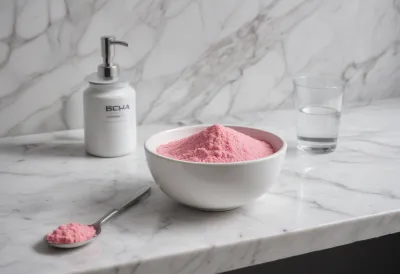
Is creatine actually worth it during menopause?
For a lot of women, yes — and the shift in medical attitude is real. Creatine used to be filed under "stuff bodybuilders take." Now it's one of the most-discussed supplements in women's health, because the same molecule that fuels short, hard muscular efforts also touches strength, possibly mood, and the muscle-and-bone questions that get sharper around menopause. The honest summary: creatine is among the most evidence-backed, well-tolerated supplements there is, the benefits in older adults and women are real, and it does not cause "bulk" or meaningful fat gain (Smith-Ryan et al., 2021).
Through menopause, what would help your strength most?
Browse the rangeLet's answer the questions a curious reader actually has next: what creatine does, why menopause changes the equation, what the science supports versus what's overhyped, and exactly how to take it.
What creatine even does
Creatine helps regenerate ATP, the body's rapid energy currency, during brief high-intensity efforts — think a hard set of squats, not a marathon. Roughly 3–5 g/day reliably raises intramuscular creatine and improves high-intensity performance (Kreider et al., 2017). That improved training quality is the indirect lever: better sets over months mean more muscle and strength preserved.
Here's the menopause-specific wrinkle: women have about 70–80% lower endogenous creatine stores than men, so there's arguably more headroom for supplementation to matter, particularly for strength, mood, and post-menopausal muscle and bone (Smith-Ryan et al., 2021).
Why menopause changes the equation
Falling estrogen accelerates muscle and bone loss and can affect sleep, mood and recovery. The front-line countermeasure isn't a pill — it's resistance training plus adequate protein, the defined treatment for age-related muscle decline (Cruz-Jentoft et al., 2019). Creatine is a force-multiplier on top of that. In older adults, adding creatine to resistance training produced roughly 1.4 kg more lean tissue mass and greater strength than training plus placebo (Chilibeck et al., 2017). Pair it with the training, not instead of it. See also Creatine for Older Adults: Preserving Muscle and Strength.
What the science supports — and what's overhyped
| Claim | Evidence status |
|---|---|
| More lean mass & strength with training | Supported in older adults (Chilibeck et al., 2017) |
| Better high-intensity performance | Strongly supported (Kreider et al., 2017) |
| Possible cognitive support under stress/sleep loss | Some support, modest (Avgerinos et al., 2018) |
| "Makes you bulky / gain fat" | Not supported — early weight is intracellular water (Smith-Ryan et al., 2021) |
| Cures menopause symptoms | Not a treatment claim — manage symptoms with your clinician |
Cognition is the trendiest claim. A review of randomized trials found creatine can improve short-term memory and reasoning, with effects most apparent under stress such as sleep deprivation or in older adults (Avgerinos et al., 2018). See also Creatine for the Brain: A 2026 Meta-Analysis Confirms Cognitive Benefits. Promising and plausible, but don't expect a personality transplant — the muscle and strength case is far stronger.
Is creatine safe during menopause?
This is the question that stops a lot of women, and the answer is reassuring. Creatine monohydrate is one of the most extensively studied supplements on the market, with a long safety record at standard doses in healthy and clinical populations (Kreider et al., 2017). The persistent fears — that it damages the kidneys, causes dehydration or cramping, or is somehow inappropriate for women — are not supported by the evidence; these myths have been examined and rejected in the research (Antonio et al., 2021). If you have existing kidney disease or another medical condition, check with your doctor first, as you would with any supplement. Otherwise, a sensible daily dose sits comfortably within established safety margins, and the women's-health literature specifically supports its use across the lifespan, including the peri- and post-menopausal years (Smith-Ryan et al., 2021). What it is not is a hormone or a menopause treatment — it won't replace estrogen or resolve symptoms, and it shouldn't be framed that way.
How to take it
- Dose: 3–5 g of creatine monohydrate daily. A loading phase (~20 g/day for 5–7 days) saturates stores faster but isn't required (Kreider et al., 2017).
- Form: Plain monohydrate. "Novel" forms aren't shown to be superior, so don't pay more (Antonio et al., 2021).
- Timing: Any time, consistently. Daily intake matters more than clock timing.
- Pick: Something simple like Scitec Creatine Monohydrate 300g (€25.90, at the time of writing), ICONFIT Creatine Monohydrate Unflavored 300g or OstroVit Creatine Monohydrate 500g (Lemon) — browse creatine or the full Creatine Guide 2026: What to Buy, How to Use, Should You Load?.
Protein still does the heavy lifting for muscle maintenance — aim near 1.6 g/kg/day (Morton et al., 2018); a powder like ICONFIT Whey Protein 80 Strawberry 1kg helps, see protein. Many women also add ICONFIT Joint Collagen Cherry 300g for joint and skin goals, though that's a separate aim — see the wider women's health range at maxfit.ee.
MaxFit, based in Estonia, stocks these so you can build a simple, evidence-led routine. The training and the consistency are still the main event.
References
Smith-Ryan, A. E., Cabre, H. E., Eckerson, J. M., & Candow, D. G. (2021). Creatine supplementation in women's health: a lifespan perspective. Nutrients, 13(3), 877. https://pubmed.ncbi.nlm.nih.gov/33800439/
Kreider, R. B., Kalman, D. S., Antonio, J., et al. (2017). International Society of Sports Nutrition position stand: safety and efficacy of creatine supplementation in exercise, sport, and medicine. Journal of the International Society of Sports Nutrition, 14, 18. https://pubmed.ncbi.nlm.nih.gov/28615996/
Chilibeck, P. D., Kaviani, M., Candow, D. G., & Zello, G. A. (2017). Effect of creatine supplementation during resistance training on lean tissue mass and muscular strength in older adults: a meta-analysis. Open Access Journal of Sports Medicine, 8, 213–226. https://pubmed.ncbi.nlm.nih.gov/29138605/
Avgerinos, K. I., Spyrou, N., Bougioukas, K. I., & Kapogiannis, D. (2018). Effects of creatine supplementation on cognitive function of healthy individuals: a systematic review of randomized controlled trials. Experimental Gerontology, 108, 166–173. https://pubmed.ncbi.nlm.nih.gov/29704637/
Antonio, J., Candow, D. G., Forbes, S. C., et al. (2021). Common questions and misconceptions about creatine supplementation: what does the scientific evidence really show? Journal of the International Society of Sports Nutrition, 18(1), 13. https://pubmed.ncbi.nlm.nih.gov/33557850/
FAQ
Will creatine make me gain weight or look bulky?
The scale may rise a little at first, but that early gain is intracellular water, not fat, and creatine does not cause bulk in women (Smith-Ryan et al., 2021; Antonio et al., 2021). Visible muscle change comes only from the training you do — and gradually.
Do I need a loading phase?
No. A loading phase of about 20 g/day for 5–7 days saturates muscle creatine faster, but a steady 3–5 g/day reaches the same place within a few weeks with less stomach upset (Kreider et al., 2017).
Can creatine help with menopause brain fog?
There's modest, promising evidence that creatine supports short-term memory and reasoning, especially under stress or sleep loss (Avgerinos et al., 2018). It's not a treatment for any condition; treat symptoms with your clinician and view any cognitive effect as a bonus to the muscle benefit.