
The Link Between Sleep and Muscle Growth
Sleep is an athlete's secret weapon. During sleep, the most intense recovery processes occur — growth hormone is released, protein synthesis takes place, and muscle tissue repairs itself. But for these processes to work optimally, the body needs a steady supply of amino acids. This is where casein before bed comes in.
Why Is Casein Ideal for Night-Time Use?
Casein is a slowly digested milk protein that forms a gel-like clot in the stomach. This dramatically slows the release of amino acids into the bloodstream — a process that lasts 5–7 hours (Boirie et al., 1997). Compared to the rapid absorption of whey protein (30–60 minutes), casein is designed to nourish the body over the long term.
During overnight sleep, the body is in a fasted state for 7–9 hours. Without casein (or another protein source) before bed, the body enters a catabolic state — muscle tissue begins to break down for energy. Casein keeps the body in an anabolic state throughout the night.
What Does the Science Say?
One of the most influential studies in this field is the randomised controlled trial by Res et al. (2012). Athletes were given 40 g of casein 30 minutes before bed following intense resistance training. Result: protein synthesis was significantly higher overnight in the casein group compared to the placebo group.
A similar finding was published by Snijders et al. (2015): the study observed significantly greater muscle mass and strength gains with night-time casein supplementation over a 12-week training period.
A meta-analysis (Trommelen & van Loon, 2016) concluded that night-time protein consumption — especially as casein — is an effective strategy for building muscle mass and optimising recovery.
Best Casein Products
Maxfit.ee offers a wide range of casein products, the most popular being:
Optimum Nutrition Gold Standard 100% Casein 1820g Strawberry — one of the world's most famous casein formulas, with 24 g of casein per serving and great taste.
Scitec 100% Casein Complex 920g Belgian Chocolate — popular in Estonia, contains micellar casein for slow absorption.
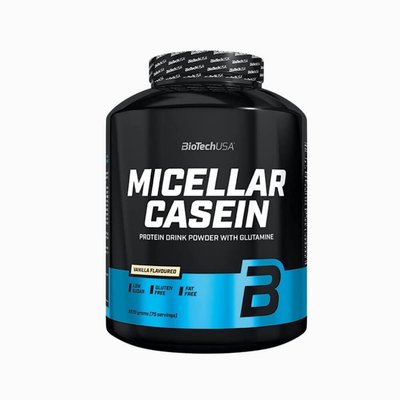 BIOTECHUSA Micellar Casein 2270g Vanilla€68.90 In stock — a large pack for economy-minded users, contains pure micellar casein.
MyProtein Impact Casein 2.5 kg Chocolate — one of the most price-effective casein options available.
Browse the full casein protein range at maxfit.ee.
How Much Casein Before Bed?
The most studied and optimal dose is 40 g of casein 30–60 minutes before bed. This dose is sufficient to maximise muscle protein synthesis during sleep.
Some athletes use 20–30 g, which is still beneficial, but studies show that 40 g delivers better results (Res et al., 2012).
Dosing Table:
| Goal | Casein dose | Time before bed |
|---|---|---|
| Muscle growth | 40 g | 30–60 min |
| Muscle mass maintenance | 20–30 g | 30–60 min |
| Recovery | 40 g | 30–60 min |
| Weight control | 20–30 g | 30–60 min |
Does Casein Add Too Many Calories?
This is a common concern. Casein provides approximately 150–180 kcal per serving (depending on quantity). If you're in a caloric deficit, factor this into your daily plan. If muscle growth is the goal, these calories are well invested.
For weight management, an alternative is cottage cheese — a natural casein source that is often less expensive.
Can Casein and Whey Be Combined?
Yes, and many athletes use both:
- Morning and post-workout: whey protein (fast absorption)
- Before bed: casein (slow absorption)
This is the ideal combination to support maximum muscle growth throughout the day.
Summary
Casein before bed is a scientifically proven strategy for building muscle mass and reducing overnight catabolism. 40 g of casein 30–60 minutes before bed is the optimal dose for most athletes. Find the best casein at maxfit.ee.
FAQ
Does casein make you fat during sleep?
No, casein itself does not cause fat gain. It is simply a slowly digested protein source. It adds ~150–180 kcal per serving — factor this into your daily calorie intake. Studies show that night-time casein supplementation supports muscle growth rather than fat accumulation.
Is casein suitable for lactose intolerance?
Casein contains lactose and may not suit those with lactose intolerance. Micellar casein (e.g. Optimum Nutrition Gold Standard) contains minimal lactose and may be tolerable for mild intolerance. For more severe intolerance, we recommend testing with a small amount first.
Is casein necessary if I eat before bed?
If you consume a complete, protein-rich meal before bed (e.g. chicken, fish, eggs), a casein supplement may not provide significant additional benefit. Casein is most useful when the last meal was more than 4 hours before sleep.
References
- Boirie, Y., Dangin, M., Gachon, P., Vasson, M. P., Maubois, J. L., & Beaufrère, B. (1997). Slow and fast dietary proteins differently modulate postprandial protein accretion. Proceedings of the National Academy of Sciences, 94(26), 14930–14935.
- Res, P. T., Groen, B., Pennings, B., Beelen, M., Wallis, G. A., Gijsen, A. P., & Van Loon, L. J. (2012). Protein ingestion before sleep improves postexercise overnight recovery. Medicine & Science in Sports & Exercise, 44(8), 1560–1569.
- Snijders, T., Res, P. T., Smeets, J. S., van Vliet, S., van Kranenburg, J., Maase, K., & Van Loon, L. J. (2015). Protein ingestion before sleep increases muscle mass and strength gains during prolonged resistance-type exercise training in healthy young men. Journal of Nutrition, 145(6), 1178–1184.
- Trommelen, J., & van Loon, L. J. (2016). Pre-sleep protein ingestion to improve the skeletal muscle adaptive response to exercise training. Nutrients, 8(12), 763.
- Phillips, S. M., & Van Loon, L. J. C. (2011). Dietary protein for athletes: From requirements to optimum adaptation. Journal of Sports Sciences, 29(S1), S29–S38.