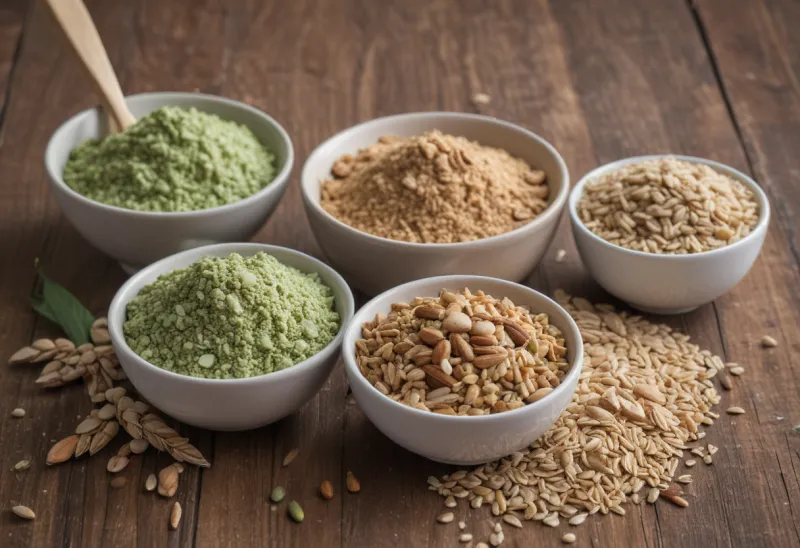
What actually makes a vegan protein powder good for athletes?
The honest answer: not all plant proteins are created equal — and a single-source powder (pure pea, pure rice) has some real disadvantages compared with whey. Plant proteins individually tend to have lower digestibility and less leucine per gram, the amino acid most critical for triggering muscle protein synthesis. Pea protein, for example, scores well for many aminos but is modest in methionine; rice protein is the reverse. Neither alone hits the amino acid profile of whey.
But the picture changes significantly with a blend. Combining pea and rice (or adding soy) creates a complementary amino acid profile that mimics whole-animal protein much more closely. A higher per-serving dose — typically 30–40 g rather than the 20–25 g often sufficient with whey — and optionally added leucine close most of the remaining gap. The science backs this up: at matched protein intakes and training loads, vegan and omnivore athletes gain the same amount of lean mass (Hevia-Larraín et al., 2021).
Which plant protein will you add to your training stack?
Browse the rangeProtein quality: what DIAAS actually means
For decades, protein quality was rated with the PDCAAS score. It has been replaced by the Digestible Indispensable Amino Acid Score (DIAAS), which better reflects how much of each essential amino acid your body can actually absorb. Dairy and animal proteins score highest; many individual plant sources score lower, largely because of lower digestibility and amino acid imbalances (Rutherfurd et al., 2015).
The practical implication: a vegan powder with a DIAAS near 1.0 (usually a blend with added leucine or isoleucine) is nutritionally close to whey. A cheap single-source pea powder with DIAAS around 0.6–0.7 is not. When choosing a product, look for a blend and, ideally, a disclosed amino acid profile on the label.
The leucine threshold and why it matters
Muscle protein synthesis (MPS) has a leucine threshold — roughly 2–3 g of leucine per serving is needed to maximally trigger MPS. Whey delivers this easily; a 25 g serving of whey concentrate typically contains 2.5–3 g leucine. Pure pea or rice protein often needs 35–40 g of powder to reach the same leucine dose.
This is why dosing matters for plant proteins. If you are using a vegan powder, aim for 30–40 g per serving (or a product with added free-form leucine), rather than matching the serving size on a whey label.
A 12-week randomised trial found that pea protein supplementation produced biceps thickness gains equivalent to whey — showing that a well-dosed plant protein can genuinely match the anabolic response of dairy (Babault et al., 2015).
Pea vs rice vs soy vs blend: an honest comparison
| Source | Leucine | Digestibility | Limiting AA | Best use |
|---|---|---|---|---|
| Pea | Moderate | Good | Methionine | Blend ingredient or standalone at ~35 g |
| Rice | Moderate | Moderate | Lysine | Best combined with pea |
| Soy | High | Good | — | Closest single-source to whey; allergen |
| Blend (pea+rice) | Higher | Good–Very good | None major | Closest to whey at matched dose |
Soy is genuinely the strongest single-source plant protein — its DIAAS is the highest among common plant proteins and it is a complete protein. If soy allergy is not a concern, it is a legitimate alternative. Pea+rice blends are the go-to for soy-free athletes.
Critical review: do plant proteins build as much muscle as whey?
The most thorough recent evidence: Berrazaga et al. (2019) reviewed the anabolic properties of plant versus animal proteins and concluded that individual plant sources are less anabolic than animal proteins at matched doses — but the deficit is largely explained by lower leucine content and digestibility. Blends, higher doses, and added leucine reverse most of the gap.
Hevia-Larraín et al. (2021) put this directly to the test: young men eating 1.6 g/kg/day from either a high-protein plant-based diet or a matched omnivorous diet — combined with 12 weeks of resistance training — gained identical leg lean mass. Vegan diets can support athletic muscle building, but protein quantity and quality both have to be managed deliberately.
What to look for when buying
1. Blend over single-source. Pea+rice (or soy if tolerated) beats pure pea or pure rice every time.
2. Serving size of 30–40 g. Adequate leucine delivery is the goal — do not underdose.
3. Disclosed amino acid profile. Products that show the full EAA breakdown let you verify leucine content.
4. Minimal fillers. Many vegan powders bulk up with maltodextrin or gums; a shorter ingredient list is usually better.
On the Estonian market, BioTechUSA Vegan Protein 500g Forest Berries is a pea-and-rice blend with a clean label that hits these criteria well. OstroVit Vegan Meal Shake 1000g Strawberry is a meal-replacement-style option that provides a broader macro profile alongside plant protein. Both are available in the plant protein for vegans category at maxfit.ee.
For athletes who also want to support strength output, adding a creatine monohydrate product from the creatine range is one of the most evidence-backed pairings regardless of whether your protein is plant or animal.
Practical daily targets
- Protein: 1.6–2.2 g/kg/day for hard-training athletes; aim toward the higher end if relying solely on plant sources
- Per-meal dose: 30–40 g of vegan protein powder to clear the leucine threshold
- Spread across 3–4 meals: distribution supports synthesis better than one large bolus
- Complement with whole foods: lentils, edamame, tofu, tempeh all contribute high-quality plant protein and close amino acid gaps
If you are meeting your overall protein targets via a high-quality protein blend, the gap between vegan and omnivore outcomes in the gym essentially closes.
References
Babault, N., Païzis, C., Deley, G., et al. (2015). Pea proteins oral supplementation promotes muscle thickness gains during resistance training: a double-blind, randomized, placebo-controlled clinical trial vs. whey protein. Journal of the International Society of Sports Nutrition, 12(1), 3. https://pubmed.ncbi.nlm.nih.gov/25628520/
Berrazaga, I., Micard, V., Gueugneau, M., & Walrand, S. (2019). The role of the anabolic properties of plant- versus animal-based protein sources in supporting muscle mass maintenance: a critical review. Nutrients, 11(8), 1825. https://pubmed.ncbi.nlm.nih.gov/31394788/
Rutherfurd, S. M., Fanning, A. C., Miller, B. J., & Moughan, P. J. (2015). Protein digestibility-corrected amino acid scores and digestible indispensable amino acid scores differentially describe protein quality in growing male rats. Journal of Nutrition, 145(2), 372–379. https://pubmed.ncbi.nlm.nih.gov/25644361/
Hevia-Larraín, V., Gualano, B., Longobardi, I., et al. (2021). High-Protein Plant-Based Diet Versus a Protein-Matched Omnivorous Diet to Support Resistance Training Adaptations. Sports Medicine, 51(6), 1317–1330. https://pubmed.ncbi.nlm.nih.gov/33599941/
FAQ
Can vegan protein powder build muscle as effectively as whey?
At matched protein intakes (around 1.6 g/kg/day) with resistance training, vegan and omnivore athletes gain the same lean mass. The key is using a blend, dosing 30–40 g per serving, and hitting your daily target consistently.
What is the best vegan protein blend?
Pea+rice is the most popular soy-free blend and the one with the most head-to-head research against whey. Soy alone is also a complete, high-DIAAS option if tolerated.
How much vegan protein powder should I take per serving?
Aim for 30–40 g per serving to ensure you clear the leucine threshold (~2–3 g leucine) that maximally triggers muscle protein synthesis — higher than the typical whey serving size.