
Ashwagandha for Weight Management: Does It Work?
Ashwagandha (Withania somnifera) is an adaptogenic herb with a long history in Ayurvedic practice and a growing body of modern clinical research. In recent years, it has attracted attention as a potential aid for weight management — primarily through its effects on cortisol and stress physiology. Before investing in a supplement, it is worth examining what the evidence actually shows about ashwagandha weight management, including honest effect sizes and the limits of current knowledge.
Proposed Mechanism: The Cortisol Connection
The most coherent pathway linking ashwagandha to body weight runs through the stress hormone cortisol:
- Sustained high cortisol is associated with increased visceral fat accumulation, elevated appetite (particularly for calorie-dense foods), and impaired insulin sensitivity.
- Ashwagandha's withanolide compounds have demonstrated HPA axis modulating properties in human trials, with several RCTs showing reductions in perceived stress and salivary cortisol (Chandrasekhar et al., 2012).
- If cortisol is meaningfully reduced, the downstream metabolic effects might theoretically include some shift in fat storage patterns and appetite regulation.
A secondary mechanism involves thyroid function: some preliminary data suggests ashwagandha may support T3 and T4 levels in subclinical hypothyroid populations, which could modestly influence metabolic rate. However, this effect has not been robustly demonstrated in euthyroid (normal thyroid function) individuals.
Honest Look at the Evidence
Direct trials of ashwagandha for body weight and composition have produced mixed results. A double-blind, randomised, placebo-controlled study in chronically stressed adults found that participants taking 300 mg of a standardised ashwagandha root extract twice daily for 8 weeks showed modest reductions in body weight and body mass index compared to placebo (Choudhary et al., 2017). The authors attributed this partly to reduced food cravings associated with lower perceived stress.
However, several important caveats apply:
- The population in these studies is specifically chronically stressed adults — the mechanism is most plausible when stress and stress-eating are genuine contributors to weight.
- Effect sizes in body weight trials are modest. The changes observed — typically 1–2 kg difference from placebo over 8–12 weeks — are within the range where confounders and reporting variation could easily account for the result.
- No robust long-term trials (beyond 12–16 weeks) have been conducted on ashwagandha for weight management.
Products available at maxfit.ee include ICONFIT Capsules Ashwagandha N90, OstroVit KSM-66 Ashwagandha VEGE 120caps, and 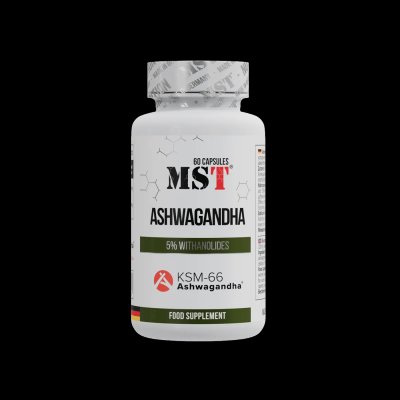 MST Ashwagandha KSM66€16.90 In stock 60caps. The KSM-66 extract is the most extensively studied ashwagandha formulation in clinical trials and is the reference extract for most of the weight-related research. Also available is BIOTECHUSA Ashwagandha 60 caps. Browse the ashwagandha category at maxfit.ee.
Realistic Expectations
Ashwagandha is not a weight-loss supplement in any conventional sense. It will not accelerate fat oxidation, suppress appetite acutely, or produce the energy expenditure effects of stimulant-based fat burners. The realistic expectation for ashwagandha in a weight management context is:
- Possible modest reduction in stress-induced food cravings if you are genuinely chronically stressed, based on limited but real RCT data.
- Potential support for sleep quality, and better sleep is independently associated with healthier appetite hormone profiles (leptin/ghrelin balance). Ashwagandha has a reasonably good evidence base for sleep improvement (Langade et al., 2019).
- No direct fat-burning or metabolism-boosting effect that has been demonstrated in well-controlled, adequately powered trials.
Better Levers for Weight Management
If body composition is the goal, the evidence hierarchy is clear:
- Dietary protein adequacy: Higher protein intake supports satiety and muscle retention during weight loss — the most robustly supported dietary lever.
- Progressive resistance training: Maintains muscle mass and resting metabolic rate.
- Sleep quality: Inadequate sleep elevates ghrelin (hunger hormone) and reduces leptin (satiety signal). Improving sleep hygiene has a direct impact on energy balance.
- Stress management: Whether through exercise, mindfulness, social support, or therapy — reducing chronic stress reduces cortisol-mediated appetite drive.
Ashwagandha may fit modestly into point 4, particularly for individuals whose weight management is genuinely complicated by chronic psychological stress. As a standalone weight loss tool, it is overstated.
FAQ
Does ashwagandha directly burn fat?
No. There is no meaningful evidence that ashwagandha increases lipolysis, fat oxidation, or thermogenesis in humans. Any body composition effects observed in trials are likely mediated through stress, sleep, and appetite pathways rather than direct metabolic effects.
Who is most likely to see weight-related benefits from ashwagandha?
Adults who are chronically stressed, who engage in emotional or stress-driven eating, and who have poor sleep driven partly by stress are the most plausible beneficiaries. Ashwagandha's primary documented benefits — stress reduction and sleep quality improvement — address root causes that can complicate weight management.
What dose of ashwagandha is used in weight-related studies?
Most clinical trials studying stress, cortisol, and body composition have used 300–600 mg/day of a standardised root extract (often KSM-66 or Sensoril). Doses outside this range have less direct trial support for these specific endpoints.
References
Chandrasekhar, K., Kapoor, J., & Anishetty, S. (2012). A prospective, randomized double-blind, placebo-controlled study of safety and efficacy of a high-concentration full-spectrum extract of Ashwagandha root in reducing stress and anxiety in adults. Indian Journal of Psychological Medicine, 34(3), 255-262. https://pubmed.ncbi.nlm.nih.gov/23439798/
Choudhary, D., Bhattacharyya, S., & Joshi, K. (2017). Body weight management in adults under chronic stress through treatment with Ashwagandha root extract. Journal of Evidence-Based Integrative Medicine, 22(1), 96-106. https://pubmed.ncbi.nlm.nih.gov/27055824/
Langade, D., Kanchi, S., Salve, J., Debnath, K., & Ambegaokar, D. (2019). Efficacy and safety of Ashwagandha (Withania somnifera) root extract in insomnia and anxiety: a double-blind, randomized, placebo-controlled study. Cureus, 11(9), e5797. https://pubmed.ncbi.nlm.nih.gov/31728244/



