
What Is Ashwagandha and How Does It Relate to Energy?
Ashwagandha (Withania somnifera) is an adaptogenic herb with a long history in Ayurvedic medicine. The term adaptogen refers to a plant that may help the body adapt to stress — by moderating the physiological stress response rather than suppressing it or artificially stimulating the nervous system.
The link between ashwagandha and energy is indirect but mechanistically coherent. Chronic stress elevates cortisol — the body's primary stress hormone — which, when persistently elevated, contributes to fatigue, disrupted sleep, reduced motivation, and impaired recovery. Ashwagandha's active compounds, primarily withanolides, appear to modulate the hypothalamic-pituitary-adrenal (HPA) axis, blunting excessive cortisol responses (Chandrasekhar et al., 2012).
This is why ashwagandha's energy effects are most credible in people whose fatigue is linked to stress and elevated cortisol — not in people who simply want more stimulation.
Role in Energy Metabolism
Ashwagandha does not provide direct energy like caffeine or carbohydrates. Instead, it may reduce the physiological cost of stress, freeing up energetic and psychological resources. In one double-blind, randomised placebo-controlled study involving chronically stressed adults, those receiving a standardised ashwagandha extract reported significantly lower perceived stress and fatigue scores compared with placebo after 60 days (Chandrasekhar et al., 2012).
Additionally, some research has explored ashwagandha's effects on physical endurance. A study in healthy male athletes found improvements in cardiorespiratory endurance markers (VO2 max) after supplementation with KSM-66 ashwagandha extract for 8 weeks compared with placebo (Choudhary et al., 2015). This suggests a secondary benefit for exercise capacity, though this should not be overstated.
Evidence in Fatigue
The most consistent signal in the literature is for stress-related fatigue. Ashwagandha's effect on general fatigue unrelated to stress or overtraining is less clear.
A systematic review concluded that there is evidence supporting ashwagandha's role in reducing fatigue, improving energy levels, and enhancing quality of life in adults experiencing stress — with effects apparent from four to eight weeks of use (Pratte et al., 2014). The effect sizes in these trials are meaningful but not large — ashwagandha is not a stimulant.
Who Is Likely to Respond?
The evidence most consistently supports ashwagandha for:
- Stressed adults with elevated perceived stress and associated fatigue.
- Athletes in heavy training blocks experiencing overreaching or accumulated fatigue.
- Those with mild sleep disruption, since poor sleep amplifies fatigue, and ashwagandha may support sleep quality.
Those unlikely to see a pronounced effect include people who are well-rested, low-stress, and simply seeking stimulation — ashwagandha is not a stimulant and will not replace the energising effect of caffeine.
Dose
The most studied and widely used standardised extract is KSM-66, which is derived from root only. Products vary in the amount of withanolide standardisation — follow the serving size stated on the specific product you choose, as concentration differs between brands.
Consistent daily use over at least four weeks is required before effects should be expected.
At maxfit.ee, the asvagandha category includes ICONFIT Capsules Ashwagandha N90, OstroVit KSM-66 Ashwagandha VEGE 120caps, 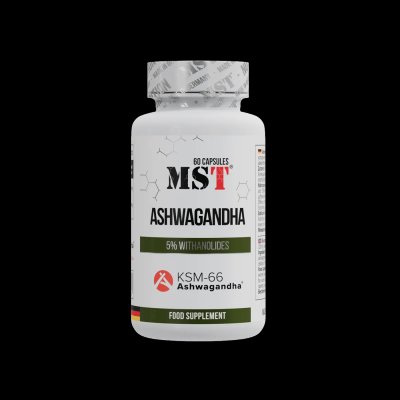 MST Ashwagandha KSM66€16.90 In stock 60caps, and BIOTECHUSA Ashwagandha 60 caps.
Realistic Expectations
Ashwagandha is not a dramatic energy booster. If you are well-rested, well-nourished, and managing stress adequately, you may notice little to no effect. If your fatigue is genuinely linked to chronic stress, heavy training, or disrupted sleep, an eight-to-twelve-week regimen may support a gradual, noticeable improvement in perceived energy and wellbeing.
Do not expect the same acute effect as caffeine. Do not expect results within a few days. Do expect that consistent daily use is required for any benefit to become apparent.
FAQ
Does ashwagandha give you energy like caffeine?
No. Ashwagandha is an adaptogen, not a stimulant. Its effect on energy is indirect — by reducing stress-related cortisol and supporting sleep quality, it may help people feel less fatigued over time. It does not provide the immediate alert feeling associated with caffeine.
How long should I take ashwagandha?
Most clinical trials showing effects ran for eight to twelve weeks. This is a reasonable minimum timeframe. Some people choose to cycle ashwagandha (for example, twelve weeks on, four weeks off), though the evidence on cycling is limited.
Can ashwagandha be taken with other supplements?
Yes. Ashwagandha is generally compatible with most sports supplements. Some people combine it with magnesium for sleep support, or with adaptogens like maca. There is no commonly documented adverse interaction with standard sports nutrition supplements.
References
Chandrasekhar, K., Kapoor, J., & Anishetty, S. (2012). A prospective, randomized double-blind, placebo-controlled study of safety and efficacy of a high-concentration full-spectrum extract of Ashwagandha root in reducing stress and anxiety in adults. Indian Journal of Psychological Medicine, 34(3), 255-262. https://pubmed.ncbi.nlm.nih.gov/23439798/
Choudhary, B., Shetty, A., & Langade, D. G. (2015). Efficacy of Ashwagandha (Withania somnifera [L.] Dunal) in improving cardiorespiratory endurance in healthy athletic adults. Ayu, 36(1), 63-68. https://pubmed.ncbi.nlm.nih.gov/26730141/
Pratte, M. A., Nanavati, K. B., Young, V., & Morley, C. P. (2014). An alternative treatment for anxiety: a systematic review of human trial results reported for the Ayurvedic herb ashwagandha (Withania somnifera). Journal of Alternative and Complementary Medicine, 20(12), 901-908. https://pubmed.ncbi.nlm.nih.gov/25405876/



