
Ashwagandha Benefits: Evidence-Backed Effects
Ashwagandha (Withania somnifera) is one of the most studied adaptogenic herbs in sports nutrition. It has been used in Ayurvedic practice for centuries, but modern clinical trials have now tested several specific ashwagandha benefits in controlled settings. This guide separates well-evidenced effects from areas where the science is still immature.
Primary Evidenced Benefits
Stress and Cortisol Reduction
The most consistent finding across randomised controlled trials is ashwagandha's ability to reduce perceived stress and lower serum cortisol. Chandrasekhar et al. (2012) conducted a double-blind, placebo-controlled RCT in adults with chronic stress and found that those taking a root extract experienced significantly lower stress scores and cortisol levels compared to placebo. This is the most robustly replicated finding for this herb.
Muscle Strength and Recovery
A secondary but meaningful benefit is support for resistance training outcomes. Wankhede et al. (2015) ran an eight-week RCT in healthy young men performing resistance exercise and found that those supplementing with ashwagandha root extract showed significantly greater gains in muscle strength on bench press and leg extension, along with greater reductions in exercise-induced muscle damage markers. The mechanism is thought to involve anabolic hormone support and reduced catabolic stress signalling.
Testosterone and Male Reproductive Health
Several trials have measured effects on testosterone. Ambiye et al. (2013) found that ashwagandha root extract supplementation in men with oligospermia was associated with improved serum testosterone and sperm quality metrics. The testosterone-supporting effect appears most pronounced in stressed or reproductively challenged populations; effects in healthy men are less consistent.
Secondary and Emerging Effects
- Aerobic capacity: Some RCTs suggest modest improvements in maximal oxygen uptake with ashwagandha supplementation, though effect sizes are small and studies have been conducted in mixed populations.
- Sleep quality: Reported in several trials as an ancillary outcome. Improved sleep may partly explain other benefits via recovery pathways.
- Anxiety: Overlaps with the stress-reduction finding; anxiety sub-scores typically fall alongside general perceived stress.
Where Evidence Is Weak
Several claims circulating online about ashwagandha lack adequate trial support:
- Thyroid effects: A small number of case reports and very small trials suggest possible thyroid hormone changes, but no large, well-controlled RCT has confirmed clinically meaningful effects. Individuals with thyroid conditions should consult a doctor before use.
- Direct fat-loss effects: Not supported by evidence in healthy adults beyond the indirect effect of stress reduction.
- Nootropic / cognitive enhancement: Preliminary but not replicated with the rigour seen in the stress-cortisol literature.
Who Gains Most from Ashwagandha
Based on current evidence, ashwagandha benefits are most pronounced in:
- Adults under chronic psychological or physiological stress
- Athletes in high-volume training phases with elevated cortisol
- Men with below-average testosterone or reproductive concerns
- Those prioritising sleep quality and recovery
Healthy, low-stress individuals with normal hormone levels are less likely to see dramatic effects — managing expectations is important.
Realistic Expectations
Ashwagandha is not a shortcut to elite performance. The Wankhede et al. (2015) RCT, for example, showed meaningful but modest strength gains over eight weeks that built on a structured resistance training programme. The herb works best as a supportive layer on top of sound training, nutrition, and sleep habits.
At maxfit.ee you will find several well-sourced options in the asvagandha category. Popular choices include OstroVit KSM-66 Ashwagandha VEGE 120caps — which uses the KSM-66 standardised root extract studied in multiple trials — and ICONFIT Capsules Ashwagandha N90 for a convenient daily capsule format. 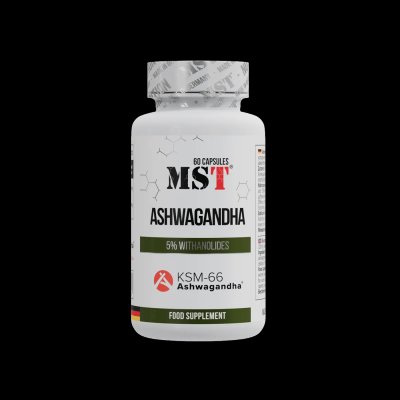 MST Ashwagandha KSM66€16.90 In stock 60caps is a compact option for those starting out.
FAQ
How long does ashwagandha take to work?
Most clinical trials showing stress and cortisol benefits lasted eight weeks. Noticeable effects on perceived stress often appear within four weeks, but the full benefit on strength and hormonal markers typically takes eight weeks or more of consistent use.
Is KSM-66 better than other ashwagandha extracts?
KSM-66 is a well-standardised root extract that has been used in several of the published RCTs. It is one of the more research-backed forms, which is why it appears frequently in premium supplements. Other standardised extracts (e.g. Sensoril, which uses root and leaf) also have clinical data, but KSM-66 has the broadest trial base.
Can women take ashwagandha?
Yes. While most testosterone-related trials enrolled men, the stress-cortisol and sleep benefits have been observed in mixed-sex and female-only cohorts as well. Pregnant women should avoid ashwagandha pending more safety data.
References
Chandrasekhar, K., Kapoor, J., & Anishetty, S. (2012). A prospective, randomized double-blind, placebo-controlled study of safety and efficacy of a high-concentration full-spectrum extract of Ashwagandha root in reducing stress and anxiety in adults. Indian Journal of Psychological Medicine, 34(3), 255–262. https://pubmed.ncbi.nlm.nih.gov/23439798/
Wankhede, S., Langade, D., Joshi, K., Sinha, S. R., & Bhattacharyya, S. (2015). Examining the effect of Withania somnifera supplementation on muscle strength and recovery: a randomized controlled trial. Journal of the International Society of Sports Nutrition, 12(1), 43. https://pubmed.ncbi.nlm.nih.gov/26609282/
Ambiye, V. R., Langade, D., Dongre, S., Aptikar, P., Kulkarni, M., & Dongre, A. (2013). Clinical evaluation of the spermatogenic activity of the root extract of Ashwagandha (Withania somnifera) in oligospermic males. Evidence-Based Complementary and Alternative Medicine, 2013, 571420.



