
What Limits Ashwagandha Absorption
Ashwagandha (Withania somnifera) contains a family of steroidal lactones called withanolides, along with alkaloids and saponins, that are responsible for its adaptogenic and stress-modulating effects. Understanding what limits the absorption of these compounds points directly to how to improve it.
Lipid solubility. Withanolides have a degree of lipid solubility, meaning they are better extracted and absorbed in the presence of dietary fat. Taking an extract-based ashwagandha capsule without any fat in the stomach is a mild limitation on bioavailability.
First-pass metabolism. Like many plant compounds, withanolides undergo some degree of first-pass metabolism in the liver before entering systemic circulation. This means the dose you take is reduced somewhat before its active components reach their target tissues.
Standardisation variation. The potency of ashwagandha products varies enormously depending on which part of the plant is used (root vs leaf vs whole plant), how it is extracted, and whether it is standardised to a defined withanolide percentage. A product with no standardisation may deliver highly variable amounts of active compounds between batches.
Cofactors That Help
Several approaches can support better utilisation of ashwagandha:
Black pepper extract (piperine). Piperine, the active compound in black pepper, is well established as a bioavailability enhancer for a range of phytochemicals. It inhibits certain intestinal and hepatic enzymes involved in first-pass metabolism, allowing more of the active compound to reach circulation. Shoba et al. (1998) demonstrated in a randomised study that piperine co-administration significantly enhanced the absorption of curcumin — a similarly lipophilic plant compound — and the same mechanism is expected to apply to ashwagandha compounds.
Dietary fat. Consuming ashwagandha with a fat-containing meal or snack enhances absorption of its lipid-soluble fractions. A tablespoon of olive oil, a handful of nuts, or a meal containing any healthy fat source is sufficient.
Vitamin C. Some traditional Ayurvedic formulations combine ashwagandha with vitamin C, which may support general bioavailability, though direct RCT evidence for this specific combination is limited.
Form and Timing Effects
Standardised KSM-66 and Sensoril extracts. These are the two best-characterised ashwagandha root extracts used in clinical trials. KSM-66 is a full-spectrum root extract standardised to at least 5% withanolides; Sensoril uses both root and leaf and is standardised to a higher withanolide percentage but at lower doses. Both are meaningfully better studied than generic ashwagandha powders.
Products at maxfit.ee include OstroVit KSM-66 Ashwagandha VEGE 120caps and MST Ashwagandha KSM66 60caps — both using the KSM-66 extract, which is the form used in most published human trials. 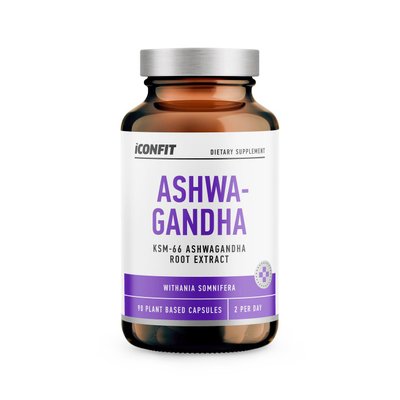 ICONFIT Capsules Ashwagandha N90€13.90 In stock and
 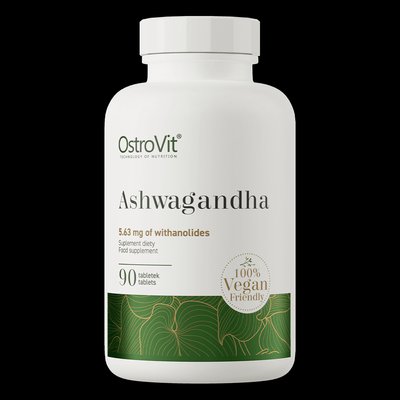 OstroVit Ashwagandha VEGE€7.90 In stock 90tabs are solid general ashwagandha options.
Timing. Most clinical trials on ashwagandha divide the dose across two daily servings, often morning and evening. Evening dosing in particular may complement ashwagandha's sleep-supportive effects, as Langade et al. (2019) demonstrated significant improvements in sleep quality and onset latency with ashwagandha supplementation compared to placebo.
Browse the full asvagandha kategooria at maxfit.ee.
Food Pairings
For practical daily use, the simplest approach is to take ashwagandha with a meal that naturally contains some fat. Breakfast options that pair well:
- Eggs or avocado toast
- Yoghurt with mixed nuts
- A smoothie with nut butter
Avoiding taking it on a completely empty stomach also helps reduce the mild GI discomfort that some people experience, particularly with higher doses.
Practical Tips
- Choose a standardised extract (KSM-66 or similar) over a generic root powder if you want predictable, consistent results.
- Take with a fat-containing meal — breakfast or dinner is ideal.
- Split your dose across two servings if taking more than the label's single serving, as this matches most clinical trial protocols.
- Be consistent. The stress-modulating and sleep benefits of ashwagandha are generally measured in weeks of daily use (Choudhary et al., 2017), not single doses.
- Consider black pepper. Some products include piperine; if yours does not, simply taking it with a peppery meal provides a natural source.
FAQ
Does taking ashwagandha with milk improve absorption?
Traditionally in Ayurveda, ashwagandha is taken with warm milk, which provides both fat (supporting withanolide absorption) and protein. This remains a reasonable and pleasant method. Modern capsule supplements taken alongside any fat-containing food achieve a similar result.
Can I take ashwagandha on an empty stomach?
Some people do without issue. For those who experience nausea or GI discomfort on an empty stomach, pairing it with food resolves this in most cases. The fat-containing meal also has the secondary benefit of improving absorption.
How long before I notice the effects of ashwagandha?
Most clinical studies observe significant effects at eight weeks of consistent daily use. Some people notice sleep improvements within two to four weeks. Do not judge the supplement on a single week of use — this is a long-game supplement where consistency matters more than any individual dose.
References
Shoba, G., Joy, D., Joseph, T., Majeed, M., Rajendran, R., & Srinivas, P. S. (1998). Influence of piperine on the pharmacokinetics of curcumin in animals and human volunteers. Planta Medica, 64(4), 353–356. https://pubmed.ncbi.nlm.nih.gov/9619120/
Langade, D., Kanchi, S., Salve, J., Debnath, K., & Ambegaokar, D. (2019). Efficacy and safety of ashwagandha (Withania somnifera) root extract in insomnia and anxiety: a double-blind, randomized, placebo-controlled study. Cureus, 11(9), e5797. https://pubmed.ncbi.nlm.nih.gov/31728244/
Choudhary, D., Bhattacharyya, S., & Bose, S. (2017). Efficacy and safety of ashwagandha (Withania somnifera (L.) Dunal) root extract in improving memory and cognitive functions. Journal of Dietary Supplements, 14(6), 599–612. https://pubmed.ncbi.nlm.nih.gov/28471731/



