
Is Long-Term Women's Vitamins Use Safe?
Women's multivitamins are formulated to address the specific nutritional needs of women — higher iron in reproductive years, extra folate, adjusted calcium and vitamin D. Whether long-term women's vitamins use is safe hinges on the same principles as any micronutrient: dose, form, and individual status.
What Long-Term Studies Show
Evidence on long-term multivitamin use in women is substantial. The Iowa Women's Health Study, a large prospective cohort, found that long-term use of certain individual supplements was associated with slightly higher total mortality in older women, but the effect was driven mainly by iron supplementation in women who were not iron deficient (Mursu et al., 2011). The multivitamin category as a whole showed no significant increase in risk in that analysis.
Conversely, consistent folate intake from multivitamins has been associated with reduced neural tube defect risk in offspring when taken peri-conceptionally (Czeizel & Dudas, 1992 — a landmark RCT with confirmed PMID). For women of childbearing age, this represents a well-established long-term benefit.
Upper Safe Limits Over Time
Several nutrients in women's formulas deserve attention over months and years:
- Iron: Formulas for premenopausal women typically include iron to compensate for menstrual losses. Post-menopausal women should reassess iron content, as their requirements drop substantially. Chronic iron excess is associated with oxidative stress.
- Vitamin A (retinol): The tolerable upper level for adults is 3,000 mcg RAE/day. Pregnant women should be particularly cautious — high retinol intake in early pregnancy has been linked to teratogenic risk. Beta-carotene is the safer form for long-term use.
- Folate/Folic acid: Generally well-tolerated at supplemental doses, but very high long-term intakes may mask vitamin B12 deficiency, which is more common in older women.
Products like Optimum Nutrition Opti-Women 120tabs, BIOTECHUSA Active Women 60tab, and 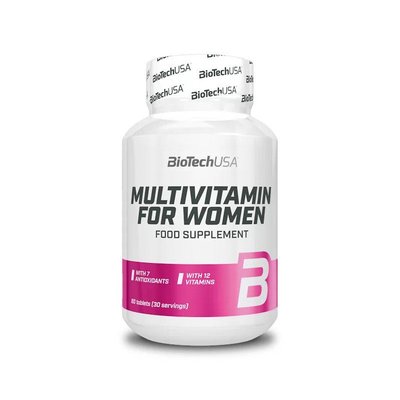 BIOTECHUSA Multivitamin for Women€18.90 In stock 60tab are formulated to address these considerations. Check whether your formula uses retinol or beta-carotene for vitamin A.
Do You Need to Cycle?
For water-soluble vitamins, cycling serves no established physiological purpose. Fat-soluble vitamins accumulate in tissue, but at typical multivitamin doses the accumulation risk over time is low for most women. The exception is very high-dose vitamin A in retinol form taken alongside a diet already rich in liver or fortified foods.
Athletes and active women often take products like NOW EVE Women's Multi 90 Soft Gels continuously throughout the year. There is no clinical consensus requiring periodic breaks from a standard women's multivitamin in healthy adults.
Monitoring
For women taking a multivitamin over years, practical monitoring includes:
- Iron and ferritin: Annual check if your formula contains significant iron, especially post-menopause.
- Serum 25-OH-D: Vitamin D status, particularly relevant in Nordic countries including Estonia where sun exposure is limited in winter months.
- Vitamin B12: Women over 50 and those on plant-based diets should monitor B12 levels, as absorption declines with age regardless of supplementation form.
The full women's vitamins range is available at maxfit.ee — comparing formulas helps you match iron and folate content to your life stage.
Honest Verdict
For most healthy women, long-term use of a well-formulated women's multivitamin at label doses is supported by evidence as safe. The primary risks are iron overload in post-menopausal women and chronic high retinol intake. Life-stage matters: what is appropriate at 25 (higher iron, higher folate) may differ at 55 (lower iron, possible B12 focus). Reassessing the formula every few years, rather than cycling, is the more practical approach.
References
Mursu, J., Robien, K., Harnack, L. J., Park, K., & Jacobs, D. R. (2011). Dietary supplements and mortality rate in older women: the Iowa Women's Health Study. Archives of Internal Medicine, 171(18), 1625-1633. https://pubmed.ncbi.nlm.nih.gov/21987192/
Czeizel, A. E., & Dudas, I. (1992). Prevention of the first occurrence of neural-tube defects by periconceptional vitamin supplementation. New England Journal of Medicine, 327(26), 1832-1835. https://pubmed.ncbi.nlm.nih.gov/1307234/
Blumberg, J. B., Bailey, R. L., Sesso, H. D., & Ulrich, C. M. (2018). The evolving role of multivitamin/multimineral supplement use among adults in the age of personalized nutrition. Nutrients, 10(2), 248. https://pubmed.ncbi.nlm.nih.gov/29470410/
FAQ
Should women change their multivitamin formula as they age?
Yes. Needs shift across life stages. Premenopausal women benefit from formulas with higher iron and folate; post-menopausal women generally need less iron and more focus on vitamin D, calcium, and B12. Reassessing every few years is sensible.
Can long-term women's vitamins use cause vitamin A toxicity?
At typical multivitamin doses, vitamin A toxicity is unlikely in otherwise healthy women. The main concern arises when retinol from supplements stacks with a retinol-rich diet (liver, heavily fortified foods). Choosing a formula using beta-carotene for vitamin A reduces this risk.
Is it safe to take women's vitamins during pregnancy long-term?
Pregnancy changes requirements substantially. A dedicated prenatal formula is preferred over a standard women's multivitamin during pregnancy. Consult a healthcare provider for personalised guidance, especially regarding folate, iron, and vitamin A form.



