
Why Women's Vitamins Interactions Deserve Special Attention
Women's vitamins interactions are particularly important because women often have specific micronutrient needs related to reproductive health, hormonal status, and iron management that men do not share. These needs create distinct interaction profiles — including with hormonal contraceptives, pregnancy supplements, and medications more commonly used by women.
This article covers the most relevant interactions for healthy, active women taking a women's multivitamin alongside common medications or additional supplements.
Drug Interactions: Women's Vitamins and Common Medications
Hormonal contraceptives and B vitamins. Combined oral contraceptives (COCs) have been shown to alter the metabolism and plasma levels of several B vitamins. Research has found that women taking COCs may have lower circulating B6 and folate levels and altered B12 metabolism (Palmery et al., 2013). A women's multivitamin containing a comprehensive B-complex is therefore particularly relevant for women on the pill.
Folate and anticonvulsant medications. Some anticonvulsants (e.g., phenytoin, carbamazepine) increase folate breakdown. Women of reproductive age on anticonvulsant therapy should discuss folate supplementation with their neurologist or GP, as adequate folate is critical for preventing neural tube defects if pregnancy occurs.
Vitamin K and anticoagulants. As with men, women taking warfarin must be cautious about vitamin K intake from supplements. Women on anticoagulant therapy should maintain consistent vitamin K intake rather than dramatically varying it, and should not change supplement regimens without prescriber guidance.
St. John's Wort and fat-soluble vitamins. Some women take St. John's Wort (a herbal supplement) for mood support. St. John's Wort is a potent CYP3A4 inducer that affects the metabolism of many drugs and can alter the balance of fat-soluble vitamins A and D. Women taking St. John's Wort should mention this to their doctor and be aware of its broad interaction potential.
Calcium supplements and levothyroxine. Women with hypothyroidism taking levothyroxine should not take calcium supplements within four hours of their thyroid medication, as calcium can significantly reduce levothyroxine absorption.
Nutrient Competition and Synergy in Women's Multivitamins
Iron and calcium compete. This interaction is particularly relevant for women because iron deficiency is common in women of reproductive age, while calcium is also widely supplemented for bone health. Calcium inhibits non-haem iron absorption when taken simultaneously. Women who need both should separate them by at least two hours or take calcium with evening meals and iron-containing supplements in the morning.
Vitamin D and vitamin K2 synergy. Women supplementing with vitamin D for bone health — especially post-menopausal women — benefit from combining this with adequate vitamin K2. Vitamin K2 ensures that calcium mobilised by vitamin D is deposited in bone rather than in soft tissue. A good-quality women's multivitamin should include both.
Folate and vitamin B12 are interdependent. High-dose folate supplementation can mask a vitamin B12 deficiency by correcting the blood picture while neurological damage progresses. Women who supplement with folate should ensure their B12 status is also monitored, particularly vegans who are at higher risk of B12 deficiency.
Zinc and copper must stay balanced. Women's multivitamins commonly include zinc for immune function and hormonal health. High supplemental zinc over time depletes copper; ensure the multivitamin includes both in balanced amounts.
Iron and vitamin C work together. Women with borderline or frank iron deficiency benefit from consuming vitamin C-rich foods alongside iron supplements or iron-rich meals to maximise non-haem iron absorption.
Food Effects on Women's Vitamin Absorption
Fat-soluble vitamins require dietary fat. Vitamins A, D, E, and K require fat for absorption. Women who often eat low-fat or fat-reduced meals should pair their women's multivitamin with a meal containing some healthy fat (eggs, avocado, nuts, olive oil).
Dairy and iron timing. Dairy products are a major source of calcium and are highly beneficial for bone health, but calcium from dairy inhibits non-haem iron absorption at the same meal. Women who are iron-deficient or at risk should separate dairy-heavy meals and iron supplements by at least one to two hours.
Coffee, tea, and iron. Polyphenols in coffee and tea strongly inhibit non-haem iron absorption. For women at risk of iron deficiency — including female endurance athletes and women with heavy menstrual losses — avoiding coffee and tea within one hour of iron-rich meals or supplements is a practical measure.
Alcohol and folate. Regular alcohol consumption reduces folate absorption and increases folate requirements. Women who drink regularly should ensure their multivitamin provides adequate folate, and should not assume dietary folate intake is sufficient.
Who Must Be Most Cautious
- Women taking combined oral contraceptives (B6, folate, B12 interactions)
- Pregnant women or those planning pregnancy (folate critical; high vitamin A from retinol is teratogenic above certain doses)
- Women on anticoagulants (vitamin K consistency)
- Women with hypothyroidism on levothyroxine (calcium timing)
- Female endurance athletes with high iron turnover
- Post-menopausal women taking calcium plus vitamin D (add K2)
Practical Rules for Women's Vitamin Supplementation
- Separate iron-containing supplements from calcium by at least two hours.
- Take your multivitamin with a meal containing fat to absorb fat-soluble vitamins A, D, E, and K.
- If on oral contraceptives, prioritise a women's multivitamin with a full B-complex including folate, B6, and B12.
- Do not add high-dose standalone vitamin A (retinol form) on top of a women's multivitamin if you are pregnant or planning pregnancy — the upper safe limit for retinol can be reached quickly from combined sources.
- If on levothyroxine, take thyroid medication at least four hours away from calcium supplements.
Products available at maxfit.ee include BIOTECHUSA Active Women 60tab, Optimum Nutrition Opti-Women 120tabs, and 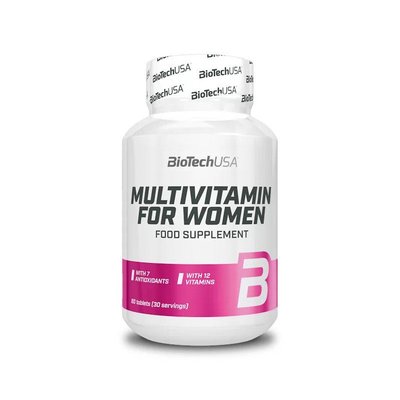 BIOTECHUSA Multivitamin for Women€18.90 In stock 60tab from the women's vitamins category.
FAQ
Can I take a women's multivitamin while on the contraceptive pill?
Yes — in fact, a women's multivitamin with a full B-complex is particularly useful for women on combined oral contraceptives, given the evidence that COCs may reduce B6 and folate levels. Always check with your GP if you are on any prescription medication and unsure about interactions.
How much folate do women need, and does my multivitamin cover it?
Women of reproductive age are advised to ensure adequate folate intake. Most women's multivitamins include folate. If you are planning pregnancy, additional folate supplementation above the multivitamin level may be recommended — this is a conversation to have with your GP.
Is it safe to take a women's multivitamin during pregnancy?
Standard women's multivitamins are not formulated for pregnancy. Pregnant women should use a dedicated prenatal vitamin, as the micronutrient requirements in pregnancy differ substantially — particularly for folate, iron, iodine, and vitamin D — and some nutrients (especially preformed vitamin A as retinol) must be carefully limited.
References
Palmery, M., Saraceno, A., Vaiarelli, A., & Carlomagno, G. (2013). Oral contraceptives and changes in nutritional requirements. European Review for Medical and Pharmacological Sciences, 17(13), 1804-1813. https://pubmed.ncbi.nlm.nih.gov/23852908/
Wallace, T. C., McBurney, M., & Fulgoni, V. L. (2014). Multivitamin/mineral supplement contribution to micronutrient intakes in the United States, 2007-2010. Journal of the American College of Nutrition, 33(2), 94-102. https://pubmed.ncbi.nlm.nih.gov/24724766/
Hess, S. Y. (2010). The impact of common micronutrient deficiencies on iodine and thyroid metabolism: the evidence from human studies. Best Practice & Research Clinical Endocrinology & Metabolism, 24(1), 117-132. https://pubmed.ncbi.nlm.nih.gov/20172476/



