Why Women's Vitamin Needs Differ from Men's
Women have distinct micronutrient requirements shaped by hormonal cycles, reproductive capacity, and physiology. Iron, folate, vitamin D, calcium, and iodine are among the nutrients where women's daily requirements or risk of deficiency diverges meaningfully from men's. Understanding which natural food sources of women's vitamins are most effective — and how bioavailability and cooking affect them — helps you build a diet that delivers results.
Top Food Sources of Key Women's Vitamins
Iron
Women of reproductive age have higher iron requirements than men due to menstrual blood losses. Haem iron from animal sources (red meat, poultry, shellfish, liver) is absorbed at a substantially higher rate than non-haem iron from plant sources (legumes, tofu, spinach, fortified cereals). A review of iron bioavailability studies confirmed that absorption from haem sources consistently exceeds that from plant sources, which is particularly relevant for women eating plant-based diets (Hurrell & Egli, 2010).
Folate
Folate (the natural form of folic acid) is critical for cell division and especially important before and during pregnancy for neural tube development. Top food sources include dark leafy greens (spinach, kale, romaine), lentils, chickpeas, avocado, and asparagus. Liver is exceptionally rich in folate but is not recommended in large amounts during pregnancy due to preformed vitamin A content.
Vitamin D
Few foods naturally contain meaningful amounts of vitamin D. Fatty fish (salmon, herring, mackerel) and egg yolks provide some. Fortified foods (certain dairy, plant milks, breakfast cereals) contribute in countries that mandate fortification, but Finland and Estonia have limited mandatory fortification. Sunlight-triggered skin synthesis is the primary source for most people, making supplementation important at northern latitudes — particularly from October to March.
Calcium
Dairy products (yogurt, cheese, milk) remain the most bioavailable dietary calcium sources. Non-dairy sources include calcium-set tofu, canned fish with bones (sardines, salmon), almonds, and calcium-fortified plant milks. Oxalic acid in spinach and certain greens significantly reduces calcium absorption from those foods.
Iodine
Iodine is essential for thyroid function and is particularly important during pregnancy and breastfeeding. Main food sources are iodised salt, seafood, dairy (if animals were fed iodine-supplemented feed), and eggs. Estonian and Nordic soils are generally iodine-poor, meaning locally grown plants are a weak source.
Bioavailability: Food vs Supplement
Not all micronutrients are absorbed equally from food and supplements:
- Folate: Synthetic folic acid in fortified foods and supplements has higher bioavailability than naturally occurring food folate, which must be converted. A study found that synthetic folic acid is roughly 1.7 times more bioavailable than natural food folates (Caudill, 2010).
- Iron: Haem iron from meat is more bioavailable than both non-haem food iron and most supplemental iron forms. Vitamin C co-consumed with non-haem sources increases absorption.
- Vitamin D: Both D2 and D3 supplements raise serum 25(OH)D, but D3 may be somewhat more effective at maintaining levels over time.
Daily Targets from Diet
For healthy adult women in Estonia, reference nutrient intakes approximately align with European standards:
| Nutrient | Approx. Daily Target (adult women) |
|---|---|
| Iron | 15–18 mg (higher during reproductive years) |
| Folate | 300–400 mcg |
| Vitamin D | 10–20 mcg (most not met by diet alone in Estonia) |
| Calcium | 800–1000 mg |
| Iodine | 150 mcg |
Cooking and Storage Effects
- Folate is heat-sensitive. Boiling vegetables can cause folate losses of up to 50%. Steaming or consuming raw reduces losses.
- Vitamin C (which supports iron absorption) degrades rapidly with heat and exposure to air.
- Fat-soluble vitamins (A, D, E, K) are better absorbed when consumed with fat — dress salads with olive oil.
- Iron absorption from plant sources is improved by pairing with vitamin-C-rich foods and avoiding tea or coffee immediately after meals.
When Food Is Not Enough
A well-designed varied diet can meet most women's vitamin needs in theory, but in practice certain groups consistently fall short:
- Women eating plant-based diets need supplemental B12 and should monitor iron and iodine.
- Women of reproductive age who may become pregnant are widely recommended to take folic acid supplements regardless of diet quality.
- Most women living in Estonia benefit from vitamin D supplementation during autumn and winter.
- Women with heavy menstrual periods may need supplemental iron if diet cannot compensate.
At maxfit.ee you can explore BIOTECHUSA Active Women 60tab, Optimum Nutrition Opti-Women 120tabs, and 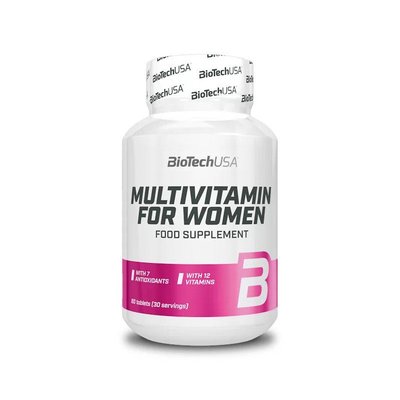 BIOTECHUSA Multivitamin for Women€18.90 In stock 60tab — women's multivitamin formulas designed to complement a healthy diet. Browse the full range at maxfit.ee/en/category/vitamiinid-naistele-valgud-vitamiinikompleksid.
FAQ
Do women need a different multivitamin than men?
Yes. Women's multivitamins are typically formulated with higher iron and folate to address menstrual losses and pregnancy support needs, and may differ in calcium and iodine levels. Men's formulas often contain lower iron levels, which can be appropriate because excess iron is not excreted easily.
Can I get enough vitamin D from food in Estonia?
Not reliably. The natural dietary sources of vitamin D (fatty fish, egg yolks) provide relatively modest amounts, and Estonian winters provide insufficient sunlight for skin synthesis. Supplementation is the practical solution for most Estonian women from October through March at minimum.
Is spinach a good source of iron for women?
Spinach contains iron, but the oxalic acid in it inhibits non-haem iron absorption significantly. Pairing spinach with a vitamin-C-rich food (e.g. lemon juice, bell pepper) improves the amount absorbed. Women relying primarily on plant iron sources should be aware that absorption rates are meaningfully lower than from meat.
References
Hurrell, R., & Egli, I. (2010). Iron bioavailability and dietary reference values. American Journal of Clinical Nutrition, 91(5), 1461S–1467S. https://pubmed.ncbi.nlm.nih.gov/20200263/
Caudill, M. A. (2010). Folate bioavailability: implications for establishing dietary recommendations and optimizing status. American Journal of Clinical Nutrition, 91(5), 1455S–1460S. https://pubmed.ncbi.nlm.nih.gov/20219964/
Cashman, K. D., Dowling, K. G., Skrabakova, Z., Gonzalez-Gross, M., Valtuena, J., De Henauw, S., ... & Kiely, M. (2016). Vitamin D deficiency in Europe: pandemic? American Journal of Clinical Nutrition, 103(4), 1033–1044. https://pubmed.ncbi.nlm.nih.gov/26864360/



