
What to Stack with Vitamin K: Synergies & Conflicts
Vitamin K stacking is one of the more nuanced topics in supplementation because vitamin K comes in multiple forms with different functions, and its most important conflict — with anticoagulant medication — is clinically significant. This guide covers the evidence-based synergies, the real conflicts, and practical approaches to stacking vitamin K safely.
Evidence-Based Synergies
Vitamin K2 + Vitamin D3: The Core Stack
The combination of vitamin K2 (specifically MK-7) and vitamin D3 is the most studied and most clinically relevant synergy in this category. Vitamin D3 promotes intestinal absorption of calcium and increases the production of certain calcium-binding proteins, including osteocalcin and matrix Gla protein (MGP). Both of these proteins require vitamin K2 for their carboxylation — the activation step that makes them functional. Without adequate K2, vitamin D-stimulated calcium may end up depositing in soft tissues rather than bone.
A randomised controlled trial found that combined K2 + D3 supplementation was more effective at improving bone mineral density compared to either alone (Knapen et al., 2007). The practical takeaway: if you supplement vitamin D3, co-supplementing with K2 MK-7 is a well-supported strategy, especially at higher vitamin D doses.
Products supporting this stack at maxfit.ee:
- NOW Vitamin D-3 & K-2 120caps (combined formula)
- OstroVit Vitamin D3 + K2 90 tabs
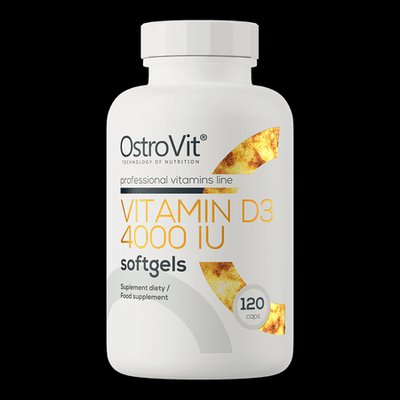 OstroVit Vitamin D3 4000 IU€8.90 In stock + K2 100tabs
Vitamin K + Calcium
Calcium supplementation is widely used for bone health, but calcium without adequate K2 has been a concern in some epidemiological studies regarding arterial calcification. Vitamin K2's role in activating MGP — the inhibitor of arterial calcification — makes it a logical co-supplement with calcium for people concerned about vascular health alongside bone density.
Vitamin K + Magnesium
Magnesium supports bone mineralisation through several pathways independent of vitamin K. There is no direct synergy between the two at the receptor level, but they complement each other in a bone health protocol: magnesium supports the structural matrix, while K2 activates the proteins that direct calcium into bone rather than soft tissue.
Antagonistic Combinations
Vitamin K and Anticoagulants (Warfarin / Acenocoumarol)
This is the most clinically significant interaction in supplement science. Warfarin (and related vitamin K antagonist anticoagulants) works by blocking vitamin K recycling, preventing the production of vitamin K-dependent clotting factors. Adding supplemental vitamin K — even at relatively low doses — can reduce the anticoagulant effect, potentially increasing the risk of clot formation.
If you take warfarin, acenocoumarol, or any vitamin K antagonist anticoagulant, do not supplement vitamin K without medical supervision. Even dietary changes that significantly increase vitamin K intake (such as starting to eat large amounts of leafy greens daily) should be discussed with your prescriber because INR monitoring and dose adjustments may be needed.
Note: newer anticoagulants (direct oral anticoagulants such as rivaroxaban, apixaban, dabigatran) do not work through the vitamin K pathway and do not have this specific interaction.
High-Dose Vitamin K and Vitamin E
Very high supplemental doses of vitamin E (above 1000 IU/day) have been observed to antagonise vitamin K-dependent clotting factor production, increasing bleeding tendency. At typical supplement doses (under 400 IU/day), this interaction is not clinically meaningful — it applies only to pharmacological vitamin E supplementation.
Timing within a Stack
Vitamin K is fat-soluble and must be taken with a meal containing dietary fat for adequate absorption. All fat-soluble vitamins (A, D, E, K) can be taken together at the same meal. There is no meaningful competition for absorption between them at typical supplement doses.
For the K2 + D3 stack specifically, taking both together with your main meal of the day is optimal and convenient. Combined products available at maxfit.ee such as NOW Vitamin K-2 (MK7) 100mcg 60 veg. caps. or OstroVit Vitamin K2 200 Natto MK-7 90tabs can be paired with a separate D3 supplement or taken as a combined product.
Sample Stacks by Goal
| Goal | Stack | Notes |
|---|---|---|
| Bone mineral density | K2 MK-7 + D3 + Calcium + Magnesium | Core bone health protocol |
| Arterial calcification prevention | K2 MK-7 + D3 | K2 activates MGP in arterial walls |
| General fat-soluble vitamin base | K2 + D3 + A + E | All taken together with a fat-containing meal |
| Post-menopausal bone support | K2 MK-7 + D3 + Calcium | Evidence base strongest for this group |
What to Avoid
- Do not stack K1 or K2 with warfarin-type anticoagulants without medical supervision.
- Do not take vitamin K supplements on a fat-free meal — absorption will be minimal.
- Do not interpret no-drug-interaction as no-food-interaction: the leafy green / warfarin interaction is dietary, not supplemental, but the mechanism is the same — monitor consistency of intake if you take an anticoagulant.
FAQ
What is the difference between K1 and K2 for stacking?
Vitamin K1 (phylloquinone) is primarily hepatic — it supports liver-based clotting factor production. Vitamin K2 (menaquinones, particularly MK-7) has longer tissue half-life and specifically supports carboxylation of bone and vascular proteins. For bone and cardiovascular health stacking purposes, MK-7 is the more relevant form. For anticoagulant interactions, both K1 and K2 can interfere with warfarin.
How much K2 is needed to support a vitamin D stack?
Most trials studying K2 + D3 combinations have used K2 MK-7 in the range of 90–200 mcg/day alongside D3. These amounts are achievable from a single K2 capsule. Products like OstroVit Vitamin K2 200 Natto MK-7 90tabs provide 200 mcg MK-7 per tablet, consistent with the trial doses.
Can I take vitamin K with a multivitamin?
Yes. Most multivitamins contain modest amounts of K1 and sometimes K2, typically within safe and beneficial ranges. If you want targeted K2 MK-7 supplementation for bone or vascular health beyond what a multivitamin provides, a separate K2 supplement is reasonable. Always check the total vitamin K content across all products to avoid unintentional high intake.
References
Knapen, M. H., Schurgers, L. J., & Vermeer, C. (2007). Vitamin K2 supplementation improves hip bone geometry and bone strength indices in postmenopausal women. Osteoporosis International, 18(7), 963-972. https://pubmed.ncbi.nlm.nih.gov/17287908/
Geleijnse, J. M., Vermeer, C., Grobbee, D. E., Schurgers, L. J., Knapen, M. H., van der Meer, I. M., Hofman, A., & Witteman, J. C. (2004). Dietary intake of menaquinone is associated with a reduced risk of coronary heart disease: the Rotterdam Study. Journal of Nutrition, 134(11), 3100-3105. https://pubmed.ncbi.nlm.nih.gov/15514282/
Cees Vermeer (2012). Vitamin K: the effect on health beyond coagulation — an overview. Food & Nutrition Research, 56, 5329.



