Vitamin D3 vs D2: A Science-Based Comparison
Vitamin D is one of the few nutrients the human body can produce on its own — but only with sufficient ultraviolet-B radiation. In Nordic countries where sunlight is scarce from October through April, supplementing vitamin D is practically a necessity for everyone. In stores, you'll find two forms: D3 (cholecalciferol) and D2 (ergocalciferol). Which is better?
What Is the Difference Between D3 and D2?
Both forms raise blood levels of 25-hydroxyvitamin D (25(OH)D), but they differ in origin and effectiveness:
| Property | D3 (Cholecalciferol) | D2 (Ergocalciferol) |
|---|---|---|
| Origin | Animal (lanolin, fish oil) | Plant (mushrooms, yeast) |
| Biological activity | Higher | Lower |
| Half-life in the body | Longer | Shorter |
| 25(OH)D elevation | Stronger | Weaker |
| Vegan-suitable | Not typically | Yes |
Why Is D3 More Effective?
A meta-analysis covering over 10 trials demonstrated that D3 raises serum 25(OH)D concentrations approximately 87% more effectively than an equivalent D2 dose (Tripkovic et al., 2012). D3 binds more strongly to the vitamin D transport protein, its metabolites are more biologically active, and it is stored in adipose tissue for longer.
How Does the Body Process Vitamin D?
Regardless of whether you take D3 or D2, it undergoes the same metabolic steps:
- Liver converts it to 25(OH)D (calcidiol) — the form measured in blood tests.
- Kidneys activate it to 1,25(OH)₂D (calcitriol) — the hormonally active form.
- Target tissues (bones, muscles, immune cells) bind the active form via the vitamin D receptor.
With D3, this chain is more efficient: 25(OH)D3 is more stable and remains in circulation longer than 25(OH)D2 (Heaney et al., 2011).
When Should You Prefer D2?
D2 is often the only option for vegans, as it is derived from UV-irradiated mushrooms or yeast. Some research shows that at higher doses (e.g., 50,000 IU once weekly), the difference between D2 and D3 narrows. However, at typical daily maintenance doses, D3 holds a clear advantage.
What Doses Make Sense?
EFSA has established a safe upper intake level of 4000 IU per day for adults. Practical recommendations for the Estonian climate:
- Maintenance dose in autumn/winter: 2000–4000 IU D3 daily
- Correcting deficiency: 4000 IU daily for 8–12 weeks, then blood test
- Summer (with active sun exposure): 1000–2000 IU or a break
At maxfit.ee you'll find a wide selection of D3 supplements. OstroVit Vitamin D3 4000 IU 120 Caps is a popular choice for daily use, while NOW Vitamin D3 5000 IU 120 softgels suits those needing a stronger dose. If you want a combination formula, 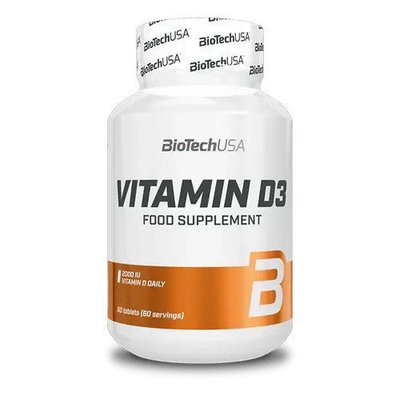 BIOTECHUSA Vitamin D3€11.90 In stock 60tab offers a convenient option.
Are There Side Effects With D3?
D3 is fat-soluble and accumulates in the body, so overdose is theoretically possible but rare from supplements. Toxicity (hypercalcaemia) typically only occurs with sustained intake above 10,000 IU per day (Holick, 2007). If you regularly take more than 4000 IU, it is wise to monitor serum calcium.
FAQ
Is D2 completely useless?
No — D2 does raise 25(OH)D levels; it is simply less efficient. If you are vegan and D2 is your only option, it is certainly better than nothing. Some researchers argue that D2 performs comparably when doses are large enough.
How do I know if I have a vitamin D deficiency?
The only reliable method is a blood test measuring 25(OH)D. Optimal levels are considered 75–150 nmol/L. Below 50 nmol/L is classified as deficiency; below 30 nmol/L as severe deficiency.
Should D3 be taken with fat?
Yes — D3 is a fat-soluble vitamin and absorption improves significantly when taken with a fat-containing meal. Research shows that the presence of dietary fat increases absorption by up to 32% (Mulligan & Bhatt, 2010).
References
- Tripkovic, L., Lambert, H., Hart, K., et al. (2012). Comparison of vitamin D2 and vitamin D3 supplementation in raising serum 25-hydroxyvitamin D status. American Journal of Clinical Nutrition, 95(6), 1357–1364.
- Heaney, R. P., Recker, R. R., Grote, J., et al. (2011). Vitamin D₃ is more potent than vitamin D₂ in humans. Journal of Clinical Endocrinology & Metabolism, 96(3), E447–E452.
- Holick, M. F. (2007). Vitamin D deficiency. New England Journal of Medicine, 357(3), 266–281.
- Mulligan, G. B., & Bhatt, D. L. (2010). A randomized trial of vitamin D supplementation in primary prevention of cardiovascular disease. Journal of Clinical Endocrinology & Metabolism, 95(3), 1357–1368.
- Bikle, D. D. (2014). Vitamin D metabolism, mechanism of action, and clinical applications. Chemistry & Biology, 21(3), 319–329.



