
Why Does Latitude Matter for Vitamin D?
Vitamin D is synthesised in the skin when ultraviolet-B (UVB) rays strike it. The problem at higher latitudes — like Estonia at approximately 59°N — is that the sun's angle from October to April is too low for UVB rays to reach the Earth's surface with sufficient intensity. Scientists call this period the vitamin D winter (Holick, 2007).
This means that people living in Estonia cannot produce any vitamin D through sun exposure for six months of the year, regardless of time spent outdoors.
Vitamin D Deficiency in Estonia
Research from Scandinavia and the Baltics consistently shows that 40–80% of the population has serum 25(OH)D levels below the recommended 50 nmol/l during winter months (Lips, 2010). The consequences touch:
- Immune function: vitamin D regulates immune cell activity — deficiency correlates with more frequent infections
- Mood and energy: vitamin D receptors are found in brain regions associated with mood regulation
- Muscle and bone health: essential for calcium absorption and muscle function
- Athletic performance: deficiency is linked to reduced muscle strength and slower recovery
Vitamin D Dosage by Latitude
| Latitude | Example Locations | Winter Period | Recommended Supplement |
|---|---|---|---|
| Below 35°N | Cyprus, Spain | None | 600 IU if needed |
| 35–50°N | France, Hungary | Nov–Feb | 1,000–2,000 IU daily |
| 50–60°N | Germany, Poland | Oct–March | 2,000–4,000 IU daily |
| Above 60°N | Estonia, Finland, Sweden | Sept–April | 2,000–4,000 IU, potentially up to 6,000 IU |
Adjusting Dose by Blood Test Result
The most precise way to calibrate vitamin D supplementation is a 25(OH)D blood test:
| 25(OH)D Level (nmol/l) | Status | Recommended Supplemental Dose |
|---|---|---|
| Below 25 | Severe deficiency | 4,000–6,000 IU daily |
| 25–50 | Deficiency | 2,000–4,000 IU daily |
| 50–75 | Insufficiency | 1,000–2,000 IU daily |
| 75–150 | Optimal | 1,000 IU maintenance |
| Above 200 | Potential toxicity | Reduce intake |
Is Vitamin D Toxicity a Real Risk?
Vitamin D toxicity is rare and requires very long-term intake of extremely high doses (above 10,000 IU per day). Evidence indicates 4,000 IU daily is safe for all adults (Hathcock et al., 2007).
Product Recommendations from maxfit.ee
OstroVit Vitamin D3 4000 IU 120 Caps is a practical daily maintenance choice for the Estonian winter — 4,000 IU hits the sweet spot of efficacy and safety margin. NOW Vitamin D3 5000 IU 120 softgels suits those with a confirmed deficiency who need a correction dose. 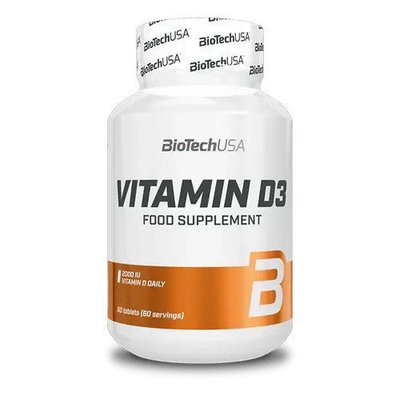 BIOTECHUSA Vitamin D3€11.90 In stock 60tab is a budget-friendly entry-level option.
All are available in the vitamin D supplement category at maxfit.ee.
D3 vs. D2: Which Is Better?
- D3 (cholecalciferol): animal-derived, more effective at raising 25(OH)D — the preferred supplemental form
- D2 (ergocalciferol): plant-derived (fungi), lower efficacy compared to D3
Research consistently shows D3 is approximately 87% more effective at raising serum levels than an equivalent dose of D2 (Tripkovic et al., 2012).
Vitamin D and K2 Together
High vitamin D intake enhances calcium absorption — K2 (particularly the MK-7 form) ensures that calcium is directed to bones rather than arterial walls. OstroVit Vitamin D3 + K2 90 tabs combines both in optimal proportions and is a particularly sensible choice for those taking 2,000+ IU of D3 daily.
Interpreting Your Vitamin D Blood Test
The 25(OH)D blood test is the gold standard for assessing vitamin D status. The most commonly used reference ranges in Europe are:
- Below 25 nmol/l: severe deficiency — bone health and immune function are at risk
- 25–50 nmol/l: deficiency — supplementation is essential
- 50–75 nmol/l: sufficient by minimal criteria, but suboptimal for health and performance
- 75–150 nmol/l: optimal — the target for most healthy adults
- Above 200 nmol/l: potentially toxic range
In Estonia, a 25(OH)D test can be requested through your family physician as part of routine blood work — particularly recommended in October (before winter begins) and again in March (at the end of the dark season).
Vitamin D and Immune Function: The Evidence
A meta-analysis covering 25 randomised controlled trials found that vitamin D supplementation reduced the risk of acute respiratory infections by 12% overall (Martineau et al., 2017). The effect was strongest in those with a low baseline vitamin D level.
This is especially relevant during Estonian winter months — the season when respiratory viral infections peak coincides precisely with the season when vitamin D levels are at their lowest. Adequate supplementation effectively bridges this vulnerability window.
Vitamin D and Muscle Function in Athletes
For Estonian athletes who train through the winter, vitamin D's effect on muscle function is a particularly practical consideration. Research shows that vitamin D receptors are present in muscle tissue, and adequate vitamin D levels correlate with better fast-twitch muscle fibre function, reduced fall risk in older adults, and faster recovery from muscle-damaging exercise (Dahlquist et al., 2015).
FAQ
When should I start taking vitamin D in Estonia?
Begin in September or October and continue through April. During summer (May to August), regular time outdoors during midday hours in Estonia is usually sufficient for adequate synthesis.
Can I get enough vitamin D from fish oil?
Fish liver oils (e.g., cod liver oil) do contain vitamin D, but typically 400–1,000 IU per serving — not enough to cover Estonia's winter requirements on its own. A separate D3 supplement remains advisable.
Does vitamin D affect athletic performance?
Yes, particularly when correcting a deficiency. Studies link optimal vitamin D status to better muscle strength, faster recovery, and a lower risk of stress fractures and acute illness (Dahlquist et al., 2015).
References
- Holick, M. F. (2007). Vitamin D deficiency. New England Journal of Medicine, 357(3), 266–281.
- Lips, P. (2010). Worldwide status of vitamin D nutrition. Journal of Steroid Biochemistry and Molecular Biology, 121(1–2), 297–300.
- Hathcock, J. N., Shao, A., Vieth, R., & Heaney, R. (2007). Risk assessment for vitamin D. American Journal of Clinical Nutrition, 85(1), 6–18.
- Tripkovic, L., Lambert, H., Hart, K., Smith, C. P., Bucca, G., Penson, S., ... & Lanham-New, S. A. (2012). Comparison of vitamin D2 and vitamin D3 supplementation in raising serum 25-hydroxyvitamin D status. American Journal of Clinical Nutrition, 95(6), 1357–1364.
- Dahlquist, D. T., Dieter, B. P., & Koehle, M. S. (2015). Plausible ergogenic effects of vitamin D on athletic performance and recovery. Journal of the International Society of Sports Nutrition, 12(1), 33.