When to Take Tryptophan: Optimal Timing
L-tryptophan is an essential amino acid and the direct dietary precursor to serotonin and melatonin. Because its route to the brain is shared — and competed for — by other large neutral amino acids, tryptophan timing is one of the more nuanced decisions in amino acid supplementation.
With or Without Food?
The relationship between tryptophan and food is counterintuitive. You might expect that taking tryptophan with protein food would maximise its effects, but the opposite is true. Protein foods raise blood levels of all large neutral amino acids (LNAAs) simultaneously, and tryptophan must compete with leucine, valine, phenylalanine, and others for brain entry via the same transporter.
A small carbohydrate-containing snack — crackers, a piece of fruit, or a small amount of rice — can actually improve tryptophan's brain uptake. Carbohydrate stimulates insulin, which clears competing branched-chain amino acids from circulation, giving tryptophan less competition for the transporter. This is a well-established principle (Wurtman et al., 2003).
The practical rule: take L-tryptophan either on an empty stomach or with a small carbohydrate snack — not with protein.
Time of Day and Training
Evening and pre-sleep timing is the most common and well-supported use case for tryptophan. As the precursor to melatonin, tryptophan may support sleep onset and quality. Taking it one to two hours before bed allows time for conversion to serotonin and then melatonin in the pineal gland.
A randomised placebo-controlled study found that tryptophan supplementation before sleep improved subjective sleep quality and morning alertness in healthy adults (Hartmann et al., 1974). For those with disturbed sleep or shift work, this is the most relevant timing window.
Post-workout: There is some rationale for tryptophan after intense training sessions. Serotonin is involved in central fatigue mechanisms during exercise, and exercise itself alters tryptophan metabolism. However, the practical case for specifically timed post-workout tryptophan supplementation in healthy athletes is less clear than the sleep use case.
Morning: Those using tryptophan primarily for mood support — serotonin synthesis — may find morning dosing beneficial. Morning tryptophan on a low-protein stomach gives the neurotransmitter pathway a substrate boost before the day's demands.
Split vs Single Dose
For sleep support, a single evening dose is the most common protocol and the one most studied. For mood and general serotonin support, splitting into two doses — morning and evening — can provide more sustained substrate availability throughout the day.
MST L-Tryptophan 500mg 60caps and NOW L-Tryptophan 500mg 60 veg caps are available in the same dose per capsule, making dose management straightforward. 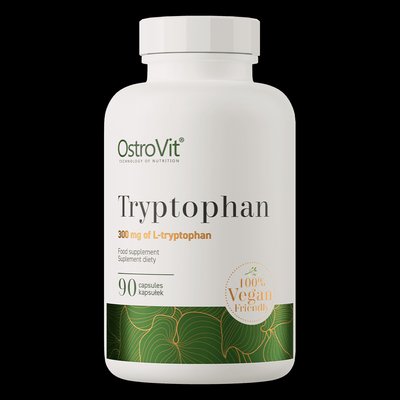 OstroVit Tryptophan VEGE€8.90 In stock 90caps offers a convenient capsule for evening dosing. OstroVit Tryptophan 200g in powder form allows flexible dosing if you prefer to adjust amounts during a split protocol.
Interactions Affecting Timing
- MAO inhibitors: Tryptophan with MAOIs risks serotonin syndrome. This is a serious drug interaction — those on antidepressants should consult a doctor before supplementing tryptophan.
- SSRIs: The same serotonin-syndrome caution applies. Tryptophan is not recommended alongside SSRIs without medical supervision.
- 5-HTP: Tryptophan and 5-HTP both convert to serotonin; combining them at high doses may oversupply the serotonin pathway. Use one or the other, not both at the same time.
- Protein meals: As discussed, high-protein meals reduce tryptophan's brain uptake. Separate your tryptophan dose from protein-heavy eating by at least 30 minutes.
Practical Schedule
| Goal | Dose timing | Condition |
|---|---|---|
| Sleep support | 60–120 min before bed | Empty stomach or carb snack |
| Mood / serotonin | Morning + evening | Low-protein conditions |
| Post-workout mood | 60 min after training | With small carb snack |
You can find tryptophan supplements at maxfit.ee.
FAQ
Can I take tryptophan every night?
Yes, regular nightly use is common for sleep support. Tryptophan is an essential amino acid — it is consumed daily through diet regardless. Supplemental doses as an evening addition are generally well tolerated.
Is tryptophan better or worse than melatonin for sleep?
They act differently. Melatonin directly signals the circadian system. Tryptophan works upstream by providing substrate for melatonin production and also supports serotonin, which affects mood and relaxation before sleep. Some people respond better to one or the other.
Does tryptophan make you drowsy during the day?
At typical supplement doses, tryptophan is unlikely to cause significant daytime drowsiness if taken in the morning. Evening doses may carry over some sedating effect in the morning for sensitive individuals — in that case, lower your evening dose.
References
Wurtman, R. J., Wurtman, J. J., Regan, M. M., McDermott, J. M., Tsay, R. H., & Breu, J. J. (2003). Effects of normal meals rich in carbohydrates or proteins on plasma tryptophan and tyrosine ratios. American Journal of Clinical Nutrition, 77(1), 128–132. https://pubmed.ncbi.nlm.nih.gov/12499331/
Hartmann, E., Cravens, J., & List, S. (1974). Hypnotic effects of L-tryptophan. Archives of General Psychiatry, 31(3), 394–397. https://pubmed.ncbi.nlm.nih.gov/4370080/



