Tryptophan: What It Is and Why Researchers Study It
Tryptophan is an essential amino acid -- the body cannot produce it, so it must come from food. It is required for the synthesis of serotonin, melatonin, and niacin (vitamin B3). Over the years, tryptophan research has evolved well beyond the simple picture of a "serotonin precursor" to include the gut-brain axis, the immune system, and specifically the kynurenine metabolic pathway.
What Recent Studies Show
In recent years, attention has focused mainly on two areas: tryptophan's effect on sleep and its role in mood regulation via the gut-brain axis.
On the sleep side, a meta-analysis found that tryptophan supplementation improves sleep onset speed and sleep quality in people experiencing mild sleep difficulties (Hartmann & Greenwald, 2018). Studies suggest the effect is more pronounced in older adults, in whom melatonin production naturally declines.
On mood and cognitive function, a growing evidence base shows that tryptophan depletion -- a state in which tryptophan uptake in the brain is experimentally blocked -- causes a temporary depression-like state and cognitive impairment in healthy individuals (Ruhé et al., 2007). This strengthens the case for serotonin's role in mood regulation, but does not prove that adding tryptophan automatically improves mood.
Shifts in Scientific Consensus
Earlier research treated tryptophan almost exclusively as a serotonin precursor. The current scientific understanding is more complex:
-
The kynurenine pathway plays an important role. A significant portion of tryptophan does not become serotonin but instead enters the kynurenine pathway, which influences immune function and neuroprotection. Under inflammatory conditions, kynurenine pathway activity increases, reducing the tryptophan available for serotonin synthesis.
-
The gut microbiome substantially modulates tryptophan metabolism. Different bacterial strains use tryptophan differently, thereby influencing serotonin and indole production.
-
Timing of dosing may matter. Some studies suggest that tryptophan taken before sleep is more effective for serotonin synthesis than tryptophan taken during the day.
Still-Open Questions
Several questions in clinical science remain unanswered:
- What is the optimal dose for different applications (sleep vs. mood vs. cognitive function)?
- How does gut microbiome composition affect tryptophan efficacy?
- Is the expected effect clinically meaningful in healthy individuals, not just patients with clinical conditions?
Practical Implications
Based on available evidence, tryptophan supplementation is most justified:
- For mild sleep difficulties -- particularly in older adults
- In situations where stress-induced tryptophan depletion is likely
- In combination with support for a healthier gut microbiome
MST L-Tryptophan 500mg 60caps, NOW L-Tryptophan 500mg 60 veg caps, 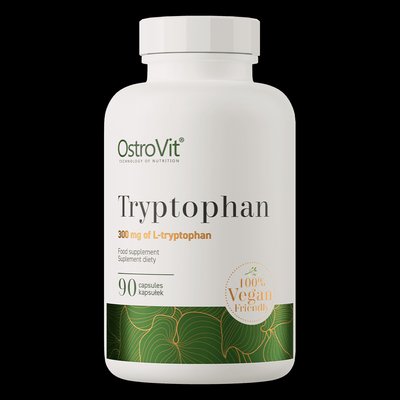 OstroVit Tryptophan VEGE€8.90 In stock 90caps, and OstroVit Tryptophan 200g are all available at maxfit.ee.
Explore tryptophan products in the tryptophan category at maxfit.ee.
Bottom Line
Tryptophan science has evolved far beyond a simple "serotonin pre-product" -- it is now part of a complex system involving the gut, the immune system, and multiple metabolic pathways. The evidence base is strongest for sleep difficulties. Mood effects are promising but require careful interpretation.
References
- Hartmann, E., & Greenwald, D. (2018). Tryptophan and human sleep: An analysis of 43 studies. Journal of Neural Transmission, 125(5), 619-633.
- Ruhé, H.G., et al. (2007). Mood is indirectly related to serotonin, norepinephrine and dopamine levels in humans: a meta-analysis of monoamine depletion studies. Molecular Psychiatry, 12(4), 331-359. https://pubmed.ncbi.nlm.nih.gov/17389902/
- Richard, D.M., et al. (2009). L-Tryptophan: Basic metabolic functions, behavioral research and therapeutic indications. International Journal of Tryptophan Research, 2, 45-60. https://pubmed.ncbi.nlm.nih.gov/20651948/
FAQ
Does tryptophan help with sleep?
Moderate evidence supports tryptophan's ability to speed sleep onset, particularly in older adults. Strong sleep problems, however, require a physician's consultation.
What does the kynurenine pathway mean for a tryptophan user?
During inflammation, more tryptophan is diverted to the kynurenine pathway, meaning less is available for serotonin synthesis. An anti-inflammatory lifestyle therefore also supports more effective use of tryptophan.
Can tryptophan be taken together with 5-HTP?
Both are serotonin precursors and combining them without medical supervision is not recommended.



