Tryptophan Myths vs Facts
Tryptophan is an essential amino acid that has attracted popular attention primarily for its role in serotonin and melatonin biosynthesis — pathways linked to mood regulation and sleep. This biochemical relevance has inspired a range of supplement claims, some grounded in evidence, others not. The turkey-at-Thanksgiving sleepiness myth is perhaps the most famous tryptophan misconception, but the supplement space has generated several of its own.
Common Myths About Tryptophan
Myth 1: Eating turkey (or tryptophan-rich foods) will make you sleepy
This is the most culturally embedded tryptophan myth. Turkey does contain tryptophan, but so do most protein-containing foods — chicken, beef, eggs, and cheese contain comparable amounts. Post-holiday sleepiness is far more attributable to overall caloric excess, alcohol consumption, and social relaxation than to tryptophan content specifically. This is worth stating plainly because it establishes an important principle: dietary tryptophan in normal food quantities does not have a meaningful pharmacological effect on sleepiness.
Myth 2: Tryptophan supplements directly raise serotonin levels in the brain
Tryptophan is indeed converted to serotonin via 5-HTP as an intermediate. However, the pathway from supplemental tryptophan to brain serotonin elevation in healthy individuals is not straightforward. Tryptophan must cross the blood-brain barrier using a transport system shared with other large neutral amino acids (LNAAs). A high-protein meal — even one rich in tryptophan — increases all LNAAs simultaneously, so the ratio of tryptophan to competing amino acids does not necessarily improve brain uptake. Supplements taken in fasted or low-protein conditions may improve the tryptophan-to-LNAA ratio and potentially support serotonin synthesis, but claiming that tryptophan supplements universally and significantly raise brain serotonin is an oversimplification.
Myth 3: Tryptophan is a natural antidepressant for everyone
There is some research on tryptophan and mood. A review found that dietary tryptophan depletion experiments (which reduce brain tryptophan) reliably worsen mood in people with a history of depression, suggesting serotonin involvement in mood regulation (Young & Leyton, 2002). However, this does not automatically reverse to mean that supplementing tryptophan improves mood in healthy people or effectively treats depression. Serotonin synthesis is subject to multiple regulation points beyond tryptophan availability.
Myth 4: Tryptophan is the most effective sleep supplement available
For sleep, tryptophan has some evidence at supplemental doses — a meta-analysis found that l-tryptophan supplementation modestly reduced the time it took to fall asleep (Hartmann et al., 1983 data reviewed in modern meta-analyses). However, more direct interventions like melatonin have stronger and more consistent evidence for sleep-onset latency reduction in specific populations. Tryptophan's sleep effects are modest and most apparent in people with mild sleep difficulties rather than clinical insomnia.
What the Evidence Actually Shows
The strongest evidence for supplemental tryptophan:
- Sleep latency reduction: modest benefits in people with mild sleep difficulties at doses in the range studied in clinical trials (Hartmann, 1982).
- Mood modulation under depletion: in people with a personal or family history of depression, maintaining adequate tryptophan intake appears relevant (Young & Leyton, 2002).
- Pre-sleep cognitive effects: some evidence that tryptophan may reduce pre-sleep cognitive alertness, which can contribute to better sleep onset.
MST L-Tryptophan 500mg 60caps, NOW L-Tryptophan 500mg 60 veg caps, 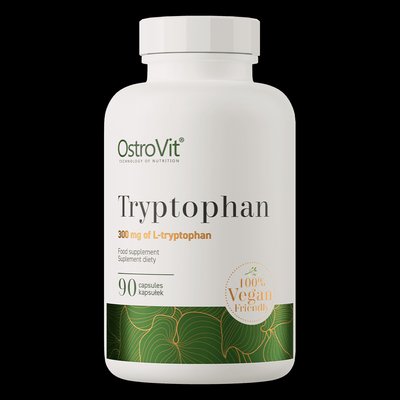 OstroVit Tryptophan VEGE€8.90 In stock 90caps, and OstroVit Tryptophan 200g are tryptophan supplements available at maxfit.ee in both capsule and powder formats.
Marketing Claims vs Reality
Tryptophan is frequently marketed as a "natural serotonin booster" or a "mood and sleep optimizer." These labels imply reliability and potency that the evidence does not fully support for the general population. The substance is not without effect — but framing it as a broadly effective antidepressant or sleep cure is beyond the evidence.
The more honest framing: tryptophan supplementation can support the serotonin and melatonin synthesis pathways — which matters most when tryptophan availability is limiting (e.g., low-protein diets, periods of high physiological stress, or specific genetic variations in tryptophan metabolism).
Grey Areas
- Tryptophan and appetite: some research suggests that tryptophan may influence appetite through serotonin pathways, potentially supporting satiety. The evidence is preliminary and mostly from animal models.
- Tryptophan and premenstrual mood changes: small trials have explored tryptophan in premenstrual dysphoric disorder with mixed results; insufficient for firm recommendations.
- Individual variation: people vary substantially in their conversion of tryptophan to serotonin vs. through the kynurenine pathway. This metabolic variation makes population-level predictions about tryptophan effects challenging.
Bottom Line
Tryptophan is a genuine physiological player in mood and sleep regulation — but as a supplement, its effects are modest and context-dependent. The strongest case for it is for people with mild sleep difficulties wanting a non-pharmacological support option, or those with dietary patterns that limit tryptophan intake. It is not a replacement for proven sleep hygiene practices or medical treatment of mood disorders. At typical supplemental doses it is generally safe and well-tolerated, though it should not be combined with SSRIs or MAO inhibitors without medical supervision.
FAQ
When should I take tryptophan for sleep?
Research typically uses tryptophan taken 30–60 minutes before sleep, in a fasted or low-protein state to maximise brain uptake relative to competing amino acids. Taking it with a carbohydrate snack may further improve the tryptophan-to-LNAA ratio by stimulating insulin release, which clears competing amino acids from the blood.
Can tryptophan interact with antidepressants?
Yes — this is an important safety point. Combining tryptophan with selective serotonin reuptake inhibitors (SSRIs) or monoamine oxidase inhibitors (MAOIs) can theoretically contribute to serotonin syndrome — a potentially serious condition. Always disclose supplement use to your prescriber if you are on antidepressant medication.
Is there a difference between L-tryptophan and 5-HTP?
Yes. 5-HTP is the direct intermediate between tryptophan and serotonin — it crosses the blood-brain barrier more efficiently and may have more potent effects on serotonin synthesis. Tryptophan is earlier in the pathway and competes with other amino acids for transport. Both are used as supplements, but 5-HTP acts more directly and carries proportionally greater caution regarding interactions with serotonergic medications.
References
Young, S. N., & Leyton, M. (2002). The role of serotonin in human mood and social interaction. Pharmacology Biochemistry and Behavior, 71(4), 857-865. https://pubmed.ncbi.nlm.nih.gov/11888576/
Hartmann, E. (1982). Effects of L-tryptophan on sleepiness and on sleep. Journal of Psychiatric Research, 17(2), 107-113. https://pubmed.ncbi.nlm.nih.gov/6764927/
van Donkelaar, E. L., Blokland, A., Ferrington, L., Kelly, P. A., Steinbusch, H. W., & Prickaerts, J. (2011). Mechanism of acute tryptophan depletion: is it only serotonin? Molecular Psychiatry, 16(7), 695-713.



