Tryptophan for Athletes: Performance Evidence
L-tryptophan is an essential amino acid — one that the body cannot synthesise and must obtain from diet. As the sole dietary precursor to serotonin and, downstream, melatonin, tryptophan occupies an interesting theoretical position for athletes: serotonin is implicated in central fatigue, sleep quality, and mood, all of which influence training capacity and recovery. This review examines the mechanistic theory, the clinical evidence in athletic populations, and an honest verdict.
Mechanism in Sport: The Serotonin Fatigue Hypothesis
The central fatigue hypothesis proposes that increased brain serotonin during prolonged exercise contributes to the perception of fatigue and eventual performance impairment. Tryptophan competes with branched-chain amino acids (BCAAs) for transport across the blood-brain barrier via the large neutral amino acid transporter. During prolonged exercise, BCAAs are oxidised by muscle, reducing their plasma concentration and giving free tryptophan a competitive advantage for brain entry. This leads to increased serotonin synthesis, theoretically contributing to central fatigue.
Based on this model, researchers originally hypothesised that:
- BCAAs might reduce fatigue by out-competing tryptophan
- Extra tryptophan might worsen fatigue
- Reducing tryptophan uptake might be performance-preserving
The picture proved more complex than early models predicted.
Strength, Endurance, and Sleep Evidence
Endurance performance. A double-blind randomised crossover study in competitive cyclists found that acute L-tryptophan supplementation had no significant effect on time-to-exhaustion cycling performance compared with placebo (Stensrud et al., 1992). The authors concluded that the serotonin-fatigue relationship was likely more nuanced than the simple precursor model suggested.
Central fatigue. A review of the central fatigue hypothesis concluded that while serotonin clearly plays a role in brain fatigue perception, the relationship between peripheral tryptophan availability and meaningful changes in brain serotonin during exercise remains uncertain in healthy athletes performing acute bouts (Meeusen & De Meirleir, 1995). The hypothesis has not translated reliably into practical performance gains from tryptophan supplementation.
Sleep and recovery. Tryptophan's role in melatonin synthesis provides a secondary rationale for athletes. Poor sleep is the single most potent impairment to athletic recovery. Some research suggests that tryptophan supplementation (typically 1 g before bed) may modestly improve sleep onset latency in people with mild sleep difficulty, which could indirectly benefit recovery (Hartmann, 1982).
Mood and motivation. Serotonin is involved in mood regulation. Overreaching/overtraining syndrome is associated with decreased resting brain serotonin markers and persistent low mood. Whether tryptophan supplementation can counter overtraining-related mood depression is speculative, with no well-powered trials.
Effective Protocol
For sleep support, research has most often used doses in the range of 1–2 g taken 30–60 minutes before sleep. Products at maxfit.ee/et/category/truptofaan include MST L-Tryptophan 500mg 60caps, NOW L-Tryptophan 500mg 60 veg caps, 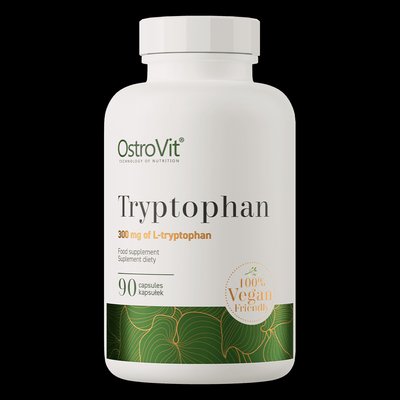 OstroVit Tryptophan VEGE€8.90 In stock 90caps, and OstroVit Tryptophan 200g — providing flexible dosing options from capsule to powder form.
For a theoretical pre-training cognitive effect, evidence is insufficient to recommend a specific protocol at this time.
Practical note: Tryptophan absorption is enhanced when taken with carbohydrates (which lower competing BCAA levels via insulin-stimulated muscle uptake) and reduced when taken alongside large amounts of other protein (high-competition environment). Taking it as a standalone supplement, away from protein-heavy meals, maximises brain availability.
Who Benefits
- Athletes with disrupted sleep patterns: those in high-volume training blocks with early morning starts or travel-related jet lag may benefit from the melatonin pathway effect
- Athletes prone to low mood during heavy training blocks: tryptophan supports serotonin precursor availability, though this is not a clinical treatment for depression
- Athletes curious about natural recovery support: tryptophan is non-stimulatory, non-habit-forming, and well-tolerated — making it a low-risk option to trial for sleep quality
Recreational athletes training at moderate volumes with no sleep complaints are unlikely to notice meaningful performance gains.
Honest Verdict
The serotonin fatigue hypothesis, while intellectually compelling, has not translated into consistent performance gains from tryptophan supplementation in well-controlled trials. Tryptophan is not an ergogenic aid in the conventional sense. Its most defensible use for athletes is as a mild sleep-support supplement taken before bed, leveraging the tryptophan-to-melatonin pathway. This is a legitimate, low-risk application with some clinical backing. For performance-during-training claims, the evidence base is insufficient to make a strong recommendation. Available at maxfit.ee, tryptophan supplements are generally safe at supplemental doses for healthy adults.
References
Stensrud, T., Ingjer, F., Holm, H., & Stromme, S. B. (1992). L-tryptophan supplementation does not improve running performance. International Journal of Sports Medicine, 13(6), 481–485. https://pubmed.ncbi.nlm.nih.gov/1428380/
Meeusen, R., & De Meirleir, K. (1995). Exercise and brain neurotransmission. Sports Medicine, 20(3), 160–188. https://pubmed.ncbi.nlm.nih.gov/8571000/
Hartmann, E. L. (1982). Effects of L-tryptophan on sleepiness and on sleep. Journal of Psychiatric Research, 17(2), 107–113. https://pubmed.ncbi.nlm.nih.gov/6764927/
FAQ
Can tryptophan improve athletic performance?
Direct evidence for performance enhancement from tryptophan supplementation is not convincing based on available randomised trials. Its most supported application for athletes is modest sleep quality support via the melatonin pathway.
When should athletes take tryptophan supplements?
For sleep support, take 500 mg to 1 g approximately 30–60 minutes before bed, ideally on an empty stomach or with a small carbohydrate-only snack to maximise brain entry. Avoid combining with large protein meals.
Is tryptophan safe for athletes?
L-tryptophan is generally safe at typical supplemental doses (500 mg–2 g per day) in healthy adults. It can cause mild drowsiness and should not be combined with serotonergic medications (SSRIs, SNRIs, MAOIs) without medical supervision due to risk of serotonin syndrome.



