What Is Tryptophan and Why Does Dosage Matter?
Tryptophan is an essential amino acid that the body cannot synthesise on its own — it must come from diet or supplementation. Its significance in supplement guides stems from its role as the sole dietary precursor to serotonin and, downstream, melatonin. Because the enzyme that converts tryptophan to serotonin (tryptophan hydroxylase) is not saturated at normal dietary intakes, providing additional tryptophan through supplementation can, in principle, increase serotonin synthesis. Tryptophan dosage therefore determines how much substrate is available for these pathways — and getting the dose right means balancing meaningful benefit against cost and safety.
Studied Effective Dose Ranges
The clinical literature on tryptophan supplementation covers a fairly wide range. For sleep onset and quality, doses of approximately 1 g taken 45–60 minutes before bed have shown benefit in studies examining subjective sleep measures (Hartmann, 1982). This is considerably lower than many products imply. For mood and cognitive effects, higher doses of 2–3 g have been explored; a review of tryptophan loading studies found dose-dependent effects on central serotonergic function, though effects in non-deficient healthy adults are limited and mixed (Silber & Schmitt, 2010).
Important context: free tryptophan crosses the blood-brain barrier via a shared transporter that it competes with other large neutral amino acids (LNAAs) for. Taking tryptophan with a carbohydrate-rich, low-protein snack increases the brain-entry ratio because insulin lowers competing LNAAs in plasma. This is why pairing tryptophan with a small carbohydrate snack may enhance its central effects at lower doses.
Dose by Goal
| Goal | Typical dose | Notes |
|---|---|---|
| Sleep onset support | 0.5–2 g, 45–60 min before bed | With carbohydrate, away from high-protein food |
| Mood / serotonin support | 1–3 g/day in divided doses | Evidence in healthy adults is weaker than for sleep |
| Athletic recovery (general amino acid role) | Met through dietary protein; supplemental need is lower | Tryptophan is present in most protein-rich foods |
MST L-Tryptophan 500mg 60caps provides 500 mg per capsule, making it easy to hit the 1 g sleep dose with two capsules. NOW L-Tryptophan 500mg 60 veg caps is a plant-based alternative at the same dose per capsule. 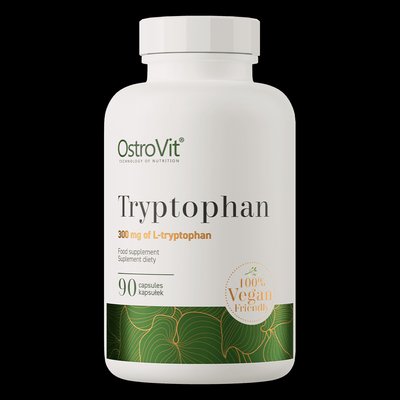 OstroVit Tryptophan VEGE€8.90 In stock 90caps and OstroVit Tryptophan 200g offer capsule and powder flexibility if you want to dial in a specific dose.
Upper Limits and Safety Signals
Tryptophan was temporarily removed from markets in some countries after a 1989 contamination incident linked to a specific manufacturing batch caused eosinophilia-myalgia syndrome (EMS). Subsequent investigation traced EMS to a contaminant in that batch, not to tryptophan itself. Pharmaceutical-grade and high-quality food-supplement tryptophan is considered safe.
No formal tolerable upper intake level (UL) has been established by EFSA for supplemental tryptophan in healthy adults. In practice, doses above 3–4 g/day are unlikely to provide additional benefit for the primary studied outcomes and may increase the theoretical risk of serotonergic side effects, particularly in people taking serotonergic medications (SSRIs, SNRIs, MAO inhibitors). This combination should be avoided without direct medical supervision.
Nausea is the most commonly reported side effect at doses above 2–3 g taken in a single sitting.
Timing Relative to the Dose
For sleep support, the clearest benefit is observed when tryptophan is taken 45–60 minutes before intended sleep time, away from a high-protein meal. A small carbohydrate snack alongside (e.g., a few crackers) can enhance brain uptake by lowering competing LNAA concentrations in plasma.
For mood or daytime use, dividing the dose across 2–3 administrations spread through the day avoids single-dose nausea and provides more consistent substrate availability.
Practical Protocol
- Start low: begin at 500 mg–1 g before bed. Assess subjective sleep quality, morning alertness, and any GI symptoms over 1–2 weeks before adjusting.
- Pair with carbohydrate: a small carbohydrate-containing snack (fruit, crackers) taken at the same time may enhance central effects by reducing LNAA competition. Avoid taking it with a protein shake or high-protein meal.
- Medication check: if you take any serotonergic medication, discuss with your doctor before starting tryptophan. The combination is not automatically dangerous but should be monitored.
- Avoid exceeding 3 g/day without a specific clinical reason. Most sleep-related benefits plateau below this threshold.
- Use as needed rather than indefinitely — for situational sleep difficulties (travel, shift work, stressful periods) rather than as a permanent sleep aid.
Tryptophan supplements are available at maxfit.ee in the truptofaan category.
References
Hartmann, E. L. (1982). Effects of L-tryptophan on sleepiness and on sleep. Journal of Psychiatric Research, 17(2), 107–113. https://pubmed.ncbi.nlm.nih.gov/6764927/
Silber, B. Y., & Schmitt, J. A. J. (2010). Effects of tryptophan loading on human cognition, mood, and sleep. Neuroscience & Biobehavioral Reviews, 34(3), 387–407. https://pubmed.ncbi.nlm.nih.gov/20416841/
FAQ
How much tryptophan should I take for sleep?
For sleep onset support, the most studied range is 0.5–2 g taken 45–60 minutes before bed with a small carbohydrate snack and away from high-protein food. Starting at 500 mg–1 g and adjusting based on response is a sensible approach.
Can I take tryptophan with 5-HTP?
Both tryptophan and 5-HTP (the intermediate between tryptophan and serotonin) act on the same serotonin synthesis pathway. Combining them without medical supervision is not recommended, as the cumulative serotonergic effect is difficult to predict and could increase side-effect risk.
Is tryptophan safe for daily use?
At the doses studied for sleep (0.5–2 g/day), tryptophan from quality supplements is generally considered safe for short-to-medium-term use in healthy adults not on serotonergic medications. Long-term daily use at higher doses has not been studied thoroughly enough to make a confident recommendation.



