How to Choose a Quality Spirulina Supplement
Spiulina quality matters more than with many other supplements. As a microalgae harvested from water, spirulina's nutritional content and safety profile are heavily dependent on where and how it is grown. A premium product from a controlled, tested source is fundamentally different from a cheap product with unknown origin. This guide covers what to check before you buy.
What to Look for on the Label
The label should declare:
- Species: Arthrospira platensis (or Spirulina platensis) or Arthrospira maxima. These are the commercially cultivated species with a research safety record. Products that do not specify species leave open the possibility of mixing with related cyanobacteria that may produce toxins.
- Growing location or production origin: Hawaii, India, and China are the three dominant growing regions. Each has reputable producers and lower-quality operations. Hawaii-grown spirulina commands a premium for strict agricultural oversight. If origin is not stated, that is a transparency gap.
- Heavy metal testing: Spirulina is a bioaccumulator and will concentrate heavy metals from its growth medium. The label or manufacturer documentation should reference testing for lead, arsenic, cadmium, and mercury within established safety limits.
- Protein content per serving: Spirulina is well-regarded as a protein-dense whole food; expect roughly 60 to 70% protein by weight in high-quality dried spirulina (Chronakis, 2000).
Form and Dose Markers
Spiulina is available as powder, tablets, and capsules. Powder allows flexible dosing and is typically better value per gram, but the taste and colour (intensely green) can be off-putting for some people. Tablets and capsules offer convenience at a modest price premium.
Clinical research on spirulina's studied benefits — including antioxidant capacity and effects on lipid parameters — has used daily doses ranging from 1 to 8 grams per day across trials (Mani et al., 2000). For general nutritional supplementation, most product labels suggest 2 to 5 grams per day, which is within the range used in human studies.
At maxfit.ee, you can find products including OstroVit Spiruline 250g, OstroVit Spiruline 90tabs, and 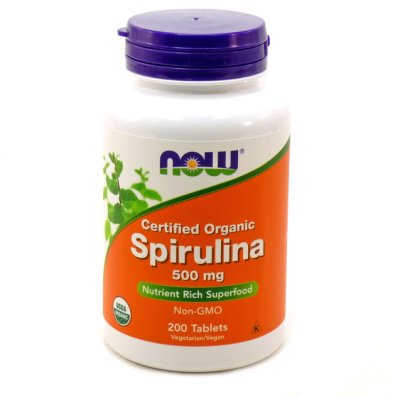 NOW Organic Spirulina€15.90 In stock 500mg 200tabs — with the NOW product carrying USDA organic certification and clearly stating species and origin.
Third-Party Testing
For spirulina more than almost any other supplement, third-party testing is critical. The key things an independent test should confirm:
- Heavy metals within safe limits — this is the primary safety concern.
- Absence of cyanotoxins — particularly microcystins, which can be produced if the culture becomes contaminated with other cyanobacteria.
- Identity confirmation — that the product actually contains Arthrospira species and not a substitute.
USDA Organic certification requires the growing medium to be free from prohibited synthetic substances, which provides some additional assurance on environmental quality. Informed Sport or NSF certification adds analytical verification of what is in the product.
Red Flags to Avoid
- No species stated — you cannot verify what you are buying.
- No origin or production location — quality control is unknown.
- No mention of heavy metal testing — the single biggest safety variable in spirulina.
- Very low price with very high claimed dose — often signals unverified or low-grade sourcing.
- Unusual colour or strong off-putting smell — fresh high-quality spirulina has a characteristic seaweedy smell; an excessively off smell can indicate oxidation or quality issues.
Value for Money
Spiulina can be purchased as a relatively inexpensive powder or in convenient tablets. Calculate value per gram, as tablet and capsule forms always cost more per gram than bulk powder. For daily use at 3 to 5 grams, powder bought in larger quantities (250 g and above) is typically the most economical.
However, a spirulina product that has not been tested for heavy metals is not a bargain regardless of price — it is an unknown risk. The premium paid for a certified product from a controlled source is justified for a supplement you plan to take regularly.
Explore the spirulina range at MaxFit in the spirulina category.
FAQ
Why is heavy metal testing so important for spirulina?
Spiulina grows in water and is a bioaccumulator — it takes up minerals and heavy metals from its growth medium at higher concentrations than are present in the water. Poorly regulated growing operations using contaminated water sources can produce spirulina with elevated levels of lead, arsenic, or cadmium. Third-party heavy metal testing is the only way to verify safety.
Can spirulina replace vegetables in my diet?
No. Spirulina is a nutritionally dense supplement that contributes protein, B vitamins, iron, and antioxidants, but it does not provide the full range of fibre, phytonutrients, and micronutrients found in a varied vegetable intake. It complements but does not replace whole foods.
Is spirulina safe for everyone?
For most healthy adults, spirulina at typical supplement doses is well-tolerated. People with phenylketonuria (PKU) should avoid it due to its phenylalanine content. Those with autoimmune conditions should consult a physician, as spirulina is thought to stimulate immune activity. Anyone on blood thinners should seek medical advice before adding spirulina regularly.
References
Chronakis, I. S. (2000). Bioseparations and bioprocessing of spirulina constituents. Bioresource Technology, 73(3), 201-209.
Mani, U. V., Desai, S., & Iyer, U. (2000). Studies on the long-term effect of spirulina supplementation on serum lipid profile and glycated proteins in NIDDM patients. Journal of Nutritional and Environmental Medicine, 10(1), 25-31.
Belay, A., Ota, Y., Miyakawa, K., & Shimamatsu, H. (2002). Current knowledge on potential health benefits of Spirulina. Journal of Applied Phycology, 5(2), 235-241.



