
Why Women May Benefit from Spirulina
Spirulina is a cyanobacterium (blue-green algae) that has been used as a food source for centuries and is now widely sold as a dietary supplement in powder and tablet form. Its nutritional profile is notable: it is a concentrated source of protein, B vitamins (except B12 in bioavailable form), iron, and antioxidants including phycocyanin.
For women specifically, two aspects of spirulina's profile are particularly relevant: its iron content and its antioxidant capacity. Women of reproductive age face higher iron requirements due to monthly losses, making plant-based or supplement-derived iron sources relevant for those who do not consume much meat. A randomised trial in anaemic school-age children found that spirulina supplementation was associated with improvements in haemoglobin levels over a 4-month period (Mani et al., 2000). While this population differs from adult women, the iron availability mechanism is applicable.
Spirulina also contains gamma-linolenic acid (GLA), an omega-6 fatty acid found in few plant sources, which has been studied in the context of hormonal regulation and premenstrual symptoms — though the evidence in women is limited and not yet conclusive.
Hormonal and Life-Stage Notes
Spirulina does not contain phytoestrogens and is not expected to significantly influence sex hormone levels. For this reason, it is generally considered a neutral supplement from a hormonal standpoint — suitable across reproductive life stages.
Some women report improved energy and reduced fatigue when correcting sub-optimal iron levels through spirulina use, consistent with its iron content. However, spirulina's iron is non-haem iron, which has lower bioavailability than haem iron from animal sources. Consuming spirulina alongside vitamin C-rich foods or supplements significantly improves non-haem iron absorption.
For perimenopausal and postmenopausal women, spirulina's antioxidant compounds — particularly phycocyanin — may support oxidative stress management. An RCT in older adults found that spirulina supplementation was associated with improvements in antioxidant markers compared with placebo (Park et al., 2008).
Dose Considerations
Studied doses in clinical trials range from approximately 1 g to 10 g per day, with many studies using 2–4.5 g daily. OstroVit Spiruline 90tabs and MST Spirulina 90tabs are tablet formats available at maxfit.ee that make dosing straightforward. 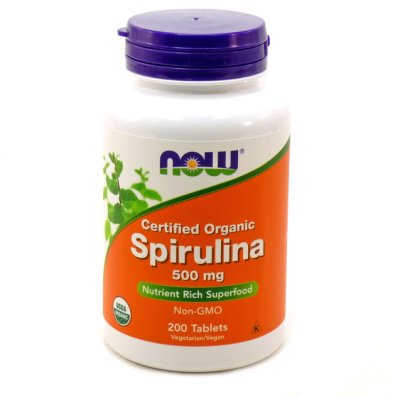 NOW Organic Spirulina€15.90 In stock 500mg 200tabs provides certified organic sourcing with 500 mg per tablet, suitable for building up to higher intakes gradually.
Powder forms like OstroVit Spiruline 250g can be mixed into smoothies or water, which some users find convenient.
Start with a lower dose (1–2 g per day) and increase over 1–2 weeks to allow the digestive system to adjust. The strong taste and colour of spirulina powder can be off-putting initially.
Pregnancy and Safety Notes
Spirulina has a long history of human consumption and a broad safety profile at typical doses. However, if spirulina is cultivated in contaminated water, it can accumulate heavy metals and toxic microcystins. This is the most important safety consideration: only choose products that have been independently third-party tested for contaminants.
Due to insufficient controlled safety data in pregnancy, standard nutritional guidance is to consult a healthcare provider before using spirulina as a supplement during pregnancy, even though it is a food-derived product.
Women taking blood thinners, immunosuppressants, or thyroid medications should discuss spirulina with their doctor, as it may interact with these treatments.
Bottom Line
Spirulina is a nutritionally rich supplement with a reasonable evidence base for antioxidant support and modest contributions to iron intake, relevant for many women. It does not appear to influence hormones and is well-tolerated at standard doses by most healthy adults. Sourcing from quality-tested suppliers is important to avoid contamination risks. Pregnant women and those on medications should seek medical guidance before use.
FAQ
Is spirulina a good source of iron for women?
Spirulina contains non-haem iron, which is less bioavailable than haem iron from meat. Pairing spirulina with vitamin C sources enhances absorption. It can contribute to daily iron intake, but women with diagnosed iron deficiency anaemia should work with a healthcare provider on their treatment plan.
Can spirulina cause hormonal changes in women?
Spirulina does not contain phytoestrogens and is not expected to alter sex hormone levels based on available evidence. It is generally considered hormonally neutral.
Is spirulina safe to take every day?
At typical supplemental doses (1–5 g per day), spirulina is generally well tolerated with daily use in healthy adults. The key safety variable is product quality — choose third-party tested brands to avoid contamination with heavy metals or microcystins.
References
Mani, U. V., Desai, S., & Iyer, U. (2000). Studies on the long-term effect of spirulina supplementation on serum lipid profile and glycated proteins in NIDDM patients. Journal of Nutraceuticals, Functional and Medical Foods, 2(3), 25-32.
Park, H. J., Lee, Y. J., Ryu, H. K., Kim, M. H., Chung, H. W., & Kim, W. Y. (2008). A randomized double-blind, placebo-controlled study to establish the effects of spirulina in elderly Koreans. Annals of Nutrition and Metabolism, 52(4), 322-328. https://pubmed.ncbi.nlm.nih.gov/18714150/
Karkos, P. D., Leong, S. C., Karkos, C. D., Sivaji, N., & Assimakopoulos, D. A. (2011). Spirulina in clinical practice: evidence-based human applications. Evidence-Based Complementary and Alternative Medicine, 2011, 531053. https://pubmed.ncbi.nlm.nih.gov/18955364/



