Natural Food Sources of Spirulina
Spirulina is a blue-green microalga (technically a cyanobacterium) that flourishes in warm, alkaline, mineral-rich lakes. The main natural food sources of spirulina are harvested from large open-water lakes — most famously Lake Chad in Africa and several lakes in Mexico — as well as from controlled aquaculture ponds worldwide. It has been eaten by indigenous peoples of those regions for centuries, and today it is one of the most studied microalgae for human nutrition.
Top Food Sources of Spirulina
Unlike vitamins and minerals that occur across a wide variety of foods, spirulina is unique: the "food source" essentially is the organism itself. There is no equivalent in conventional Western food that contains spirulina.
| Source format | Typical use |
|---|---|
| Dried spirulina flakes | Traditional harvest from lakes (Lake Chad, Mexico) |
| Spirulina powder | Commercially spray-dried; can be added to smoothies or food |
| Spirulina tablets / capsules | Compressed powder; most controlled dose form |
| Spirulina-enriched foods | Pasta, crackers, energy bars with spirulina added |
The nutritional profile of spirulina is notable. Per gram of dry weight, spirulina contains a high proportion of protein including all essential amino acids, as well as the pigment phycocyanin, beta-carotene, gamma-linolenic acid (GLA), iron, and B vitamins. Protein content can reach roughly 60–70% of dry weight in quality preparations (Dillon et al., 2003), though the exact figure varies by strain and drying method.
Bioavailability from Food vs Supplement
Spirulina lacks the hard cellulose cell walls found in higher plants, which means its cellular contents are relatively accessible during digestion. This makes bioavailability of spirulina protein and pigments generally good compared to many plant protein sources.
The iron in spirulina is primarily non-haem iron. Absorption of non-haem iron is influenced by co-consumed foods — vitamin C increases uptake while calcium, tannins, and phytates reduce it. The phycocyanin content, responsible for spirulina's characteristic blue-green colour, is water-soluble and digests readily.
Powder and tablet forms are nutritionally equivalent as long as quality and storage conditions are similar. The tablet form has the advantage of standardised weight per unit, making dosing straightforward.
Daily Targets from Diet
There is no established dietary reference value for spirulina in Estonia or the EU. Studies examining health outcomes — including antioxidant capacity and lipid profiles — have used varying amounts of dried spirulina. A review of clinical trials found that research protocols typically used multi-gram daily doses over periods of several weeks to observe measurable effects (Dillon et al., 2003).
Adding spirulina powder to daily smoothies or meals is a practical way to incorporate it as a food, though reaching the higher amounts used in research protocols purely through food-enriched products requires dedicated effort.
Cooking and Storage Effects
Spirulina's phycocyanin and chlorophyll degrade with prolonged heat exposure. Adding spirulina powder to already-prepared warm food or blending it into cold smoothies preserves more of its pigment content than baking or cooking it at high temperatures for extended periods.
Storage in airtight, light-protected containers in cool conditions is important. Spirulina powder oxidises and loses colour over time when exposed to air, light, or humidity. Well-sealed tablets and capsules are more stable over longer storage periods.
When Food Is Not Enough
For most Europeans, "food sources of spirulina" means incorporating spirulina powder or spirulina-enriched products into the diet — not eating it from a lake. The dried powder and supplement forms are effectively the same material, making the distinction between "food" and "supplement" largely about format and dose control.
For consistent, measured intake, dedicated tablets or capsules are the most practical option. OstroVit Spiruline 250g offers a versatile powder format, while OstroVit Spiruline 90tabs and MST Spirulina 90tabs provide convenient tablet dosing. 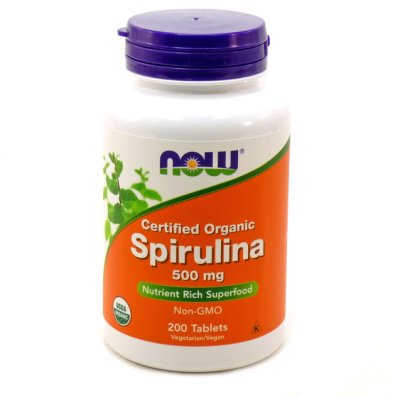 NOW Organic Spirulina€15.90 In stock 500mg 200tabs is a certified organic option. All are available at maxfit.ee.
See the full spirulina range at MaxFit spirulina category.
FAQ
Is there spirulina in any common foods?
Spirulina does not naturally occur in common European foods. It is found in certain fortified or specialty products — spirulina pasta, energy bars, or green superfood blends — but these use added spirulina powder, not a natural food source.
Does cooking destroy spirulina nutrients?
Prolonged high-heat cooking does degrade heat-sensitive pigments such as phycocyanin. For maximum nutritional value, add spirulina to cold or lightly warm dishes rather than baking it at high temperatures for long periods.
Can spirulina replace meat protein?
Spirulina provides complete protein with all essential amino acids, but the amounts in typical servings are modest compared to a meat-sized portion. It can complement a varied diet rather than replace a main protein source entirely.
References
Dillon, J. C., Phuc, A. P., & Dubacq, J. P. (2003). Nutritional value of the alga Spirulina. World Review of Nutrition and Dietetics, 77, 32–46.
Karkos, P. D., Leong, S. C., Karkos, C. D., Sivaji, N., & Assimakopoulos, D. A. (2011). Spirulina in clinical practice: evidence-based human applications. Evidence-Based Complementary and Alternative Medicine, 2011, 531053. https://pubmed.ncbi.nlm.nih.gov/18955364/



