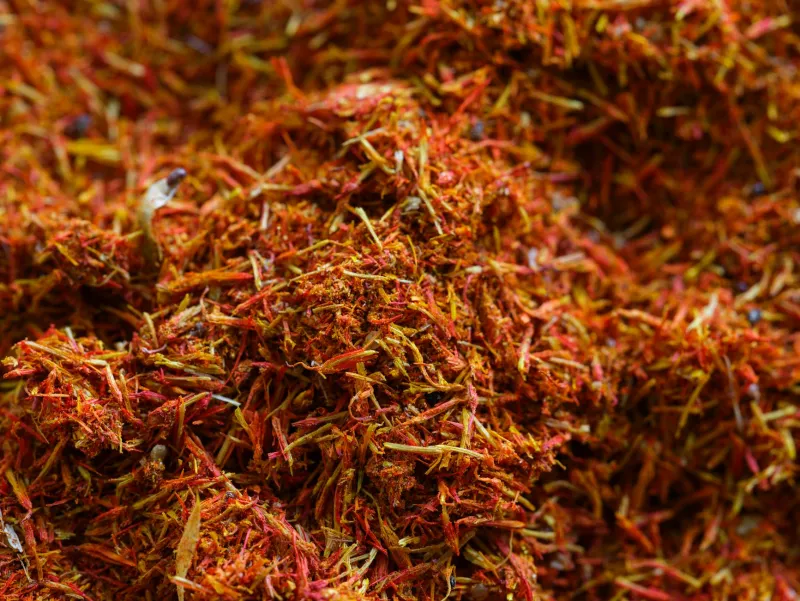
Saffron Extract vs Culinary Saffron: Why the Distinction Matters
Who this is for: Anyone considering saffron for mood, sleep, or recovery support who doesn't know what to look for on the label. After reading, you'll be able to evaluate quality, find the right dose, and avoid overpaying for underdosed products.
Saffron (Crocus sativus) is the world's most expensive spice — one kilogram requires the stigmas of roughly 150,000 flowers and costs between €3,000 and €15,000. But saffron extract sold as a dietary supplement is a fundamentally different product from the spice on your kitchen shelf. The key difference: extract is standardized to contain a defined concentration of bioactive compounds, while the spice varies widely (Melnyk et al., 2010).
TL;DR
- Effective dose: 30 mg standardized extract per day (Hausenblas et al., 2013)
- Look for on the label: ≥3.5% lepticrosalides OR ≥2% crocins
- Duration: at least 6–8 weeks of consistent use before judging
- Culinary saffron does not replace supplements — 30 mg extract ≈ 150 mg spice, but bioactive content varies massively
- Price: €15–40/month is a reasonable range for quality extract
The Three Key Bioactive Compounds
Saffron's effects come from three compounds that work in concert (Finley & Gao, 2017):
| Compound | Function | What to Check |
|---|---|---|
| Crocin | Carotenoid pigment; supports mood via serotonin and dopamine pathways | ≥2% standardization |
| Safranal | Volatile compound; calming effect, supports sleep | Present only in quality extracts |
| Crocetin | Smaller molecule; crosses blood-brain barrier | Best bioavailability |
Important: these three work synergistically. Isolated crocin capsules may not deliver the same results as a full-spectrum extract.
Standardization: How to Evaluate Quality
The saffron supplement market is one of the most problematic in the herbal product space. A 2023 study found that nearly 40% of marketed saffron contained adulteration with safflower (Carthamus tinctorius) or turmeric (Heidarbeigi et al., 2023).
Quality Control Checklist:
- ISO 3632 compliance — the international standard that grades saffron into Categories I, II, and III based on absorption values
- Lepticrosalides content ≥3.5% — the standard used by affron® and Saffr'Activ®
- Third-party testing — HPLC analysis confirming actual bioactive content
- Origin: Iran (90% of world production), Spain, Greece, Kashmir — all are fine, but Iranian saffron is the most studied
- Capsules vs powder: capsules are more stable because safranal is volatile
Dosing: What the Research Shows
The vast majority of clinical trials use 30 mg per day, split into two doses (Hausenblas et al., 2013). This dose has shown efficacy across 5 meta-analyses.
| Goal | Dose | Duration | Evidence Level |
|---|---|---|---|
| Mood support | 30 mg/day | 6–12 weeks | Strong — multiple RCTs |
| PMS symptoms | 30 mg/day | 2 cycles | Moderate — Agha-Hosseini et al., 2008 |
| Appetite control | 176.5 mg Satiereal® | 8 weeks | Moderate — Gout et al., 2010 |
| Sleep | 30 mg/day | 4 weeks | Limited — early studies |
| Eye health | 20–30 mg/day | 3+ months | Moderate — Piccardi et al., 2012 |
Important: Do not exceed 200 mg per day. Doses above 5 g can be toxic (Schmidt et al., 2007).
Patented Extracts: What They Mean
Several patented saffron extracts exist, each with their own clinical dossier:
| Extract | Standardization | Studies | Avg Price |
|---|---|---|---|
| affron® | ≥3.5% lepticrosalides | 8+ RCTs | €25–35/month |
| Saffr'Activ® | ≥2% crocins | 3+ RCTs | €20–30/month |
| Satiereal® | Standardized extract | 2 RCTs (appetite) | €20–25/month |
| Generic | Variable | Few | €10–20/month |
Patented extracts aren't always better, but they guarantee batch-to-batch consistency.
Common Mistakes
- Using culinary spice instead of extract — kitchen saffron bioactive content varies up to 10-fold. 30 mg of extract is not the same as a few threads of spice.
- Adulteration behind low prices — sub-€10 packages often contain safflower. If it tastes only floral without bitterness, be cautious.
- Testing period too short — studies show results after 6–8 weeks. A 2-week trial proves nothing.
- Drug interactions — saffron may potentiate the effects of SSRIs and MAO inhibitors. Consult your doctor if taking antidepressants (Lopresti & Drummond, 2014).
- Use during pregnancy — high doses (>200 mg) may stimulate uterine contractions. Pregnant women should avoid saffron supplements.
Frequently Asked Questions
Is saffron extract the same as saffron spice?
No. Extract is concentrated and standardized — 30 mg of extract contains more bioactives than a full teaspoon of spice. Capsules also maintain more stable safranal levels since this compound is volatile.
Can saffron be combined with omega-3?
Yes, they work through different mechanisms. Omega-3 fatty acids support anti-inflammatory pathways while saffron influences serotonin and dopamine levels. Some research suggests synergy (Kashani et al., 2017).
Is cheap saffron from the internet reliable?
Rarely. Saffron adulteration is a well-documented problem. Trust only products with an ISO 3632 label, third-party testing certificate, and specific bioactive standardization stated as a percentage.
Can children take saffron?
Clinical studies have been conducted mainly in adults. Some pediatric ADHD studies have used 30 mg/day with positive results (Baziar et al., 2019), but always consult a pediatrician.
Does saffron help with post-workout recovery?
Not directly — saffron is not a recovery supplement. However, chronic stress and poor sleep slow recovery. If saffron improves sleep and mood, the indirect effect on recovery can be positive.
Estonia Context
Estonian pharmacies carry saffron extracts mostly in the €20–35 range per monthly supply. Health stores stock some standardized products, but the selection is limited. Given Estonia's long, dark winter, saffron's mood- and sleep-supporting effects are particularly relevant from October through March — the period when vitamin D deficiency (Kull et al., 2009) and lack of daylight affect well-being.
MaxFit carries quality saffron extracts with standardized bioactive content.
References
- Melnyk, J.P., Wang, S. & Marcone, M.F. (2010). Chemical and biological properties of the world's most expensive spice: Saffron. Food Research International, 43(8), 1981–1989.
- Hausenblas, H.A., Saha, D., Dubyak, P.J. & Anton, S.D. (2013). Saffron (Crocus sativus L.) and major depressive disorder: a meta-analysis of randomized clinical trials. Journal of Integrative Medicine, 11(6), 377–383.
- Finley, J.W. & Gao, S. (2017). A Perspective on Crocus sativus L. (Saffron) Constituent Crocin: A Potent Water-Soluble Antioxidant. Journal of Agricultural and Food Chemistry, 65(5), 1005–1020.
- Agha-Hosseini, M. et al. (2008). Crocus sativus L. (saffron) in the treatment of premenstrual syndrome. BJOG, 115(4), 515–519.
- Gout, B., Bourges, C. & Paineau-Dubreuil, S. (2010). Satiereal, a Crocus sativus L. extract, reduces snacking and increases satiety. Nutrition Research, 30(5), 305–313.
- Piccardi, M. et al. (2012). A longitudinal follow-up study of saffron supplementation in early age-related macular degeneration. Evidence-Based Complementary and Alternative Medicine, 2012, 429124.
- Lopresti, A.L. & Drummond, P.D. (2014). Saffron (Crocus sativus) for depression: a systematic review. Human Psychopharmacology, 29(6), 517–527.
- Schmidt, M., Betti, G. & Hensel, A. (2007). Saffron in phytotherapy: pharmacology and clinical uses. Wiener Medizinische Wochenschrift, 157(13–14), 315–319.
- Kashani, L. et al. (2017). Comparison of Saffron versus Fluoxetine in Treatment of Mild to Moderate Postpartum Depression. Pharmacopsychiatry, 50(02), 64–68.
- Baziar, S. et al. (2019). Crocus sativus L. Versus Methylphenidate in Treatment of Children with ADHD. Journal of Child and Adolescent Psychopharmacology, 29(3), 205–212.
- Kull, M. et al. (2009). Seasonal variance of 25-(OH) vitamin D in the general population of Estonia. BMC Public Health, 9, 22.
Browse saffron products at MaxFit and read more about mood support in our herbal supplements section.