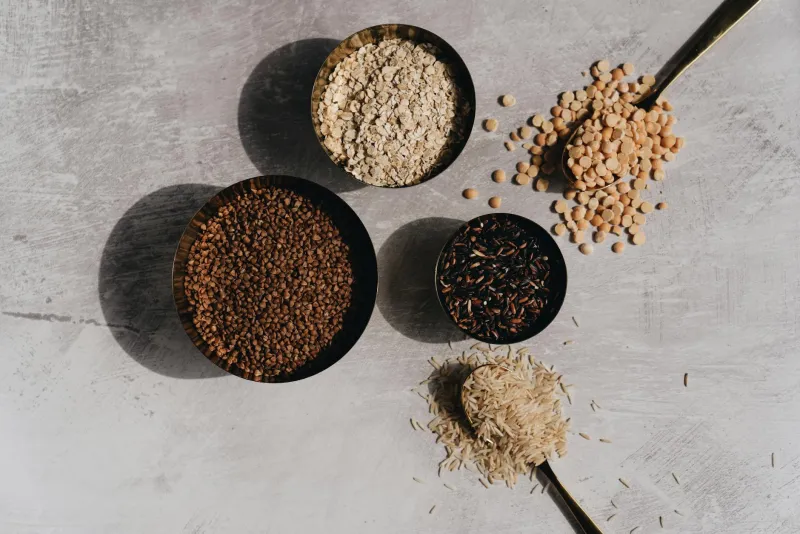
What Is Rice Protein?
Rice protein is extracted from brown rice by removing starch and fibre fractions, leaving behind a high-protein concentrate. Brown rice is preferred over white rice as it contains more protein and nutrients in unprocessed form.
The final product typically contains 70–80% protein by dry weight — slightly lower than pea protein, but still high enough for effective use as a protein supplement.
Amino Acid Profile
Rice protein's most notable limitation is its lysine deficiency. Lysine is an essential amino acid that plant proteins commonly lack:
| Amino Acid | Rice Protein | Requirement |
|---|---|---|
| Lysine | ~3.2 g/100g | Low |
| Methionine | ~3.3 g/100g | Good |
| Leucine | ~8.4 g/100g | Excellent |
| Cysteine | ~1.8 g/100g | Good |
Rice protein's leucine content is notably high — this is one reason it's more effective for muscle building than its amino acid score might suggest.
The Science: Does Rice Protein Work for Muscle Building?
Joy et al. (2013) conducted an 8-week study comparing rice protein to whey in resistance-trained men. The result was surprising: both groups showed equal gains in muscle size and strength. Rice protein did not underperform compared to whey.
The explanation lies in rice protein's high leucine content — it activates muscle protein synthesis despite the lower lysine levels.
Hypoallergenicity — Rice Protein's Greatest Advantage
Rice protein is one of the few protein sources considered nearly universally hypoallergenic:
- No lactose (dairy-free)
- No gluten (safe for wheat allergy)
- Not soy (safe for soy allergy)
- Not nut-based (safe for nut allergy)
- Suitable for most individuals with multiple food allergies
This makes rice protein the ideal choice for those with multiple food allergies who struggle to find a compatible protein source.
Digestibility
Rice protein digestibility is moderate — PDCAAS ~0.37–0.47, which is low. The main reason is lysine deficiency, which depresses the score.
However, real-world study results (Joy et al., 2013) are better than the theoretical score predicts. Digestibility score is not the only predictor of muscle mass outcomes.
Combining for Best Results
Rice protein + pea protein is one of the most popular plant protein combinations:
| Protein | Strength | Weakness |
|---|---|---|
| Rice protein | Methionine, leucine | Lysine |
| Pea protein | Lysine | Methionine |
| Combination | Complete | Minimal |
This combination produces a biologically complete protein equivalent to animal-based proteins.
Products
OstroVit Vegan Meal Shake 1000g Cappuccino contains plant protein sources including rice protein and is available at maxfit.ee. An excellent choice for those looking to replace or supplement meals with plant-based protein.
Combining rice protein with pea protein gives you a complete plant protein complex — explore the plant-based protein range at maxfit.ee.
Price
Rice protein is often cheaper than pea protein, especially in bulk sizes. This makes it an attractive option for budget-conscious vegans.
Summary
Rice protein is a valuable hypoallergenic protein source that works better for muscle building than its theoretical amino acid profile suggests. Lysine deficiency is easily solved by combining with pea protein. Ideal for people with multiple food allergies and those following whole-food plant diets.
FAQ
Does rice protein contain arsenic?
Some studies have found elevated arsenic in rice products. Reputable manufacturers test their products and heavy metal concentrations must be below safety thresholds. Choose products from established, quality-tested manufacturers.
Is rice protein gluten-free?
Yes — pure rice protein doesn't contain gluten. However, cross-contamination can occur in manufacturing facilities; check the label for a certified gluten-free mark if this is medically important.
How much rice protein per serving?
The same as other protein products: ~25–35 g per serving depending on body weight and daily protein goals.
References
- Joy, J. M., Lowery, R. P., Wilson, J. M., Purpura, M., De Souza, E. O., Wilson, S. M., ... & Jäger, R. (2013). The effects of 8 weeks of whey or rice protein supplementation on body composition and exercise performance. Nutrition Journal, 12(1), 86.
- Gorissen, S. H., Crombag, J. J., Senden, J. M., Waterval, W. H., Bierau, J., Verdijk, L. B., & van Loon, L. J. (2018). Protein content and amino acid composition of commercially available plant-based protein isolates. Amino Acids, 50(12), 1685–1695.
- van Vliet, S., Burd, N. A., & van Loon, L. J. (2015). The skeletal muscle anabolic response to plant- versus animal-based protein consumption. The Journal of Nutrition, 145(9), 1981–1991.
- Mathai, J. K., Liu, Y., & Stein, H. H. (2017). Values for digestible indispensable amino acid scores (DIAAS) for some dairy and plant proteins. British Journal of Nutrition, 117(4), 490–499.



