
What Is Quercetin and Why Does Quality Matter?
Quercetin is a flavonoid — a plant pigment compound found naturally in onions, apples, berries, and many other plants. As a supplement it is taken for its potential antioxidant, anti-inflammatory, and anti-allergic properties. Quality matters because quercetin has naturally low bioavailability, and products made from raw materials of varying purity differ substantially.
What to Look for on the Label
First check: the active-ingredient amount in milligrams. Trustworthy products clearly state quercetin (or quercetin dihydrate) content per serving. Research has used a range of amounts, and standard supplement doses typically fall between 250 and 1,000 mg per day.
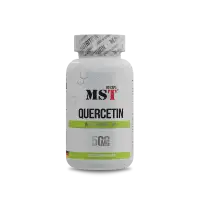 MST Quercetin Bromelain€26.90 In stock 60caps is an interesting choice because it combines quercetin with bromelain — a pineapple enzyme that may enhance absorption. OstroVit Quercetin 90caps is a clear, straightforward option with pure quercetin.
Also check:
- Quercetin purity and standardisation
- The excipient list
- Capsule material (plant-based vs. gelatin)
Forms and Bioavailability
Standard quercetin (quercetin dihydrate) is the most common form, but its bioavailability is low. Research shows quercetin absorbs better alongside fat and bioavailability enhancers. Some products use:
- Quercetin + bromelain: bromelain may improve quercetin absorption
- Liposomal quercetin: higher bioavailability, but typically more expensive
- Phytosome quercetin: phospholipid-bound form with improved absorption
Mansouri et al. (2021) found in their meta-analysis that quercetin supplementation was associated with reductions in inflammatory markers in study populations, suggesting a potential anti-inflammatory effect.
Third-Party Testing
Independent laboratory confirmation is important for quercetin products because raw material quality varies. Look for NSF, Eurofins, or another recognised certification. This ensures the product contains the stated dose and is free from contaminants.
Red Flags
- No milligram figure for quercetin content
- Unrealistic claims about "curing" allergies
- No information about the source of the raw material
- Vague "immunity boosting" claims without specific data
- Excipient-heavy products with minimal active content
Value for Money
MST Quercetin Bromelain 60caps suits those seeking a combined synergistic approach. OstroVit Quercetin 90caps suits those who prefer pure quercetin at a reasonable price. Always compare cost per dose rather than pack price.
Both products are available at maxfit.ee, letting you choose the option that fits your needs.
Summary
A quality quercetin supplement should: state the exact active-ingredient amount, use a bioavailability-enhancing formulation (e.g., combined with bromelain), carry independent laboratory verification, and come from a reputable manufacturer.
FAQ
Is quercetin helpful for allergies?
Quercetin has been studied in relation to mast cell stabilisation and histamine release inhibition. The data are promising but quercetin does not replace prescribed antihistamines or allergy medication.
What is the best time to take quercetin?
Most studies recommend taking quercetin with food, as dietary fat may improve absorption. A routine with a morning meal is practical.
Can quercetin be combined with vitamin C?
Yes, vitamin C may complement quercetin's antioxidant activity. Some products combine both. This is generally a safe combination for healthy adults.
References
Mansouri, M., Alimi, R., Hosseini, S. A., Dehghan, P., Mir, H., & Hosseinzadeh, M. (2021). Quercetin supplementation and inflammatory biomarkers: a systematic review and meta-analysis of randomized controlled trials. Complementary Therapies in Medicine, 61, 102761.
Formica, J. V., & Regelson, W. (1995). Review of the biology of quercetin and related bioflavonoids. Food and Chemical Toxicology, 33(12), 1061–1080. https://pubmed.ncbi.nlm.nih.gov/8847003/
Hirano, T., Higa, S., Arimitsu, J., Naka, T., Ogata, A., Shima, Y., Fujimoto, M., Yamadori, T., Minoda, Y., & Taga, T. (2004). Flavonoids such as luteolin, fisetin and apigenin are inhibitors of interleukin-4 and interleukin-13 production by activated human basophils. International Archives of Allergy and Immunology, 134(2), 135–140. https://pubmed.ncbi.nlm.nih.gov/15153793/



