Quercetin Myths vs Facts
Quercetin is a flavonoid found naturally in onions, apples, berries, and green tea. As a supplement, it is marketed for everything from allergy relief and immune support to anti-ageing and athletic performance. This guide separates the quercetin myths from the actual evidence base.
Common Quercetin Myths
Myth 1: Quercetin is a powerful natural antihistamine that replaces medication
Quercetin does inhibit mast cell degranulation in laboratory models, which is the mechanism behind its supposed antihistamine action. However, the human evidence for clinically meaningful allergy relief from quercetin supplementation is limited and inconsistent. Quercetin is not a validated replacement for pharmaceutical antihistamines in people with clinically significant allergic conditions.
Myth 2: Quercetin dramatically boosts immune function and prevents illness
A handful of studies have explored quercetin's effects on upper respiratory illness, particularly in athletes who are at elevated risk during heavy training. A meta-analysis by Somerville et al. (2016) found that quercetin supplementation was associated with a statistically significant but numerically small reduction in incidence and duration of upper respiratory tract infections in athletes (Somerville et al., 2016). The effect size was modest and the clinical relevance for the general population is unclear.
Myth 3: All quercetin supplements are absorbed equally
Quercetin has notoriously poor bioavailability when taken as the aglycone (free form). Food-derived quercetin arrives bonded to sugars (glycosides) which may enhance absorption. Some supplements pair quercetin with bromelain or other absorption enhancers to improve uptake. A product's absorption profile matters significantly for whether the dose on the label actually reaches the bloodstream.
What the Evidence Actually Shows
Quercetin's most consistent evidence base is as an antioxidant and a modest modulator of inflammatory pathways. A systematic review by Li et al. (2016) found that quercetin supplementation was associated with significant reductions in circulating inflammatory markers, particularly CRP and IL-6, though effects varied by population and dose (Li et al., 2016).
For athletic performance, the evidence is mixed and any effects are small. Quercetin is more valuable as part of a diet rich in colourful plant foods than as a standalone high-dose supplement for most people.
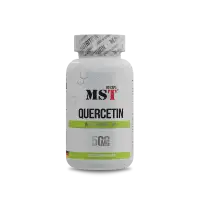 MST Quercetin Bromelain€26.90 In stock 60caps combines quercetin with bromelain to support absorption, and OstroVit Quercetin 90caps offers a straightforward quercetin supplement — both available at maxfit.ee via the quercetin category.
Marketing Claims vs Reality
| Marketing claim | What evidence actually suggests |
|---|---|
| Natural antihistamine | Some lab-model data; limited clinical evidence |
| Prevents all colds and infections | Small reduction in upper respiratory illness in athletes |
| Anti-ageing miracle | Preliminary research in cells/animals; not established in humans |
| Powerful anti-inflammatory | Modest reductions in inflammatory markers in some studies |
Grey Areas
Quercetin research is genuinely evolving. There is interesting preliminary work on quercetin as a senolytic (clearing aged cells) and on its interactions with zinc uptake, which attracted attention during the COVID-19 period. However, these areas remain experimental and are far from clinical recommendations. Do not supplement quercetin based on extrapolations from mechanistic studies.
Bottom Line
Quercetin is a safe and well-tolerated supplement with a modest evidence base for supporting inflammatory balance and, to a lesser extent, immune function in athletic contexts. It is not a medical treatment. Eating a varied, colourful diet remains the most accessible way to get quercetin alongside its natural co-factors from whole foods.
FAQ
Does quercetin help with seasonal allergies?
There is some mechanistic rationale, but clinical evidence in humans for meaningful allergy relief is limited. Do not use quercetin supplements as a replacement for prescribed allergy medication.
How much quercetin should I take?
Human studies have used a range of doses. Follow the product label and stay within recommended amounts. Products that include absorption enhancers may achieve meaningful plasma levels at lower doses.
Can I get enough quercetin from food?
Dietary quercetin from onions, apples, capers, and berries contributes to daily intake, but reaching the doses used in clinical studies typically requires supplementation.
References
Somerville, V. S., Braakhuis, A. J., & Hopkins, W. G. (2016). Effect of flavonoids on upper respiratory tract infections and immune function: a systematic review and meta-analysis. Advances in Nutrition, 7(3), 488-497. https://pubmed.ncbi.nlm.nih.gov/27184276/
Li, Y., Yao, J., Han, C., Yang, J., Chaudhry, M. T., Wang, S., Liu, H., & Yin, Y. (2016). Quercetin, inflammation and immunity. Nutrients, 8(3), 167. https://pubmed.ncbi.nlm.nih.gov/27886045/



