Best Form of Quercetin: How to Choose
Quercetin is a flavonoid polyphenol found naturally in onions, apples, berries, and green tea. It is studied for antihistamine, anti-inflammatory, and antioxidant properties. Like many polyphenols, quercetin has inherently limited oral bioavailability, which makes the choice of quercetin form practically significant.
Forms Compared
| Form | Relative absorption | Notes |
|---|---|---|
| Quercetin dihydrate | Reference — moderate | Most common retail form; stable crystalline |
| Quercetin aglycone | Similar to dihydrate | Varies by source |
| Quercetin glucoside (isoquercetin, rutin) | Higher than aglycone | Glucose attachment aids small-intestine transport |
| Quercetin + bromelain | Similar; bromelain may aid protein co-absorption | Bromelain is a digestive enzyme from pineapple |
| Quercetin phytosome (phospholipid complex) | Higher than dihydrate | Phosphatidylcholine carrier; Quercetin C3G complexes similar |
| EMIQ (enzymatically modified isoquercitrin) | Among highest studied | Very water-soluble; human PK data available |
Isoquercetin (quercetin-3-glucoside) has demonstrated notably higher plasma concentrations than quercetin aglycone in human pharmacokinetic studies (Erlund et al., 2000), because the sugar moiety facilitates active transport across the intestinal brush border.
Bioavailability Differences
Quercetin aglycone (the form most supplements use) is absorbed through passive diffusion, limited by its low aqueous solubility. Adding a glucose group (as in isoquercetin or rutin) or complexing with phospholipids substantially improves solubility and intestinal uptake.
Bromelain co-supplementation does not directly increase quercetin plasma levels but may modulate inflammatory pathways complementarily; the combination is common in sports supplement formulations for that reason.
Cost Per Effective Dose
Quercetin dihydrate is the most economical option and widely available. Phytosome or isoquercetin forms cost more but offer meaningfully higher delivery of the active compound. For everyday use where budget matters, quercetin dihydrate is practical. For situations where maximum absorption is desired, enhanced-bioavailability forms offer a tangible advantage.
At maxfit.ee you will find 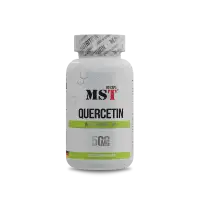 MST Quercetin Bromelain€26.90 In stock 60caps and OstroVit Quercetin 90caps — the MST product combines quercetin with bromelain for a dual-action approach. Browse the full range at /et/category/kvertsetiin.
Which Form for Which Goal
- Allergy and mast cell support: quercetin dihydrate or isoquercetin at consistent daily doses — broad flavonoid intake supports stable histamine pathways.
- Exercise recovery and inflammation: quercetin + bromelain combination — both have anti-inflammatory associations; bromelain also supports protein breakdown post-exercise.
- Maximum bioavailability: phytosome or EMIQ forms — for those wanting the highest plasma delivery per dose.
- Budget daily use: quercetin dihydrate in standard capsules — practical and widely available.
What to Look for on the Label
- Form specified: aglycone, dihydrate, isoquercetin, phytosome — generic "quercetin" without a form descriptor often means standard aglycone/dihydrate.
- Dose in mg: typical doses studied in human trials range from several hundred milligrams per day.
- Bromelain dose (GDU or FIP units) if combined — enzyme activity units matter more than mass.
- Absence of artificial colours: some quercetin products use synthetic dyes unnecessarily.
- Third-party COA: quercetin content can vary between batches, particularly in lower-cost bulk raw materials.
FAQ
Is quercetin an antihistamine?
Quercetin has demonstrated mast cell stabilising properties in laboratory studies, which is consistent with antihistamine-like activity. Human clinical evidence specifically for allergy symptom reduction is limited but promising. It should not replace prescribed antihistamines for acute allergic reactions.
Does quercetin help with exercise performance or recovery?
Some trials have explored quercetin's effects on exercise capacity and recovery, but results are inconsistent and effect sizes modest. It is best viewed as a potential supportive supplement in the context of a broader recovery strategy.
Can I take quercetin long-term?
Quercetin is generally considered safe at typical supplemental doses. Long-term human safety data beyond a few months is limited; taking breaks periodically is a sensible precaution.
References
Erlund, I., Kosonen, T., Alfthan, G., Maenpaa, J., Perttunen, K., Kenraali, J., Parantainen, J., & Aro, A. (2000). Pharmacokinetics of quercetin from quercetin aglycone and rutin in healthy volunteers. European Journal of Clinical Pharmacology, 56(8), 545-553. https://pubmed.ncbi.nlm.nih.gov/11151743/
Kempuraj, D., Madhappan, B., Christodoulou, S., Boucher, W., Cao, J., Papadopoulou, N., Cetrulo, C. L., & Theoharides, T. C. (2005). Flavonols inhibit proinflammatory mediator release, intracellular calcium ion levels and protein kinase C theta phosphorylation in human mast cells. British Journal of Pharmacology, 145(7), 934-944. https://pubmed.ncbi.nlm.nih.gov/15912140/



