Introduction to Quercetin
Quercetin (3,3',4',5,7-pentahydroxyflavone) belongs to the flavonoid family — a subgroup of polyphenols abundantly present in fruits and vegetables. It is one of the most common dietary bioflavonoids: found in especially high concentrations in onions (particularly red onions), apples, berries, capers and green tea. Adults typically consume 10–100 mg of quercetin per day through diet.
What Makes Quercetin Special?
Quercetin is a multifunctional compound with several proven mechanisms:
Antioxidant Activity
Quercetin is among the most potent flavonoid antioxidants, scavenging free radicals and protecting cells from oxidative damage (Boots et al., 2008). It is particularly effective against superoxide and hydroxyl radicals.
Anti-Inflammatory Effects
Quercetin inhibits several pro-inflammatory enzymes, including cyclooxygenase-1 and -2 (COX-1, COX-2) and lipoxygenase (LOX), reducing prostaglandin synthesis — a mechanism resembling that of non-steroidal anti-inflammatory drugs (Boots et al., 2008).
Immune System Modulation
Quercetin inhibits IgE-mediated allergic reactions by stabilising mast cell membranes and reducing histamine release (Mlcek et al., 2016). It is widely used to ease seasonal allergy symptoms.
Antiviral Properties
Laboratory studies show that quercetin inhibits viral replication, including certain influenza strains, by targeting viral proteases and polymerases (Roschek et al., 2009). This application is being actively researched for clinical use.
Bioavailability and Enhancement Strategies
Quercetin bioavailability is generally low — approximately 24% of dietary quercetin is absorbed (Erlund, 2004). Improvement options:
| Method | Effect | Mechanism |
|---|---|---|
| Combined with bromelain | Significant increase | Enzymatic breakdown |
| With vitamin C | Moderate increase | Antioxidant synergy |
| Liposomal form | Substantially better | Lipid encapsulation |
| Taken with food | ~20% increase | Fat-solubility utilisation |
Products in Estonia
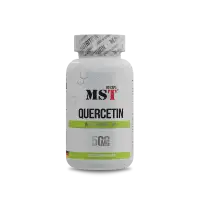 MST Quercetin Bromelain€26.90 In stock 60caps pairs quercetin with bromelain — a natural enzyme from pineapple that improves quercetin absorption and adds its own anti-inflammatory properties. OstroVit Quercetin 90caps provides pure quercetin supplementation. Both are available at maxfit.ee in the immunity category.
Quercetin and Athletic Performance
Small-scale research has explored quercetin's role in sport:
- Aerobic endurance: a meta-analysis found quercetin improved VO2max by an average of 0.3 ml/kg/min — statistically significant but clinically modest (Kressler et al., 2011)
- Recovery: reduces inflammatory markers of muscle cell damage after intense training
- Immunity: intense exercise temporarily suppresses immune function — quercetin may narrow this "open window"
Dosage
Clinical studies typically used 500–1000 mg per day, often divided into 2 doses. Take with food to improve bioavailability.
Safety
Quercetin is generally safe at doses up to 1000 mg/day. Very high doses (above 1 g/day) carry a theoretical mutagenic risk in prolonged use, though this has not been confirmed in human studies. Pregnancy — data insufficient; avoid supplementation.
References
- Boots, A. W., Haenen, G. R., & Bast, A. (2008). Health effects of quercetin: from antioxidant to nutraceutical. European Journal of Pharmacology, 585(2–3), 325–337.
- Mlcek, J., Jurikova, T., Skrovankova, S., & Sochor, J. (2016). Quercetin and its anti-allergic immune response. Molecules, 21(5), 623.
- Roschek, B., et al. (2009). Elderberry flavonoids bind to and prevent H1N1 infection in vitro. Phytochemistry, 70(10), 1255–1261.
- Erlund, I. (2004). Review of the flavonoids quercetin, hesperetin, and naringenin. Nutrition Research, 24(10), 851–874.
- Kressler, J., Millard-Stafford, M., & Warren, G. L. (2011). Quercetin and endurance exercise capacity: a systematic review and meta-analysis. Medicine & Science in Sports & Exercise, 43(12), 2396–2404.
FAQ
Does quercetin help with allergies?
Yes, quercetin has demonstrated antihistamine properties — it stabilises mast cell membranes and reduces histamine release. The effect is milder than prescription antihistamines, and individual responses vary.
Why is bromelain often paired with quercetin?
Bromelain is a pineapple enzyme that helps break down quercetin in the gut and enhances its absorption. Bromelain also has independent anti-inflammatory activity, making the combination synergistic.
Is quercetin suitable for winter immune support?
Yes, quercetin is a logical addition to a winter immune support plan, particularly in Estonia and other Nordic countries. It is frequently used alongside vitamin C and zinc during the autumn-winter period.



