


Why nobody in Estonia talks about passionflower
When an Estonian cannot sleep, step one is usually melatonin from the pharmacy, step two is valerian, and step three is googling at two in the morning. Passionflower (Passiflora incarnata) almost never enters that sequence, even though the European Medicines Agency has a formal monograph covering its traditional use for nervous tension and mild sleep problems. The reason is mundane: almost nothing on Estonian shelves is sold as passionflower alone. It hides inside multi-herb evening blends, where its amount appears on the fourth line of the ingredient list.
This article is written from a shop's point of view rather than a herbal manual's. We will look at what passionflower actually does, where its evidence stops, how it lines up next to melatonin, valerian and ashwagandha, and what you can realistically buy here if you decide to try it. If your problem is "my head will not shut up in the evening" rather than "I physically cannot fall asleep", passionflower is one of the few herbs with real randomised trials behind it rather than only tradition.
What the plant is and what is inside it
Passiflora incarnata is a climbing vine native to North America, cultivated in Europe as a medicinal plant. The aerial parts are used: stems, leaves, flowers. Frost-hardy Passiflora species are grown in Estonia as ornamentals, but medicinal-grade raw material is essentially not produced here - everything you buy locally is imported dried herb or extract.
The active-compound picture is messy, and it matters before anyone promises you a named "active ingredient". The plant contains flavonoids (vitexin, isovitexin, orientin), small amounts of harmala alkaloids, and the amino acid GABA itself. For a long time the alkaloids were assumed to do the work; current literature leans towards the flavonoids and their combined effect. No regulator has declared which single molecule is responsible, which is exactly why extracts are not interchangeable. Tea, tincture and dry extract are three different products whose doses cannot be converted one to one.
In practice this means that if the label states neither the amount of dried herb nor an extract ratio (4:1 or 5:1, for example), you do not know what you are buying. With passionflower that is usually the first reason I would reject a product.
How it works in the brain
The most consistent explanation runs through the GABA system. GABA is the brain's main inhibitory neurotransmitter; benzodiazepines, alcohol and several sleeping pills act on the same system, just far more forcefully. Passionflower extracts bind at the GABA-A receptor in laboratory conditions and also affect GABA reuptake. The effect is orders of magnitude weaker than a drug - a feature, not a flaw. That is precisely why passionflower does not deliver the classic "switched off" sensation, and equally does not deliver the morning grogginess benzodiazepines do.
A second, clinically more interesting observation: trials more often show improvement in the tension that precedes sleep than in sleep itself. That explains why one group of users says passionflower "did nothing" while another says they simply stopped thinking in bed. If anxiety is the engine of your insomnia, the target is right. If your problem is a shifted circadian rhythm - shift work, or a dark December - passionflower is the wrong tool and melatonin is the right one.
What the anxiety trials actually say
The most cited study is a four-week double-blind Iranian trial in which patients with generalised anxiety disorder received either passionflower extract or oxazepam; anxiety scores fell similarly in both arms, but the drug arm had significantly more side effects affecting job performance (Akhondzadeh et al., 2001). The sample was small, 36 people, and that should stay in mind when reading the result.
The second solid study is pre-operative: 60 ambulatory patients received either a passionflower preparation or placebo 90 minutes before surgery, and anxiety was significantly lower in the treatment group without slowing psychomotor recovery (Movafegh et al., 2008). This is probably the cleanest demonstration that the effect exists and that it is short-acting and situational.
A systematic review pulling those and the remaining clinical trials together reached a cautious conclusion: the signal is there, the safety profile is good, but samples are small and preparations too heterogeneous to produce a unified dosing recommendation (Miroddi et al., 2013). That remains an honest summary in 2026. Anyone promising you drug-comparable results from a herb is selling you something.
And what the sleep trials say
Two studies are worth knowing. In an Australian trial, 41 people drank passionflower tea in the evening for one week and placebo tea for another; sleep-diary quality improved modestly but statistically significantly, while polysomnography showed no large changes (Ngan & Conduit, 2011). A later Korean study using a dry extract and laboratory sleep measurement found improved sleep efficiency and more slow-wave sleep versus placebo (Lee et al., 2020).
Read it this way: passionflower affects how sleep feels more than what a sleep lab measures. A "modest but significant" change over one week is not the same thing as treating insomnia. If you are awake because of pain, sleep apnoea, reflux or an untreated anxiety disorder, a plant extract is not the answer and your family doctor is.
Dosing without invented precision
It is more honest to talk in ranges than in exact numbers, because preparations are not comparable.
As tea, traditional European use is roughly 1-2 g of dried herb per cup, steeped ten minutes, up to three times daily, with the evening cup an hour before bed. For tinctures, always follow the label, because the alcohol-to-water ratio changes extraction completely. Dry-extract capsules typically show 200-500 mg doses, corresponding to a much larger amount of original herb - which is exactly why the extract ratio on the label matters.
Timing matters more than dose. For anxiety, passionflower works situationally, 30-90 minutes before a stressful event. For sleep, favour a stable evening routine across two to four weeks, because a single night decides nothing here. And unlike melatonin, stacking the dose is pointless: if 400 mg does nothing, 1200 mg probably will not either, though it will increase nausea.
Comparison: where passionflower stands
| Option | What it targets | How fast | Strength | Main drawback |
|---|---|---|---|---|
| Passionflower | Pre-sleep tension, situational anxiety | 30-90 min | Weak to moderate | Preparations not comparable, scarce in Estonia |
| Melatonin | Circadian rhythm, sleep onset | 30-60 min | Moderate for rhythm shifting | Not calming; high doses cause morning grogginess |
| Valerian | Sleep onset, subjective quality | 2-4 weeks | Weak, trials conflicting | Smell and taste; paradoxical arousal in some |
| Lemon balm | Tension, nervous gut | 30-60 min | Weak | Effect often disappears when used alone |
| Ashwagandha | Chronic stress, cortisol | 4-8 weeks | Moderate over time | Not an evening quick fix; thyroid caution |
| Hops | Sleep onset alongside valerian | 1-2 weeks | Weak alone | Almost always sold in blends |
The summary of that table: passionflower is fast and gentle, ashwagandha is slow and systemic, melatonin is a rhythm tool. Those three do not compete - they solve different problems, and that is precisely why so many disappointed buyers simply picked the wrong category.
How to tell a decent preparation from a poor one
Passionflower is a herb where reading the label tells you more than any review. Four things I check before buying.
First, whether the Latin name Passiflora incarnata is stated. The genus has over 500 species and the clinical trials were run on essentially one of them. "Passiflora" without a species name is a warning sign.
Second, whether the plant part is stated. The aerial parts were studied, not the fruit or the root. If the label only says "passionflower extract", you do not know what it was made from.
Third, the extract ratio or herb equivalent. 250 mg of a 4:1 extract corresponds to about 1 gram of dried herb; 250 mg with no ratio corresponds to nothing you could compare with a trial. Standardisation to vitexin content is a bonus, but rare on Estonian shelves.
Fourth, in blends, the amounts of the other components. If a calming blend lists six herbs and discloses no amounts, most of them are probably present in a pinch - the length of the list is a sales argument, not a dose. A transparent three-ingredient product is almost always a better buy than an opaque eight-ingredient one.
Most cheap web-shop offers fail these four checks in practice, and quite a few expensive ones do too. The check costs you thirty seconds and usually saves ten to twenty euros on the wrong jar.
What you can actually buy in Estonia, and what it costs
Here is the honest part. MaxFit does not currently carry a single-ingredient passionflower capsule, and I am not going to sell you something that does not exist. What does exist are products aimed at the same target - evening tension and sleep onset - with transparent compositions.
The closest mindset is a multi-component evening blend: 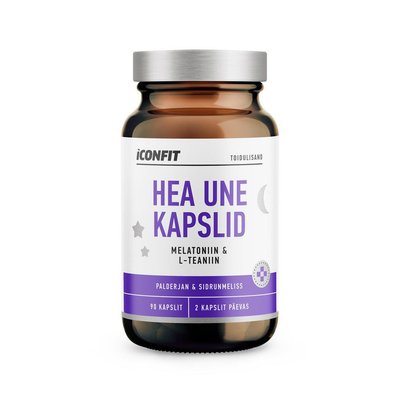 ICONFIT Capsules Good Sleep N90€13.55 In stock costs 12.90 euros at the time of writing and is designed to cover several sleep-onset obstacles at once. If you would rather assemble single components yourself,
 OstroVit Lemon Balm VEGE€8.30 In stock 90caps at 7.90 euros gives you lemon balm, passionflower's most common classical partner in calming blends, and OstroVit Hop Strobile VEGE 90caps at the same 7.90 euros covers hop strobile, the other traditional partner. If your problem is purely timing rather than tension, ICONFIT Capsules Melatonin N90 costs 7.90 euros and is frankly cheaper than most pharmacy melatonin packs per tablet.
The rest of the range - valerian, ashwagandha, glycine, magnesium forms - sits together in the sleep and relaxation category. If you suspect the real driver of your sleep problem is a general micronutrient gap during the dark half of the year, starting with vitamin complexes is more sensible than starting with a herbal extract. Prices change, so check the product page.
Who should skip passionflower
The list is short but not optional.
Pregnancy and breastfeeding: data are insufficient and several traditions considered the plant uterine-stimulating. Do not use it. Children: safety data under 12 are essentially absent. Planned surgery: tell your anaesthetist, and stop at least two weeks beforehand, because sedative effects can add to anaesthesia. Benzodiazepines, sleeping pills, opioids, alcohol: additive effects are likely and not worth testing. Antihypertensive medication: isolated reports of blood-pressure drops in combination.
Driving on the first day: try any new preparation at home in the evening, not before a morning commute. And if you already take a prescription medicine for anxiety or depression, adding a herb is not "just a natural extra" - ask your doctor. The Estonian Health Board treats food supplements as food, not medicine, which means checking interactions genuinely lands on you and your physician.
The four-week protocol I would follow
Week 1: measurement only, no supplement at all. Write down sleep-onset time, number of awakenings, and how you feel in the morning on a 1-5 scale. Without that week you have nothing to compare against and you end up rating your expectations instead of your results.
Week 2: add one thing. Either evening passionflower tea or one clearly labelled preparation. Same time every evening, an hour before bed. Do not change training, coffee intake or bedtime at the same time.
Week 3: hold steady. If nothing has moved in the diary by the end of week three, this tool does not work for you and raising the dose further is wasting money.
Week 4: decide. Continue, switch category (rhythm problem - melatonin; chronic stress - ashwagandha), or see your doctor. If you are weighing a switch, our sleep aid comparison and sleeping tablet guide cover those options in more detail, and the lemon balm review is a sensible next step if the gentle herbal direction suited you.
The whole point of the protocol is that placebo effects are large and memory is unreliable in the sleep-supplement space. Four weeks with a diary give you data to decide on, instead of guesswork based on reviews.
Where the honest limit of this plant sits
Passionflower is a good example of a supplement whose real value is smaller than the marketing claims and larger than the sceptic allows. It does not cure insomnia, does not replace treatment, and will not give you eight hours if you go to bed at one. It may moderately reduce the evening restlessness that blocks sleep onset, and it does so with a side-effect profile that is markedly cleaner than that of medication.
In the Estonian context the main obstacle is simply availability. If you find a decent preparation with a declared extract ratio, it is a reasonable four-week experiment. If you do not, it is cheaper and more logical to start with the categories that genuinely sit on our shelves, and leave passionflower as what it mostly is anyway: one component in a well-built evening blend.
FAQ
Can passionflower be taken daily for a long time?
Traditional use is short-term, up to two to four weeks at a stretch. Good safety data for long-term daily use do not exist. It is sensible to take a break and assess whether there is any effect at all.
Is it habit-forming?
There are no data indicating dependence, and the strength of the mechanism does not suggest it. This is one of the plant's main advantages over prescription drugs acting on the same receptor system.
Can passionflower and melatonin be combined?
Theoretically yes, because the targets differ - one addresses tension, the other rhythm. Practically, start with one at a time or you will not know which one worked. If you test the combination, do it only after trying each separately.
How quickly should I feel something?
For situational anxiety, 30-90 minutes. For sleep, allow two to four weeks. Nothing happening on the first evening does not mean the product fails - three weeks with no change does.
Is tea worse than capsules?
Not necessarily. The positive Australian sleep study was done with tea. Tea also brings the ritual itself, which calms independently of any compound. The downsides are imprecise dosing and the fact that not everyone wants half a litre of liquid at 10 pm.
Why is passionflower so scarce in Estonian shops?
Demand is small and a quality standardised extract is relatively expensive, so manufacturers put it into multi-herb sleep blends rather than a standalone product. Most Estonian consumers meet it exactly there: in an ingredient list.
References
Akhondzadeh, S., Naghavi, H. R., Vazirian, M., Shayeganpour, A., Rashidi, H., & Khani, M. (2001). Passionflower in the treatment of generalized anxiety: a pilot double-blind randomized controlled trial with oxazepam. Journal of Clinical Pharmacy and Therapeutics, 26(5), 363-367. https://pubmed.ncbi.nlm.nih.gov/11679026/
Movafegh, A., Alizadeh, R., Hajimohamadi, F., Esfehani, F., & Nejatfar, M. (2008). Preoperative oral Passiflora incarnata reduces anxiety in ambulatory surgery patients: a double-blind, placebo-controlled study. Anesthesia & Analgesia, 106(6), 1728-1732. https://pubmed.ncbi.nlm.nih.gov/18499602/
Ngan, A., & Conduit, R. (2011). A double-blind, placebo-controlled investigation of the effects of Passiflora incarnata (passionflower) herbal tea on subjective sleep quality. Phytotherapy Research, 25(8), 1153-1159. https://pubmed.ncbi.nlm.nih.gov/21294203/
Miroddi, M., Calapai, G., Navarra, M., Minciullo, P. L., & Gangemi, S. (2013). Passiflora incarnata L.: ethnopharmacology, clinical application, safety and evaluation of clinical trials. Journal of Ethnopharmacology, 150(3), 791-804. https://pubmed.ncbi.nlm.nih.gov/24140586/
Lee, J., Jung, H. Y., Lee, S. I., Choi, J. H., & Kim, S. G. (2020). Effects of Passiflora incarnata Linnaeus on polysomnographic sleep parameters in subjects with insomnia disorder: a double-blind randomized placebo-controlled study. International Clinical Psychopharmacology, 35(1), 29-35. https://pubmed.ncbi.nlm.nih.gov/31714321/


