
Multivitamins for Women: Benefits & Considerations
Women-specific multivitamins are formulated to address nutritional gaps that are more common or more impactful in women than in men. These include higher iron needs during reproductive years (from menstrual losses), folate requirements for foetal development, calcium and vitamin D needs that escalate as oestrogen declines with age, and specific B-vitamin needs that interact with hormonal contraception. This article takes an evidence-grounded look at which adaptations in women's multivitamins are genuinely justified and what to look for across different life stages.
Popular products at maxfit.ee in this category include BIOTECHUSA Active Women 60tab, Optimum Nutrition Opti-Women 120tabs, and 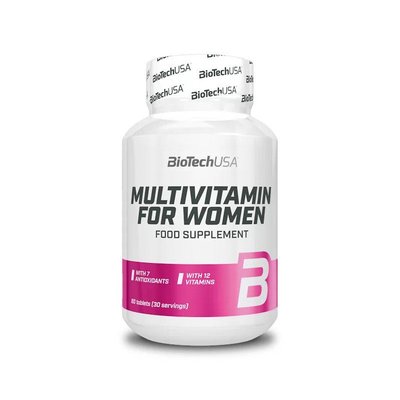 BIOTECHUSA Multivitamin for Women€18.90 In stock 60tab.
Why Women May Need a Tailored Multivitamin
Women's nutritional requirements differ from men's in several well-documented ways:
- Iron: Premenopausal women lose iron monthly through menstruation. The dietary reference intake for iron in premenopausal women is substantially higher than for men and postmenopausal women. Iron deficiency anaemia disproportionately affects young women.
- Folate: Essential for neural tube development during early pregnancy, folate requirements increase substantially during conception and pregnancy. Women of childbearing age who may become pregnant are advised to maintain adequate folate intake continuously.
- Calcium and vitamin D: Oestrogen protects bone mineral density. After menopause, its decline accelerates bone loss, making calcium and vitamin D increasingly important.
- B6 and B12: Hormonal contraceptives (the pill) can reduce circulating B6 levels, and B12 absorption declines with age. Women on the pill or over 50 may benefit from higher B-vitamin intake.
Hormonal and Life-Stage Notes
Reproductive years (roughly 18–45): The most critical targeted nutrients are iron (to compensate for menstrual losses), folate (particularly if pregnancy is a possibility), and vitamin D (most people in northern latitudes, including Estonia, are insufficient in winter months). Calcium requirements are met by most women through diet if dairy or fortified alternatives are consumed.
Pregnancy and breastfeeding: Standard women's multivitamins are NOT a substitute for a dedicated prenatal supplement. Prenatal formulas provide higher folate (typically as methylfolate for women with MTHFR variants), appropriate iodine, omega-3s, and calcium — at levels that women's multivitamins typically do not match. Always seek specific prenatal guidance from a healthcare provider.
Perimenopause and menopause: The focus shifts toward calcium, vitamin D (for bone), magnesium (for sleep and cardiovascular support), and vitamin B12 (as absorption tends to decline). Women's multivitamins targeted at this life stage reduce or omit iron (postmenopausal women have the same iron needs as men) and increase calcium and vitamin D.
Women in sport and high training loads: Active women have increased requirements for magnesium, iron (further elevated by foot-strike haemolysis in runners), and B-vitamins that support energy metabolism. Sweat losses of zinc and selenium are also relevant for highly active women.
Dose Considerations
| Nutrient | Premenopausal Need | Postmenopausal Need | Notes |
|---|---|---|---|
| Iron | Higher (from menstrual loss) | Similar to men | Postmenopausal formulas should reduce or omit |
| Folate | 400 mcg DFE minimum | Maintained | Methylfolate preferred for absorption |
| Calcium | 1000 mg total (food + supplement) | 1200 mg total | Divide doses across day for absorption |
| Vitamin D | 600–2000 IU depending on sun exposure | 800–2000 IU | Northern latitudes generally need more |
| Magnesium | 310–320 mg | 320 mg | Often undersupplied in women's diets |
Pregnancy and Safety Notes
High-dose vitamin A (as retinol, not beta-carotene) is teratogenic and should not exceed 3,000 mcg/day during pregnancy. Most quality women's multivitamins now use beta-carotene as the vitamin A precursor to avoid this risk. Check the label. Similarly, high-dose vitamin E supplementation has not shown benefit in pregnancy and is not recommended above tolerable upper limits.
For non-pregnant, non-breastfeeding women, standard women's multivitamins at recommended doses have a strong safety record.
Bottom Line
A women-specific multivitamin makes sense as nutritional insurance — not as a replacement for a balanced diet, but as a practical way to fill the gaps most common in women at your life stage. The most important variables are iron content (appropriate for your life stage), folate form and dose, vitamin D level, and calcium content. At maxfit.ee, products like Optimum Nutrition Opti-Women 120tabs and BIOTECHUSA Active Women 60tab are designed for active women's needs.
Browse the full range at /et/category/multivitamiinid-vitamiinikompleksid.
FAQ
Are women's multivitamins genuinely different from general multivitamins?
Yes — in meaningful ways. Women's formulas typically contain more iron (for premenopausal versions), higher folate doses, and sometimes added calcium. Formulas for older women reduce iron and may increase vitamin D and B12. Generic multivitamins are usually designed for a median adult, not optimised for women's specific requirements.
Should I take a women's multivitamin if I eat a varied, healthy diet?
A genuinely varied, nutrient-dense diet reduces the need significantly, but does not eliminate it for all nutrients. Vitamin D is practically impossible to obtain adequately from diet alone in northern climates during winter. Iron sufficiency depends on red meat consumption. A lower-dose women's multivitamin as nutritional insurance is reasonable even for people with good diets.
Do women's multivitamins help with energy and fatigue?
If fatigue is caused by iron deficiency, correcting the deficiency (which a multivitamin with iron supports) will improve energy levels. If fatigue is caused by poor sleep, stress, or overtraining, no multivitamin will address the root cause. B-vitamins support energy metabolism but do not act as stimulants — they help the body use energy from food efficiently, not add energy above what food provides.
References
Benedikt, L. P., & Roman, K. M. (2016). Iron deficiency in women of reproductive age: review of the evidence and recommendations for diagnosis and treatment. Journal of Mid-Life Health, 7(2), 53-57.
McNulty, H., & Pentieva, K. (2004). Folate bioavailability. Proceedings of the Nutrition Society, 63(4), 529-536. https://pubmed.ncbi.nlm.nih.gov/15831124/
Prentice, A. (2004). Diet, nutrition and the prevention of osteoporosis. Public Health Nutrition, 7(1A), 227-243. https://pubmed.ncbi.nlm.nih.gov/14972062/



