
Multivitamins for Athletes: Performance Evidence
Multivitamins are the world's most widely used dietary supplements, and athletes are among their heaviest consumers. The rationale is intuitive — intense training increases metabolic demands for many micronutrients, and deficiency in any essential vitamin or mineral can impair performance. But does taking multivitamins for athletes actually translate to measurable performance gains? The evidence is more nuanced than most marketing suggests.
Mechanism in Sport
Multivitamins do not directly build muscle or increase VO2 max. Their role in sport is substrate-level: they provide cofactors for the metabolic pathways that underpin performance. B vitamins (especially B1, B2, B3, B6, and B12) are central to energy metabolism — the Krebs cycle, electron transport, and glucose utilisation all depend on these coenzymes. Iron is required for haemoglobin and myoglobin, which carry oxygen to exercising muscles. Vitamin C and E support antioxidant defence against exercise-induced oxidative stress. Vitamin D regulates calcium homeostasis and has a direct role in muscle function through the vitamin D receptor expressed in skeletal muscle.
The key insight is that multivitamins help performance indirectly and conditionally: they are most useful when they correct a deficiency. Supplementing vitamins or minerals that are already sufficient does not produce additional benefit and, for some fat-soluble vitamins, carries toxicity risk at high doses.
Strength and Endurance Evidence
For athletes who are deficient in specific micronutrients, correcting that deficiency produces clear performance benefits. Iron deficiency — even without anaemia — impairs aerobic capacity, and iron supplementation in deficient athletes has been shown to improve VO2 max and endurance performance (Hinton et al., 2000). Vitamin D deficiency is associated with reduced muscle strength and increased injury risk; RCTs in deficient populations show improvements in muscle function following supplementation.
For athletes who are already micronutrient-replete, the evidence for multivitamin supplementation improving performance is weak. A systematic review found that antioxidant supplementation (vitamins C and E) in doses above dietary levels did not improve athletic performance and may blunt some adaptation signals from training by interfering with exercise-induced reactive oxygen species signalling (Peternelj & Coombes, 2011). This is a meaningful counterargument to blanket high-dose supplementation.
For multivitamin complexes specifically — as opposed to individual micronutrients — the RCT literature on performance is sparse. Most trials are too short or too underpowered to detect effects in already-replete athletes.
Effective Protocol
- Who needs it: Athletes in caloric restriction (cutting phases), those eating a limited dietary variety, vegans and vegetarians (particularly at risk for B12, iron, zinc, and vitamin D), and those training heavily in winter at Northern latitudes where UV exposure is low.
- Dose: Choose a multivitamin providing close to 100% of the reference nutrient intake (RNI) for most vitamins and minerals, not mega-dose formulas providing 500-1000% RNI. Exceptions: vitamin D, where 1,000-2,000 IU may be appropriate especially in Northern Europe; iron, which should only be supplemented if blood tests confirm deficiency.
- Timing: Fat-soluble vitamins (A, D, E, K) are better absorbed with a fat-containing meal. Water-soluble vitamins (B complex, C) can be taken at any time but splitting across two meals may improve absorption for high-dose products.
- Form: Bioavailability varies between forms. Methylcobalamin is better absorbed than cyanocobalamin for B12; magnesium citrate or glycinate is better absorbed than magnesium oxide in multivitamin blends. Read the microform on the label.
Products available at maxfit.ee include Optimum Nutrition Opti-men 180tabs, BIOTECHUSA Vitabolic 30tab, Mutant Core Multi 60 tabs, and 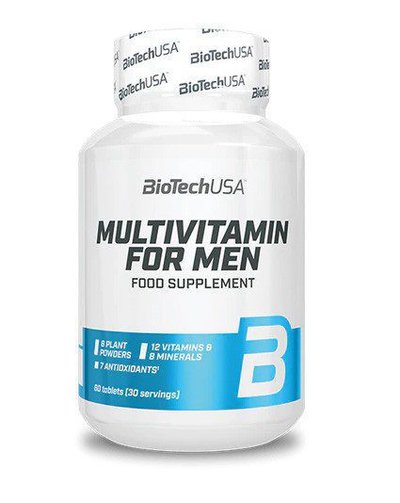 BIOTECHUSA Multivitamin for Men€17.90 In stock 60tab. Browse the full range at maxfit.ee/en/category/multivitamiinid-vitamiinikompleksid and maxfit.ee/en/category/spordivitamiinid.
Who Benefits Most
- Endurance athletes training more than 10 hours per week — metabolic demands for B vitamins and iron are elevated
- Vegan and vegetarian athletes — at risk for B12, zinc, and long-chain omega-3s
- Athletes eating in a deficit — caloric restriction inherently reduces micronutrient intake
- Older athletes (over 50) — B12 absorption decreases with age; vitamin D requirements increase
- Athletes in winter in Estonia — UV-B exposure is insufficient for cutaneous vitamin D synthesis from October to March
Honest Verdict
Multivitamins are insurance, not ergogenics. For athletes eating a varied, sufficient diet, a standard multivitamin is unlikely to improve performance measurably. For athletes with dietary gaps — through restriction, food preferences, or seasonal limitations — a well-formulated multivitamin at near-RNI doses is a sensible, low-risk way to maintain the micronutrient foundation that performance depends on. Prioritise getting blood work done to identify actual deficiencies before choosing supplements; targeted correction is more effective than broad multivitamin use for known deficiency states.
References
- Hinton, P. S., Giordano, C., Brownlie, T., & Haas, J. D. (2000). Iron supplementation maintains ventilatory threshold and improves energetic efficiency in iron-deficient nonanemic athletes. Journal of Applied Physiology, 88(3), 1103-1111. https://pubmed.ncbi.nlm.nih.gov/10710409/
- Peternelj, T. T., & Coombes, J. S. (2011). Antioxidant supplementation during exercise training: beneficial or detrimental? Sports Medicine, 41(12), 1043-1069. https://pubmed.ncbi.nlm.nih.gov/22060178/
- Larson-Meyer, D. E., & Willis, K. S. (2010). Vitamin D and athletes. Current Sports Medicine Reports, 9(4), 220-226. https://pubmed.ncbi.nlm.nih.gov/20622540/
FAQ
Do multivitamins help recovery after training?
Indirectly, yes — in athletes with micronutrient deficits. Zinc and vitamin C are cofactors in tissue repair; vitamin D supports muscle protein synthesis signalling; B vitamins restore depleted coenzyme pools. In replete athletes, adding a multivitamin is unlikely to speed recovery measurably beyond adequate food, sleep, and protein intake.
Should athletes take a sport-specific multivitamin or a standard one?
Sport-specific formulas often provide higher amounts of B vitamins and vitamin D, and sometimes include performance-specific additions like iron, magnesium, or zinc at training-relevant doses. For athletes with high training loads, these tailored formulas can better address elevated demand. For recreational athletes, a standard quality multivitamin at near-100% RNI is adequate.
Can I take a multivitamin alongside other supplements without risk?
Generally yes, but check for overlap. Stacking a multivitamin with separate vitamin D, vitamin C, and vitamin A supplements can push fat-soluble vitamins (especially A) beyond safe thresholds. Always calculate total daily intake from all sources before adding individual vitamin products to a multivitamin regimen.



