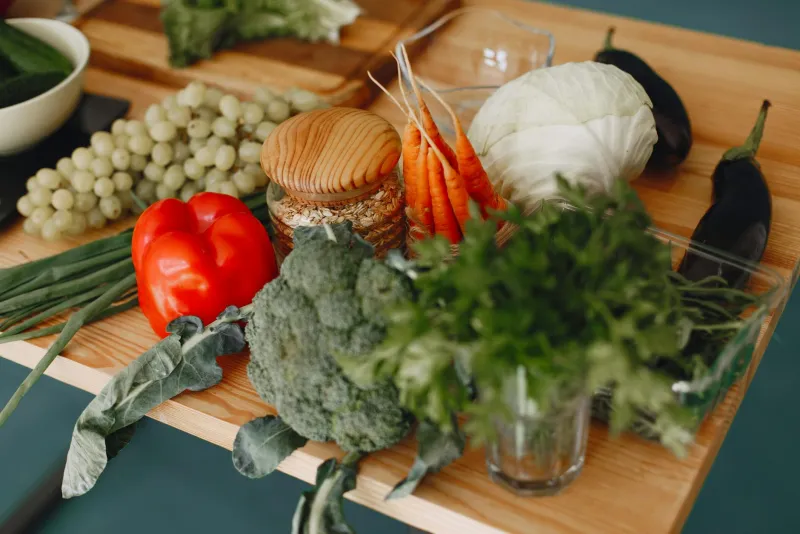
Natural Food Sources of Multivitamins
When we talk about multivitamins food sources, we mean the wide range of whole foods that together supply the essential vitamins your body needs every day. No single food contains all vitamins in optimal amounts, but a varied diet comes remarkably close.
Top Food Sources of Essential Vitamins
Different foods excel at different vitamins. Understanding which foods deliver which nutrients helps you build a genuinely vitamin-rich diet.
| Food | Key vitamins supplied |
|---|---|
| Liver (beef, chicken) | A, B12, B2, folate, B5 |
| Eggs | D, B12, B2, A, choline |
| Fatty fish (salmon, mackerel) | D, B12, B3, B6 |
| Leafy greens (spinach, kale) | K, folate, C, B2 |
| Bell peppers | C, B6, folate |
| Citrus fruits | C, folate, thiamine |
| Whole grains | B1, B2, B3, B6, folate |
| Legumes | B1, folate, B6, iron |
| Dairy (milk, yoghurt) | B2, B12, D, calcium |
| Nuts and seeds | E, B1, B6, magnesium |
Beef liver stands out as perhaps the most nutrient-dense single food, delivering preformed vitamin A, a substantial portion of B-complex vitamins, and more vitamin B12 per serving than almost any other food.
Bioavailability from Food vs Supplement
Obtaining vitamins from food offers advantages beyond raw quantity. Many vitamins arrive alongside companion nutrients that improve absorption. Vitamin C in fruit, for example, comes packaged with bioflavonoids; fat-soluble vitamins A, D, E, and K are absorbed far better when consumed with dietary fat, which whole foods naturally provide.
Not all food-form advantages are universal, however. Vitamin B12 from plant sources is essentially absent unless foods are fortified, and the preformed vitamin A (retinol) from animal liver is far more readily used than the provitamin A carotenoids in carrots and sweet potatoes (Bohn et al., 2004). The conversion of beta-carotene to retinol is variable and can be as low as 3–28% depending on the food matrix, gut health, and vitamin A status.
Daily Targets from Diet
A diet that regularly includes fatty fish or eggs, a variety of coloured vegetables, citrus or berries, whole grains, and some dairy or fortified plant milk covers most micronutrient targets for healthy adults. The practical challenge is consistency: studies consistently show that large proportions of the population fall short of several vitamins, most commonly vitamin D, vitamin B12 in older adults and vegans, and folate in women of reproductive age (Pfeiffer et al., 2007).
How Cooking and Storage Affect Vitamins
Water-soluble B-vitamins and vitamin C are the most vulnerable to heat and water. Boiling vegetables can reduce their vitamin C content substantially; steaming or microwaving with minimal water preserves more. Fat-soluble vitamins (A, D, E, K) are far more stable during cooking.
Key practical tips:
- Eat some vegetables raw or lightly steamed.
- Store produce in a cool, dark place to slow vitamin degradation.
- Use cooking water from vegetables in soups and sauces.
- Choose whole grains over refined grains; milling removes B-vitamins stored in the bran.
When Food Alone Is Not Enough
Certain groups struggle to meet micronutrient needs through diet alone:
- Vegans and vegetarians are at risk for B12, D, and iodine deficiency.
- Older adults absorb vitamin B12 less efficiently and synthesise less vitamin D from sunlight.
- Pregnant women have substantially higher folate and iron needs.
- Athletes training intensively may have elevated needs for several B-vitamins involved in energy metabolism.
- People with restricted diets for medical or weight-management reasons may miss entire food groups.
In these situations, a broad-spectrum supplement fills the gap efficiently. At maxfit.ee you will find a range of options including BIOTECHUSA One a Day 100tab, Optimum Nutrition Opti-Women 120tabs, and SELF Multivitamin 60caps — all formulated to complement a varied diet rather than replace it.
For active men, Optimum Nutrition Opti-men 180tabs is a popular choice that covers both micronutrient gaps and the higher B-vitamin demands of intensive training.
FAQ
Can I get all my vitamins from food alone?
For most healthy adults eating a varied diet that includes animal products, it is possible to meet nearly all micronutrient needs from food. The exception is vitamin D, which is difficult to obtain in adequate amounts from food in northern countries like Estonia, especially in winter. Vegans and older adults are also at risk for B12 deficiency and should consider targeted supplementation.
Are vitamins from food better absorbed than those in supplements?
Often yes — the food matrix can enhance absorption of fat-soluble vitamins and some B-vitamins. However, supplements use bioavailable forms such as methylcobalamin (B12) or methylfolate (folate) that can actually outperform food forms in certain individuals, particularly those with genetic variants affecting nutrient metabolism (Pfeiffer et al., 2007).
How do I know if I need a multivitamin?
Blood tests can detect deficiencies in key vitamins such as D, B12, iron, and folate. If your diet consistently excludes major food groups — for example, no animal products, no dairy, or very low vegetable intake — a broad-spectrum multivitamin is a reasonable precaution.
References
Bohn, T., Davidsson, L., Walczyk, T., & Hurrell, R. F. (2004). Fractional magnesium absorption is significantly lower in human subjects from a meal served with an oxalate-rich vegetable, spinach, as compared with a meal served with kale, a vegetable with a lower oxalate content. British Journal of Nutrition, 91(4), 601-606. https://pubmed.ncbi.nlm.nih.gov/15035687/
Pfeiffer, C. M., Sternberg, M. R., Schleicher, R. L., Haynes, B. M., Rybak, M. E., & Pirkle, J. L. (2013). The CDC's Second National Report on Biochemical Indicators of Diet and Nutrition in the U.S. Population is a valuable tool for researchers and policy makers. Journal of Nutrition, 143(6), 938S-947S. https://pubmed.ncbi.nlm.nih.gov/23596169/
Heaney, R. P. (2001). Factors influencing the measurement of bioavailability, taking calcium as a model. Journal of Nutrition, 131(4), 1344S-1348S. https://pubmed.ncbi.nlm.nih.gov/11285351/



