Why Do Women Need a Specialised Multivitamin?
Women's and men's nutritional requirements differ considerably. Menstruation causes monthly iron losses; women of reproductive age need more folate; post-menopausal bone loss demands extra calcium and K2. Women suffer from iron-deficiency anaemia roughly five times more often than men (WHO, 2021).
Key Nutrients in a Women's Multivitamin
1. Iron — Replacing Menstrual Losses
Most women of reproductive age need 18 mg of iron per day (men need only 8 mg). Iron deficiency presents as fatigue, difficulty concentrating, and cold intolerance. For best absorption, pair iron with vitamin C and avoid simultaneous coffee or tea consumption.
2. Folate (B9) — Cell Division and Prenatal Health
Folate is critical for pregnant women and those planning pregnancy — it reduces the risk of neural tube defects (Czeizel & Dudas, 1992). Non-pregnant women also benefit from folate for red blood cell production and DNA synthesis. Prefer the methylfolate form (5-MTHF), since approximately 40% of the population cannot efficiently convert synthetic folic acid due to MTHFR gene variants.
3. Calcium, D3, and K2 — Bone Density
Women's bone mass begins declining around age 35, accelerating sharply after menopause. Calcium, D3, and K2 work as a team: D3 enhances intestinal calcium absorption, and K2 directs calcium into bones rather than arterial walls.
4. B-Vitamins — Energy and Hormonal Balance
Vitamin B6 helps reduce PMS symptoms (Wyatt et al., 1999). B12 and B6 lower homocysteine — a marker linked to cardiovascular risk.
5. Antioxidants — Skin and Healthy Ageing
Vitamin C, vitamin E, selenium, and lutein support collagen synthesis, skin elasticity, and eye health.
Comparison Table: Top Women's Multivitamins
| Product | Iron | Folate | D3 | Calcium | Best For |
|---|---|---|---|---|---|
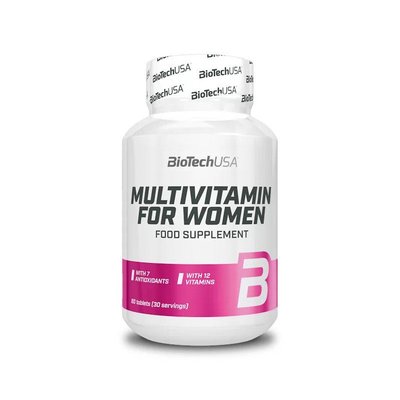 BIOTECHUSA Multivitamin for Women€18.90 In stock 60tab BIOTECHUSA Multivitamin for Women€18.90 In stock 60tab | ✓ | ✓ | ✓ | ✓ | General daily use |
| NOW EVE Women's Multi 90 Soft Gels | ✓ | ✓ | ✓ | ✓ | Comprehensive coverage |
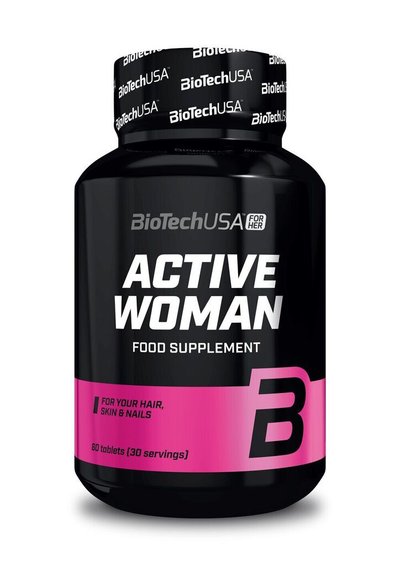 BIOTECHUSA Active Women€19.90 In stock 60tab BIOTECHUSA Active Women€19.90 In stock 60tab | ✓ | ✓ | ✓ | ✓ | Active women |
| Optimum Nutrition Opti-Women 120tabs | ✓ | ✓ | ✓ | ✓ | Athletes |
NOW EVE Women's Multi 90 Soft Gels is among the most well-regarded women's formulas — it uses chelated minerals and methylfolate for superior absorption. Optimum Nutrition Opti-Women 120tabs is designed for women who train regularly.
BIOTECHUSA Active Women 60tab suits sporty women needing extra activity support alongside standard vitamins. BIOTECHUSA Multivitamin for Women 60tab is an accessible everyday choice available at maxfit.ee.
Life-Stage Priorities
| Life Stage | Key Priorities |
|---|---|
| 18–35 years | Iron, folate, D3, energy B-vitamins |
| Pregnancy | Methylfolate, iron, DHA, iodine |
| 35–50 years | Bone support (Ca+D3+K2), antioxidants |
| Menopause+ | High D3+K2+Ca, cardiovascular support, CoQ10 |
When and How to Take It
Take your women's multivitamin with breakfast — fat-soluble vitamins absorb best alongside dietary fat. If it contains iron, avoid taking it with calcium supplements or coffee at the same time, as both inhibit iron absorption.
Browse the full range in the vitamins category at maxfit.ee.
FAQ
Can I take a standard women's multivitamin during pregnancy?
Not ideally — prenatal vitamins are specifically formulated with appropriate folate (as methylfolate), iron levels, and DHA for foetal brain development. Always consult your doctor or midwife.
Can the iron in a multivitamin be harmful?
For post-menopausal women and men, regular supplemental iron is unnecessary and can promote oxidative stress. Women of reproductive age, however, often genuinely need it.
Does a woman over 50 need a different multivitamin?
Yes. Women over 50 need more D3 (up to 2,000 IU), calcium, K2, and B12 (whose absorption declines with age). Some products are specifically formulated for this life stage.
References
- World Health Organization. (2021). Anaemia. WHO Fact Sheet.
- Czeizel, A.E., & Dudas, I. (1992). Prevention of the first occurrence of neural-tube defects by periconceptional vitamin supplementation. New England Journal of Medicine, 327(26), 1832–1835.
- Wyatt, K.M., Dimmock, P.W., Jones, P.W., et al. (1999). Efficacy of vitamin B-6 in the treatment of premenstrual syndrome. BMJ, 318(7195), 1375–1381.
- Bolland, M.J., Grey, A., Avenell, A., et al. (2011). Calcium supplements with or without vitamin D and risk of cardiovascular events. BMJ, 342, d2040.
- Feskanich, D., Willett, W.C., & Colditz, G.A. (2003). Calcium, vitamin D, milk consumption, and hip fractures. American Journal of Clinical Nutrition, 77(2), 504–511.