Why Plant-Based Diets May Fall Short on Minerals
Mineral complexes for vegans address a real and documented nutritional challenge. While plant foods provide many essential minerals in reasonable quantities, several factors conspire to make plant-based mineral nutrition less efficient than it appears on a nutrient composition table.
The key issue is bioavailability. Plant foods contain antinutritional factors — primarily phytate (phytic acid) and oxalate — that bind divalent minerals such as zinc, iron, and calcium in the gut, reducing how much is actually absorbed. A diet centred on wholegrains, legumes, nuts, and seeds (all nutritious and valuable foods) also tends to be high in phytate. As a result, someone eating plant sources with similar mineral content to an omnivore diet may absorb substantially less of those minerals.
For vegans and vegetarians, the minerals most commonly at risk are zinc, iron, calcium, iodine, and selenium — with zinc and iodine among the most frequently suboptimal in cross-sectional surveys of plant-based populations (Sobiecki et al., 2016).
Key Mineral Gaps on a Plant-Based Diet
| Mineral | Main animal sources | Plant challenge |
|---|---|---|
| Zinc | Red meat, shellfish | Phytate inhibits absorption |
| Iron | Red meat (haem) | Non-haem form, lower bioavailability |
| Calcium | Dairy | Low-oxalate sources vary in bioavailability |
| Iodine | Seafood, dairy | Absent from most plant foods |
| Selenium | Seafood, meat | Highly soil-dependent in plant sources |
Vegan-Friendly Mineral Complex Options
A well-designed mineral complex for vegans should use chelated or organic mineral forms — bisglycinate, citrate, or picolinate — which generally have better bioavailability than oxide or sulfate forms and are less likely to cause GI irritation.
Crucially for vegans, the capsule shell matters: HPMC (vegetable cellulose) or pullulan, not gelatin. Look also for a product that explicitly includes iodine and selenium, as these are often omitted from generic mineral blends.
Products such as SELF Potassium Magnesium 120 vegan caps, BIOTECHUSA Calcium Zinc Magnesium 100tab, and 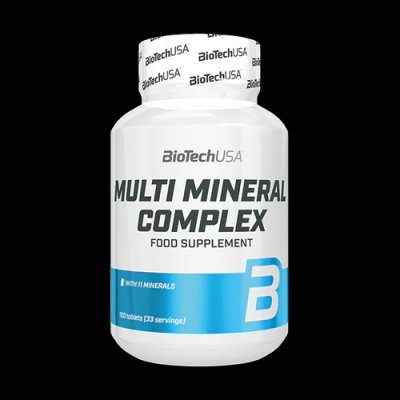 BIOTECHUSA Multi Mineral Complex€14.90 In stock 100tabl are available at maxfit.ee/et/category/mineraalikompleksid.
Dose Targets
For a general-purpose mineral complex, look for a product that provides meaningful amounts relative to established reference intakes. A few practical pointers:
- Zinc: adequate intake is around 8-11 mg per day for adults; vegans may benefit from amounts in the upper portion of this range, or slightly above, due to phytate interference.
- Calcium: total intake from food plus supplement should reach the reference value; if dairy is excluded and low-oxalate plant calcium sources are limited, a standalone calcium supplement may be more practical than relying on a complex.
- Iodine: sea vegetables (seaweed) can provide iodine but with highly variable content — a supplement with a standardised dose is more reliable.
- Selenium: soil selenium content in Estonian and Northern European agricultural soils tends to be low, making supplementation particularly relevant in this region.
What to Combine With a Mineral Complex
Minerals interact with each other and with vitamins. Key points for vegans:
- Take iron and calcium at different times of day — calcium inhibits iron absorption when co-ingested.
- Vitamin C taken with iron-containing meals significantly improves iron absorption.
- Vitamin D is required for calcium absorption; vegans who do not supplement D3 (vegan algae-derived D3 exists) may not absorb calcium from supplements efficiently.
- Avoid taking a full mineral complex with phytate-rich foods (oats, bran, legumes) — take with a lower-phytate meal or between meals.
Choosing a Vegan Product
When evaluating a mineral complex:
- Confirm capsule shell is HPMC or pullulan, not gelatin.
- Check the mineral forms — chelates and citrates preferred over oxides.
- Verify iodine and selenium are included, especially for vegans.
- Look for third-party testing or certification (vegan society logo).
- Avoid megadose products — very high individual mineral doses in a complex can interfere with absorption of others (e.g., very high zinc reduces copper absorption).
FAQ
Do vegans need a separate iron supplement in addition to a mineral complex?
Not always. If the mineral complex provides iron and the individual's ferritin level is within normal range, a complex may suffice. However, if iron deficiency is confirmed by blood test, a dedicated iron supplement at a therapeutic dose is more appropriate and the complex iron amount may be insufficient.
Are mineral complexes from plant-based brands the same as standard ones?
The mineral molecules themselves are chemically identical regardless of brand positioning. What differs is the capsule material and possibly the mineral form. A brand labelled "vegan" should provide verified HPMC capsules and, ideally, chelated mineral forms.
Can I take a mineral complex and a separate multivitamin together?
Yes, but check for overlapping minerals to avoid exceeding safe upper limits — particularly for zinc, selenium, and iron. Adding up total amounts from both products is a prudent step.
References
Sobiecki, J. G., Appleby, P. N., Bradbury, K. E., & Key, T. J. (2016). High compliance with dietary recommendations in a cohort of meat eaters, fish eaters, vegetarians, and vegans: results from the European Prospective Investigation into Cancer and Nutrition-Oxford study. Nutrition Research, 36(5), 464-477. https://pubmed.ncbi.nlm.nih.gov/27101764/
Hunt, J. R. (2003). Bioavailability of iron, zinc, and other trace minerals from vegetarian diets. American Journal of Clinical Nutrition, 78(3 Suppl), 633S-639S.



