
How to Choose a Quality Mineral Complex Supplement
Mineral complexes are among the most purchased dietary supplements, yet most buyers spend little time evaluating what is actually inside the product. Two mineral complexes on the same shelf can differ dramatically in bioavailability, dose adequacy, and manufacturing quality — at the same or similar prices. This guide gives you the tools to tell them apart.
What to Look for on the Label
Mineral Forms (Not Just Names)
The form a mineral is in determines how well it is absorbed. The label should tell you the chemical form, not just the mineral name. Compare:
| Mineral | Lower-quality forms | Higher-quality forms |
|---|---|---|
| Magnesium | Oxide | Citrate, malate, glycinate |
| Zinc | Oxide, sulphate | Picolinate, bisglycinate |
| Iron | Sulphate, oxide | Bisglycinate, ferrous fumarate |
| Calcium | Carbonate (with food) | Citrate |
Magnesium oxide, for example, has poor absorption compared to organic forms like citrate or malate (Walker et al., 2003). A product listing "magnesium (as oxide)" alongside a high mg amount is not necessarily delivering that magnesium to your tissues.
Elemental vs Total Dose
The label may state, for example, "500 mg magnesium citrate" — but the elemental magnesium in that amount is approximately 80 mg (since citrate makes up most of the molecular weight). A quality label will specify "elemental magnesium: 80 mg" rather than just the salt weight. If a product claims a very high amount of a mineral but only lists the salt form, calculate the elemental content or look for a product that declares it explicitly.
Presence of Cofactors
Some minerals work better with specific cofactors:
- Magnesium pairs well with B6 (P-5-P form is more bioactive)
- Calcium requires vitamin D for optimal absorption
- Iron is enhanced by vitamin C
Quality complexes often include these cofactors intentionally. Look for them on the label.
Form and Dose Markers of Quality
Beyond chemical form, look for:
- Reasonable doses per serving. A product claiming 10 minerals all at their full recommended daily intake in one capsule is unlikely to be providing accurate amounts. Some minerals compete for absorption.
- Transparent proprietary blends. Avoid products that list a "mineral blend" total weight without showing individual mineral amounts. You cannot assess dosing without individual figures.
- Targeted, not kitchen-sink. A focused magnesium-zinc-potassium complex is often better designed than a 20-mineral product at implausibly low doses.
Third-Party Testing
Third-party testing confirms that what is on the label is in the product, and that it is free from heavy metal contaminants — a genuine concern with mineral supplements, since the raw materials are earth-derived. Look for seals from recognised testing organisations (NSF, Informed Sport, USP, or equivalent EU bodies). Products sold through reputable retailers with quality control standards offer a baseline assurance even without these specific seals.
Red Flags
- "Proprietary blend" hiding individual doses — you cannot evaluate a product you cannot read
- Only oxide forms for every mineral — indicates cost-cutting on raw materials
- Implausibly high claims — "covers 1000% of daily magnesium needs" in a single small capsule should raise questions
- No information on manufacturing standards (GMP certification) on the brand's website
- Artificial colours, excessive fillers — capsule supplements need minimal excipients; a long filler list in mineral capsules suggests low-grade production
Value for Money
The cheapest mineral complex per capsule is rarely the best value when you factor in bioavailability. A product delivering 150 mg of elemental magnesium as glycinate at a higher price may be more effective than 400 mg of elemental magnesium as oxide at a lower price — the oxide form is largely excreted.
Options available at maxfit.ee illustrate the range: SELF Potassium Magnesium 120 vegan caps is a focused potassium-magnesium combination; BIOTECHUSA Calcium Zinc Magnesium 100tab covers three key minerals in one product; 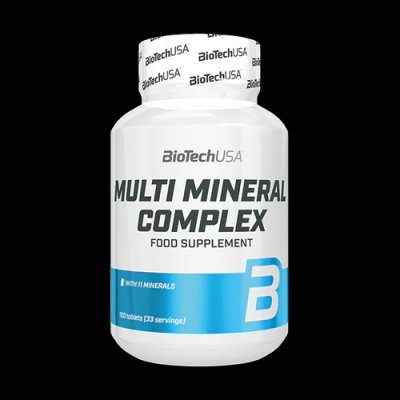 BIOTECHUSA Multi Mineral Complex€14.90 In stock 100tabl offers a broader spectrum. Check each product page for the specific mineral forms used.
References
Walker, A. F., Marakis, G., Christie, S., & Byng, M. (2003). Mg citrate found more bioavailable than other Mg preparations in a randomised, double-blind study. Magnesium Research, 16(3), 183-191. https://pubmed.ncbi.nlm.nih.gov/14596323/
Holick, M. F., & Chen, T. C. (2008). Vitamin D deficiency: a worldwide problem with health consequences. American Journal of Clinical Nutrition, 87(4), 1080S-1086S. https://pubmed.ncbi.nlm.nih.gov/18400738/
Zhang, C., Rawal, S., & Chong, Y. S. (2016). Risk factors, health consequences, and treatment of obesity in women before and during pregnancy. American Journal of Clinical Nutrition, 83(2), 303-309.
FAQ
Should I choose a multi-mineral or targeted single minerals?
For general insurance purposes, a quality multi-mineral makes practical sense. For addressing a confirmed deficiency or specific athletic need (e.g., magnesium for muscle cramps), a targeted single-mineral product allows better dose control. Many people do both.
How do I know if a mineral complex is absorbed?
The most direct indicator is how you feel after several weeks of consistent use — energy, sleep quality, and muscle function often reflect magnesium and zinc status. For confirmed deficiency, before-and-after blood tests for specific minerals provide objective data.
Can minerals in a complex interfere with each other?
Yes — this is one reason to look at the design carefully. High-dose calcium can reduce zinc and iron absorption. High-dose zinc can deplete copper. Quality complex formulations account for these interactions by selecting non-competing ratios and recommending taking the supplement with food.



